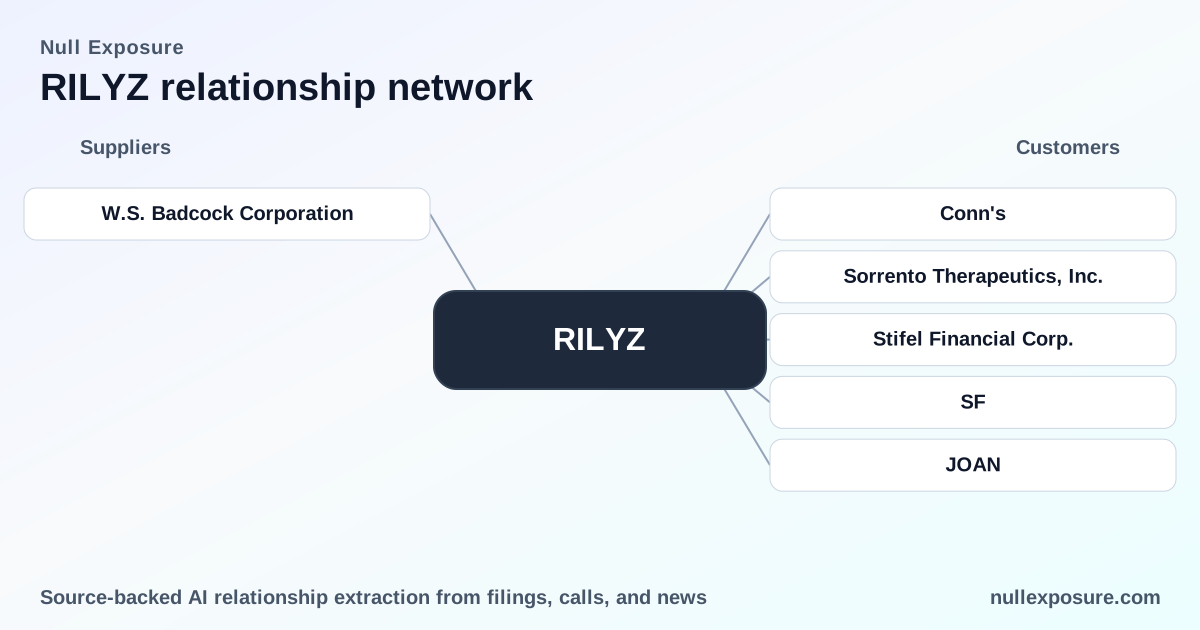
RILYZ (B. Riley Financial 5.25% Senior Notes due 2028): supplier relationships and operational signals investors need
B. Riley Financial operates a diversified financial services platform across North America, Australia and Europe; RILYZ represents its 5.25% senior notes due 2028 and is serviced from the company’s operating cash flows and financing activities. For investors and counterparty managers evaluating supplier exposure, the company’s disclosures around receivables structures and third‑party manufacturing and service relationships reveal a hybrid operating model that combines receivables finance with outsourced operational dependencies. Read on for a concise map of disclosed supplier relationships, the operating constraints that matter to credit and operational risk analysis, and clear monitoring priorities.
For a full view of supplier linkages and disclosure-backed risk signals, visit https://nullexposure.com/.
Why the Badcock receivables agreement matters to RILYZ investors
B. Riley disclosed that on December 20, 2021 the company entered a Master Receivables Purchase Agreement (Badcock Receivables I) with W.S. Badcock Corporation. This is a receivables financing arrangement that converts customer receivables into liquidity and can affect short-term cash flow dynamics relevant to the company’s ability to service fixed‑rate debt such as RILYZ. According to the company’s FY2024 10‑K filing, the arrangement remains a disclosed element of the firm’s receivables portfolio and financing activity (FY2024 10‑K).
W.S. Badcock Corporation — what was disclosed
W.S. Badcock Corporation entered into a Master Receivables Purchase Agreement (Badcock Receivables I) with the company on December 20, 2021, and the contract is referenced in the firm’s FY2024 disclosures. This agreement represents a structured receivables purchase used by B. Riley to monetize receivables from a retail counterparty and is recorded in the company’s supplier/partner relationships (FY2024 10‑K).
All disclosed supplier relationships (complete list)
- W.S. Badcock Corporation — Master Receivables Purchase Agreement, executed December 20, 2021 and disclosed in the company’s FY2024 filing (10‑K). The arrangement is documented as Badcock Receivables I and is part of the company’s receivables financing activities (FY2024 10‑K).
Operating and business model constraints that shape counterparty risk
Company-level disclosures and extracted evidence present several clear operational characteristics that drive supplier risk and contract design:
- Outsourced production footprint concentrated in APAC. Management discloses that “All of our production is performed by third‑party contract manufacturers… in Taiwan, China, Thailand, Vietnam, Cambodia, India, South Korea and Philippines.” This indicates a geographically concentrated manufacturing base in Asia-Pacific that exposes the company to regional supply‑chain disruption and trade/regulatory events (company filing excerpts).
- Suppliers are functionally critical. The disclosure that third‑party manufacturers “supply substantially all of the raw materials and provide all facilities and labor required to manufacture our products” signals high supplier criticality and operational dependency rather than peripheral sourcing.
- Outsourcing includes both manufacturing and hosted service providers. The firm relies on external manufacturers for production and uses third‑party hosted IT solutions for transaction and billing processing, with SOC 1 Type 2 reports cited for the service provider control environment — this reflects a mature outsourcing posture with formalized controls around key service providers.
- Segment focus on manufacturing. The company labels manufacturing as a key segment of activity, reinforcing that supplier performance is directly tied to product availability and revenue recognition cycles.
These constraints should be read as company-level signals about contracting posture, concentration and criticality. They translate into tighter operational covenants in financing arrangements and higher priority placed on counterparty resilience by creditors and noteholders.
What this means for credit and operations teams
The combined picture from the Badcock receivables agreement and the company‑level constraints creates a set of actionable risk considerations:
- Cash‑flow flexibility driven by receivables monetization. Receivables purchase agreements such as Badcock Receivables I supply liquidity but add dependence on buyer performance and documentation risk; covenant stress or counterparty deterioration could reduce available cash to service debt.
- Concentration and geopolitical exposure. Heavy reliance on APAC contract manufacturers demands active monitoring of regional risks (logistics, tariffs, labor and energy shocks) because production interruptions flow directly to revenue and liquidity.
- Control maturity mitigates some outsourcing risk. The presence of SOC 1 Type 2 reporting on hosted service providers indicates an established control framework for critical IT and billing functions, which reduces operational failure risk versus unmanaged providers.
- Counterparty operational risk is material. Descriptions that suppliers provide virtually all raw materials and facilities mark these suppliers as single points of failure; procurement continuity clauses and disaster recovery expectations should be explicit in counterparty monitoring for noteholders.
Consider tracking the items below quarterly:
- Receivables sale balances and concentration by buyer (including Badcock Receivables I exposure).
- Any amendments or terminations to material receivables purchase agreements.
- Supplier geographic concentration metrics and notable supplier consolidations.
- SOC reports and third‑party audit results for critical hosted providers.
Practical monitoring checklist and next steps
- Request quarterly disclosures on receivables financing exposure and counterparty concentration for receivables purchases.
- Insist on public or investor access to supplier continuity plans for APAC manufacturers supporting material product lines.
- Review SOC 1 Type 2 attestation summaries or executive summaries for hosted service providers that handle billing and collection flows.
For ongoing monitoring tools and supplier relationship intelligence, see https://nullexposure.com/ — our platform consolidates disclosure‑level supplier signals and maps them to credit and operational risk for investors and operators.
Bottom line: concentrated operational exposures change the debt conversation
B. Riley’s receivables monetization strategy (Badcock Receivables I) and its reliance on APAC contract manufacturers create a blend of financing flexibility and operational concentration. For RILYZ holders, the immediate credit focus is on receivables purchaser performance and regional manufacturing continuity; for operations teams, the priority is strengthening counterparty controls and redundancy. Both investor and operator actions converge on more frequent supplier reporting, targeted covenant language and active monitoring of SOC attestations.
To evaluate supplier-linked credit risk across a broader portfolio, visit https://nullexposure.com/ for disclosure‑backed supplier mapping and monitoring tools.