Riot Platforms (RIOT): Supplier relationships that underpin mining scale and data-center transition
Riot Platforms operates large-scale bitcoin mining and increasingly leases data-center capacity; it monetizes by mining bitcoin, selling mined BTC and hosting/ leasing power and compute capacity to third parties. The company’s economics depend on three durable inputs: mining hardware, long-term power contracts, and service providers for custody and development — each driving capital intensity and operational leverage. For deeper supplier mapping and risk analysis, visit https://nullexposure.com/ for a focused supplier intelligence view.
Big-picture takeaways investors need first
Riot’s supplier posture is capital-heavy and contract-heavy. The company secures miners under a long-term master purchase agreement, commits large upfront deposits to suppliers, and locks in fixed-price power blocks via multi-year PPAs — all of which reduce short-term commodity exposure but increase vendor and geographic concentration. Riot is also moving up the value chain by developing AI-ready data-center capacity and signing anchor tenants, which changes its supplier and cash-flow profile from pure mining capex to mixed mining-plus-hosting revenue.
- Long-term contracting reduces procurement volatility and supports scale economics.
- High upfront spend increases execution risk if deliveries or commissioning slip.
- Geographic concentration in ERCOT/North America concentrates regulatory and grid risk but preserves favorable power-cost economics for large-scale miners.
The constraints that shape Riot’s supplier strategy
Riot’s public disclosures and filings show a company structured around long-dated commitments and concentrated inputs:
- Long-term contracting posture: Riot discloses a Master Agreement for miners (dated June 23, 2023, as amended) to secure immersion miners and multiple long-term fixed-price power commitments under the Rockdale PPA, some fixed through April 30, 2030. These provisions indicate a procurement strategy designed for stability and predictability in power and hardware supply.
- Geographic concentration: Riot sources a large portion of Bitcoin-mining power from ERCOT, signaling North American operational concentration and exposure to Texas grid and regulatory dynamics.
- Service-provider reliance: Riot uses third-party custodians to hold cold storage wallets for bitcoin, which represents a critical operational dependency for asset security and continuity.
- Manufacturer linkage and large deposits: Riot documents that MicroBT is the source of immersion miners and that the company made $364.8 million in deposits and advance payments to MicroBT during the year ended December 31, 2024, illustrating both vendor concentration and material spend commitment to hardware delivery.
These are company-level signals about maturity and criticality: long-term contracts and large advance payments indicate an operationally mature buyer willing to assume execution risk to scale quickly and secure technology.
Line-by-line supplier relationships investors should evaluate
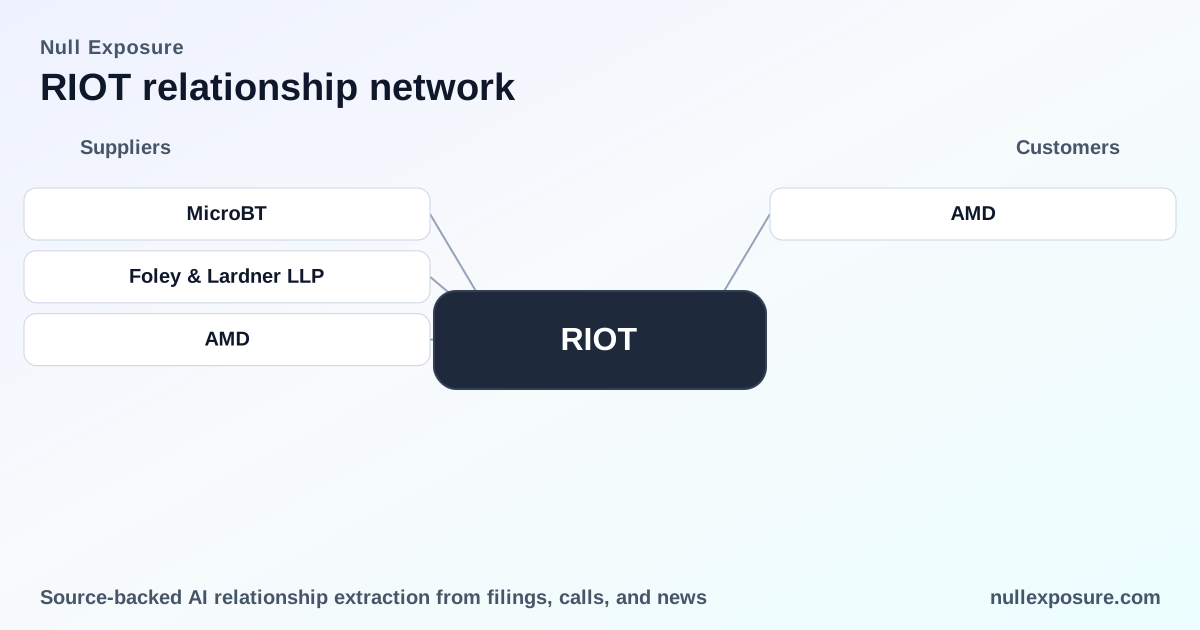
MicroBT
Riot entered purchase orders under a long-term Master Agreement to acquire immersion miners, and Riot disclosed $364.8 million in deposits and advance payments to MicroBT for miners during the year ended December 31, 2024. This makes MicroBT a material hardware supplier whose delivery cadence and product performance directly affect Riot’s hashing capacity and near-term cash flow. According to Riot’s FY2024 Form 10-K, these arrangements are part of Riot’s strategy to secure U.S.-manufactured immersion mining equipment (FY2024 filing).
Foley & Lardner LLP
Foley & Lardner acted as legal counsel representing Riot on its acquisition of roughly 200 acres in Rockdale, Texas, and related development work tied to a landmark data-center lease. The law firm’s March 2026 announcement documents Riot’s land purchase and the broader corporate real-estate and contracting activity around the Rockdale development (Foley & Lardner LLP press release, March 2026).
AMD
Riot executed a long-term commercial arrangement with AMD: a 10-year lease for 25 megawatts of data center capacity (public reporting in March 2026). This represents a strategic pivot toward hosting AI and enterprise compute customers and provides an anchor tenant that diversifies revenue away from pure bitcoin mining, while also creating dependencies on construction timelines and integration with tenant hardware (news coverage, March 2026).
What investors should read into these relationships
The supplier map supports a narrative of intentional vertical scaling and diversification. Riot is locking in hardware supply via MicroBT, securing power through multi-year PPAs, and signing commercial hosting deals with enterprise tenants like AMD. These moves reduce short-term mining revenue volatility by creating more predictable hosting income streams, but they also increase exposure to execution risk: large deposits to manufacturers, multi-year construction programs, and reliance on ERCOT power all create concentrated failure modes.
- Concentration risk: Significant deposits to a single hardware manufacturer and power sourcing tied to ERCOT concentrate supplier risk.
- Contract maturity: Multi-year PPAs and a master purchase agreement increase operational predictability and enable aggressive capacity planning.
- Criticality: Custodial service providers are material for asset security; hardware suppliers are material for buildout; anchor tenants are material to future revenue diversification.
For a supplier-risk dashboard and ongoing monitoring of these relationships, check the supplier intelligence resources at https://nullexposure.com/.
Investment implications and next steps
Riot’s trajectory is clear: scale hashing capacity while converting some assets to data-center hosting for enterprise compute. That strategy improves revenue diversification but raises capital deployment and execution risk. Investors should focus on delivery milestones for MicroBT shipments, the timeline and capex execution at Rockdale, and AMD’s onboarding schedule — each directly affects near-term EBITDA and cash needs.
- Monitor miner delivery schedules and any warranty or performance guarantees from MicroBT.
- Track Rockdale PPA expirations and the staggered nature of fixed-price blocks through 2027–2030.
- Confirm custodial arrangements for bitcoin holdings to ensure operational resilience.
If you want an ongoing, supplier-focused view to translate these relationships into investment signals, visit https://nullexposure.com/ to subscribe for alerts and supplier risk analytics.
Final read: what matters for risk-adjusted returns
Riot is no longer just a bitcoin miner — it is a capital-intensive platform operator where supplier contracts and large vendor deposits set the pace of scale and risk. The company’s strength is in locking favorable long-term power and hardware terms; its vulnerability is concentrated execution risk tied to a handful of counterparties and a single power grid region. For investors, the key question is whether Riot converts contracted capacity and tenant commitments into sustained cash flow before market cycles compress bitcoin prices or hardware delivery timelines slip.
Act now to integrate supplier intelligence into your RIOT thesis: visit https://nullexposure.com/ for more detailed supplier profiles and monitoring tools.