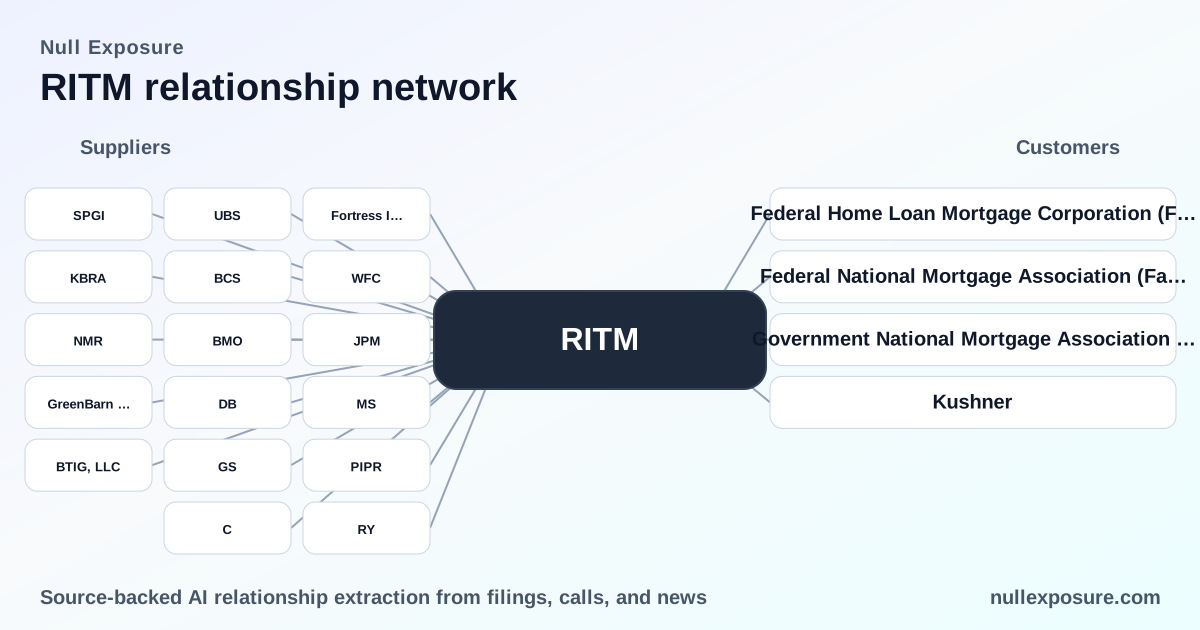
Rithm Capital (RITM): supplier network and what it tells investors about funding, servicing and concentration
Rithm Capital is a mortgage-focused REIT that earns returns through mortgage finance spread, securitizations, and servicing-related cash flows; it monetizes by acquiring loan pools and MSR exposures, packaging and selling ABS tranches, and collecting servicing and ancillary income. For investors this is a capital-markets and counterparty business: Rithm sources loans, transfers risk via securitizations underwritten by major banks, and relies on servicers and third-party vendors to operate the underlying assets. Understanding who underwrites, rates and services Rithm’s paper is essential to assessing funding optionality, concentration risk and execution costs. For more context on supplier relationships and counterparty analysis visit https://nullexposure.com/.
How Rithm’s operating model translates to supplier risk and value
Rithm runs a two-armed business model: balance-sheet mortgage exposure and capital markets distribution. On the balance-sheet side it holds consumer and mortgage assets and collects yield; on the distribution side it reduces funding risk through ABS deals and bank syndication. That structure forces a dual supplier posture:
- Funding and distribution are concentrated among large investment banks who act as joint bookrunners and placement agents; these parties determine execution timing, pricing and rating outcomes for Rithm’s securitizations.
- Servicing and operational partners execute day-to-day loan performance, advances and loss mitigation; disruptions or contract terminations carry material remediation costs.
The company’s public metrics underline the stakes: a meaningful dividend yield (10.6% in the provided snapshot) and a modest price-to-book (0.75) indicate investor reliance on steady income streams that are sensitive to servicing continuity and ABS market access.
Constraints that shape supplier strategy and contracting posture
Three company-level signals drive how management contracts and prioritizes counterparties:
- Material counterparty dependency. Rithm acknowledges that disruptions to third-party services could have a material adverse effect on results; this pushes the company toward more formal contracting, higher reserves for remediation, and contingency liquidity planning. (Company-level disclosure excerpts cited in constraint evidence.)
- Buyer behavior on portfolio acquisition. Rithm functions as a buyer of consumer loan portfolios, including purchases from Goldman Sachs (the “Marcus” loans) and other sellers; that role creates counterparty negotiation leverage but also requires diverse funding partners to avoid concentration. (Evidence: portfolio purchases disclosed for FY2023.)
- Service-provider reliance and vertical integration. The firm uses servicers and operating partners to perform servicing, advancing and property management; where Rithm holds ownership stakes in managers (for example an entity managing SFR properties), it reduces some vendor risk but increases operational complexity.
These signals imply a hybrid contracting posture: selective vertical integration where feasible, and diversified bank syndication to preserve funding flexibility while accepting execution fees.
For a broader corporate supplier map and risk scoring, see https://nullexposure.com/.
Vendor and capital-markets partner roll call (what the record shows)
Below is a concise, plain-English summary for every supplier relationship surfaced in public reporting. Each line is tied to the reporting source.
- Fortress Investment Group — Fortress historically provided external management services to Rithm’s predecessor and Rithm paid termination fees related to rescinding that contract, which were identified as a primary culprit for a multi-million-dollar Q2 loss tied to the FY2022 reorganization. (MPA Mag and National Mortgage News reporting on FY2022 reorganizations.)
- Wells Fargo — Wells Fargo participated as a joint bookrunner on recent offerings and was named among the syndicate for a FY2025 non‑QM securitization, indicating an active role in distributing Rithm paper. (National Mortgage Professional coverage of the FY2025 $504m non‑QM securitization.)
- J.P. Morgan Securities LLC — J.P. Morgan was listed among joint bookrunners for a FY2025 offering, serving as a primary capital-markets distribution partner. (Rithm press release reported on Yahoo Finance, FY2025.)
- Morgan Stanley & Co. LLC — Morgan Stanley acted as a joint bookrunner on a FY2025 Rithm offering and on securitization syndicates, showing repeated distribution involvement. (Yahoo Finance announcement, FY2025.)
- Piper Sandler & Co. — Piper Sandler appeared in the bank syndicate for a FY2025 offering, supporting placement and underwriting activity. (Yahoo Finance, FY2025.)
- RBC Capital Markets, LLC — RBC was named in the joint bookrunning group for a FY2025 offering, playing a distribution and underwriting role. (Yahoo Finance, FY2025.)
- UBS Investment Bank — UBS acted as a jointrunner on Rithm’s FY2025 offering, contributing to pricing and placement. (Yahoo Finance, FY2025.)
- Wells Fargo Securities, LLC — As the securities arm of Wells Fargo, it was explicitly named among joint bookrunners for a FY2025 offering and a securitization syndicate, reinforcing Wells Fargo’s distribution footprint. (Yahoo Finance and National Mortgage Professional, FY2025.)
- Barclays — Barclays structured and acted as joint bookrunner on a FY2025 $504m non‑QM securitization, taking lead structuring responsibility. (National Mortgage Professional, FY2025.)
- BMO Capital Markets — BMO was a joint bookrunner on the FY2025 non‑QM deal, participating in distribution and underwriting. (National Mortgage Professional, FY2025.)
- Deutsche Bank Securities — Deutsche Bank served as a joint bookrunner on the FY2025 non‑QM securitization, contributing to structuring and syndication. (National Mortgage Professional, FY2025.)
- Goldman Sachs / Goldman Sachs & Co. LLC — Goldman Sachs appears as both an underwriting partner on syndications and as an originator counterparty; the firm is also noted historically as a loan seller (Marcus loans) that Rithm purchased, tying it to both buy-side and distribution dynamics. (Yahoo Finance and company disclosures around FY2023 purchases and FY2025 syndication.)
- Citigroup Global Markets Inc. — Citi was listed among joint bookrunners for a FY2025 offering, supporting placement and institutional distribution. (Yahoo Finance, FY2025.)
- BTIG, LLC — BTIG appeared in the syndicate for a FY2025 offering, acting in a distribution capacity. (Yahoo Finance, FY2025.)
- Nomura — Nomura was a joint bookrunner on the FY2025 non‑QM securitization, included in the syndicate led by Barclays. (National Mortgage Professional, FY2025.)
- S&P (S&P Global Ratings) — S&P rated tranches of a FY2025 non‑QM deal, assigning ratings across AAA through B, which sets investor risk buckets for Rithm’s securitized paper. (National Mortgage Professional, FY2025.)
- KBRA — KBRA also rated tranches on the FY2025 non‑QM securitization, providing an alternative rating view for investors. (National Mortgage Professional, FY2025.)
- GreenBarn Investment Group — GreenBarn is identified as Rithm’s operating partner on a construction loan tied to Monmouth Mall redevelopment, managing a $112.5m loan as Rithm’s operating partner. (RE-NJ reporting, FY2024.)
Each relationship above is pulled from contemporaneous press coverage and regulatory filing summaries; the bank syndicates are visible in Rithm’s FY2025 deal announcements and the servicer/management references stem from company restructuring coverage in FY2022–FY2024.
What investors should take away: concentration, counterparty strength and execution risk
- Concentration in large banks is intentional and value-accretive — Rithm uses an array of major banks to underwrite and place ABS, which preserves funding capacity and taps institutional buyers. The presence of Barclays, Morgan Stanley, J.P. Morgan and a broader syndicate demonstrates market access.
- Servicer and vendor dependency is the principal operational risk — Rithm’s disclosures flag servicer concentration and remediation costs as material; this elevates the importance of contract terms, advance recourse and contingency liquidity when underwritten paper underperforms. Operational continuity is a lever on dividend sustainability.
- Ratings and structuring partners matter for pricing and capital efficiency — Dual ratings from S&P and KBRA and active structuring by Barclays indicate that Rithm seeks to optimize tranche pricing, which directly impacts yield on equity.
If you are modeling dividend durability or stress-testing capital markets access, start with syndicate composition and servicer contracts as primary inputs. For a practical supplier-risk scorecard and to benchmark Rithm against peers visit https://nullexposure.com/.
Bottom line and next steps for investors
Rithm’s supplier map is dominated by major investment banks and a small set of servicing and operating partners; this combination supports distribution scale but concentrates execution and remediation risk. Investors should underwrite bank syndicate depth, servicer contractual protections, and the company’s contingency capital planning as part of any valuation or income-security analysis.
To review supplier profiles, counterparty risk metrics and tailored exposure reports for Rithm and comparable issuers, go to https://nullexposure.com/.