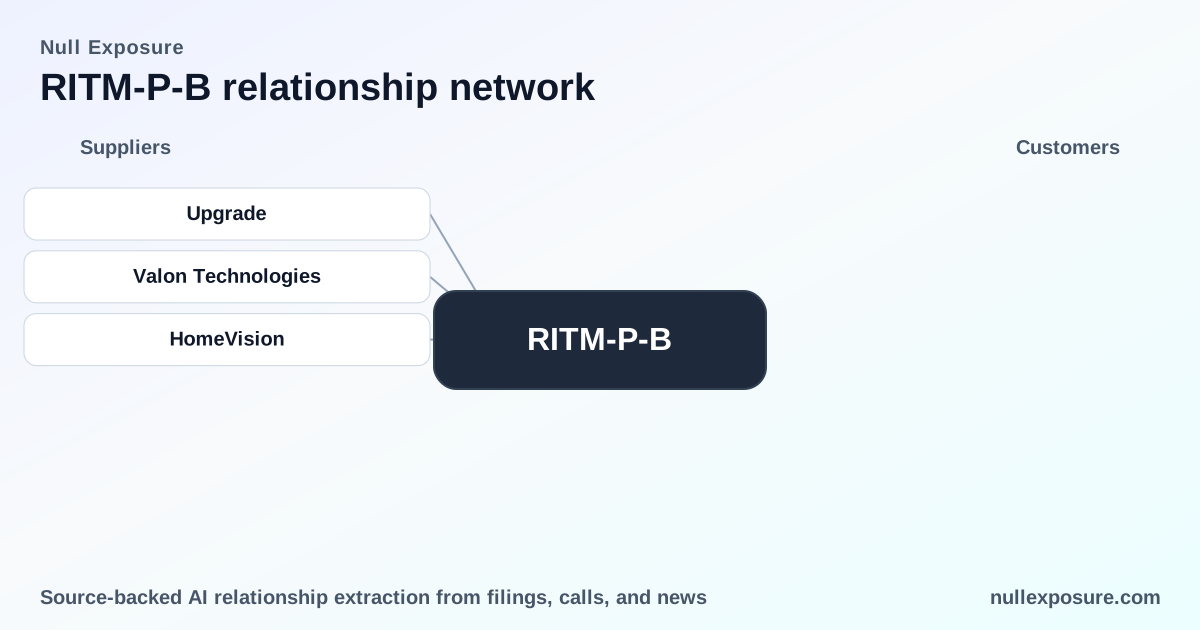
Rithm Capital (RITM-P-B): Supplier map and what it means for investors
Rithm Capital operates as a diversified REIT focused on residential mortgage finance and asset management, monetizing through loan acquisition, servicing spreads, and fee income from asset management activities. The company augments its balance-sheet strategy with flow purchase agreements and strategic platform partnerships that embed third-party underwriting and servicing capabilities into its operating model. These supplier relationships directly influence portfolio scale, operational efficiency, and execution risk — critical drivers for dividend sustainability and book-value management. For a quick tour of Rithm’s supplier footprint and implications, visit the NullExposure homepage: https://nullexposure.com/.
How Rithm monetizes and runs the business
Rithm acquires and manages residential mortgage loans for yield and capital appreciation, generating returns from net interest spread, servicing fees, and asset-management economics. The firm uses flow agreements to scale originations quickly, and relies on technology and servicing partners to lower operating cost and speed underwriting decisions. This combination creates a capital-efficient engine: balance-sheet deployment through purchase pipelines, complemented by third-party systems that reduce fixed-cost burdens and shorten time-to-yield on assets.
The supplier relationships that matter (concise summaries)
Upgrade — large-scale flow purchase relationship
Rithm entered a flow agreement with Upgrade to purchase up to $1 billion of home-improvement loans and purchased just under $600 million in 2025, signaling active utilization of that capacity to grow originated balances. According to the Q4 2025 earnings call transcript reported by InsiderMonkey (March 10, 2026), this arrangement is a primary channel for incremental loan inventory and demonstrates Rithm’s preference for sizeable, committed purchase flows. Source: InsiderMonkey Q4 2025 earnings call transcript (reported March 10, 2026) — https://www.insidermonkey.com/blog/rithm-capital-corp-nyseritm-q4-2025-earnings-call-transcript-1689395/.
Valon Technologies — servicing operating system partnership
Rithm announced a partnership with Valon Technologies to run its servicing operating system, outsourcing core servicing infrastructure while retaining economic exposure to mortgage assets. The earnings call transcript disclosed this arrangement as a material operating step to modernize servicing and reduce operational drag, positioning Rithm to scale servicing without a commensurate increase in back-office headcount. Source: InsiderMonkey Q4 2025 earnings call transcript (reported March 10, 2026) — https://www.insidermonkey.com/blog/rithm-capital-corp-nyseritm-q4-2025-earnings-call-transcript-1689395/.
HomeVision — underwriting decision engine integration
Two weeks before the call, Rithm announced a partnership with HomeVision to implement an underwriting decision engine, signaling a shift to technology-enabled credit adjudication that accelerates loan intake and standardizes risk selection. The company identified this partnership on the Q4 2025 earnings call as a component of its strategy to automate underwriting workflows and improve hit-rates on flow-originated loans. Source: InsiderMonkey Q4 2025 earnings call transcript (reported March 10, 2026) — https://www.insidermonkey.com/blog/rithm-capital-corp-nyseritm-q4-2025-earnings-call-transcript-1689395/.
(For a deeper view of how these supplier pairings influence portfolio dynamics, review the company’s vendor disclosures and earnings materials via NullExposure: https://nullexposure.com/.)
Operating model and business-model constraints (company-level signals)
There were no supplier-specific constraint excerpts extracted from the available source material; at the company level this is itself an informative signal. The absence of public constraint disclosures in the referenced materials suggests:
- Contracting posture: Rithm uses structured, commercial contracts (e.g., flow agreement with Upgrade) and commercial technology partnerships rather than ad-hoc vendor relationships, reflecting a negotiated, scalable contracting posture.
- Concentration: Rithm is diversifying operational suppliers across originations, servicing, and underwriting technology, which reduces single-vendor dependence but still leaves concentrated execution risk if any single partner underdelivers.
- Criticality: The named partners are operationally critical — flow supply affects balance-sheet deployment, servicing systems determine loss mitigation and cash flows, and underwriting engines shape asset quality.
- Maturity: Recent partnership announcements and an active flow purchase in 2025 indicate a transitional maturity stage where Rithm is moving from legacy, vertically integrated workflows toward a partner-enabled model to scale quickly.
These are company-level signals drawn from the available disclosures rather than supplier-specific caveats.
Investment implications: risk and opportunity
Rithm’s supplier strategy produces clear investor-facing impacts:
- Growth lever: The Upgrade flow agreement is a direct growth lever — committed capacity accelerates asset accumulation and potential dividend coverage if assets perform to underwriting standards.
- Operational efficiency: Outsourcing servicing to Valon and automating underwriting with HomeVision compresses operating leverage and can improve return on equity through lower fixed costs per dollar of assets.
- Execution risk concentration: Although multiple partners diversify functionally, the operational criticality of each relationship concentrates execution risk; a failure in any one pillar (flow supply, servicing, or underwriting) would materially affect cash generation.
- Transparency and disclosure: The lack of supplier-level constraints in public excerpts implies limited visibility for investors. Active monitoring of counterparty performance, contract terms, and flow utilization rates is necessary to price operational risk correctly.
Key takeaways for a portfolio manager or operator:
- Supplier partnerships are shaping Rithm’s scalability and are central to near-term growth.
- Flow purchase economics will determine dividend durability as balance-sheet exposure grows.
- Operational reliance on third-party systems increases vendor risk even as it lowers fixed-cost intensity.
What investors should watch next
Monitor three data points quarterly:
- Flow utilization versus contracted capacity under the Upgrade agreement.
- Servicing KPIs reported post-Valon integration (delinquencies, cure rates, cost-to-collect).
- Underwriting performance and vintage-level credit metrics after HomeVision deployment.
For ongoing coverage and updated counterparty tracking, visit the NullExposure research hub: https://nullexposure.com/.
Conclusion and recommended actions
Rithm’s supplier posture is purposeful: use committed flows to scale, outsource servicing to modern platforms, and automate underwriting to protect credit selection. This structure supports faster growth and leaner operations but concentrates execution risk in a few critical suppliers. Investors and operators should maintain active counterparty diligence and focus on the three performance vectors above when evaluating dividend sustainability and book-value trajectory.
For a concise supplier risk scorecard and ongoing monitoring tools, explore the NullExposure homepage: https://nullexposure.com/.