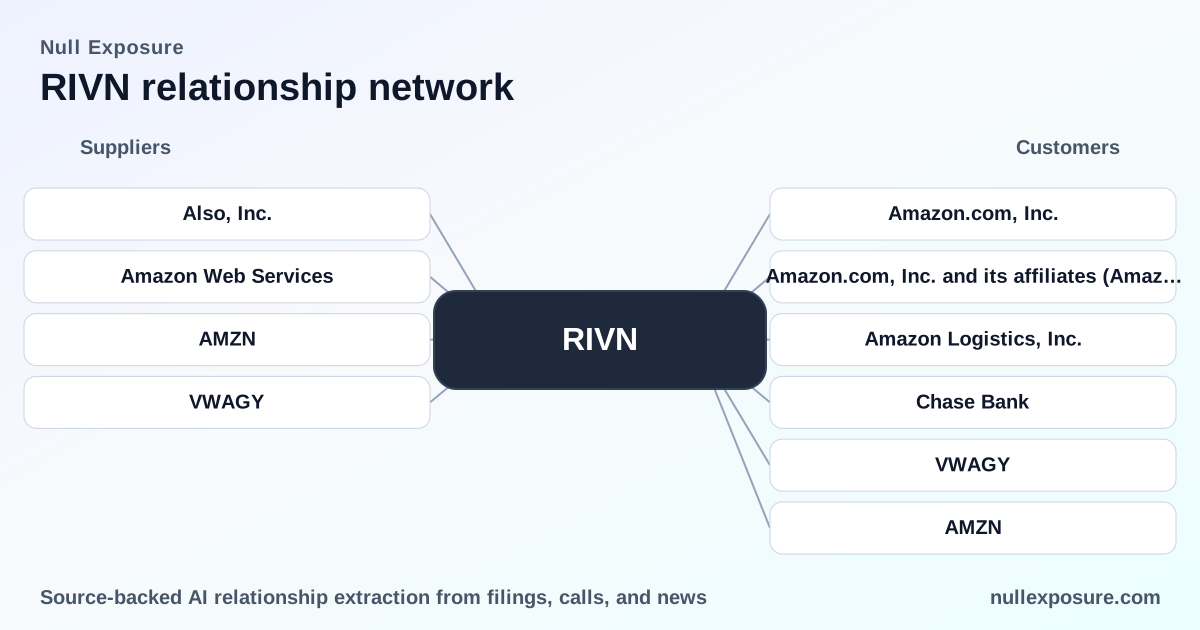
Rivian’s supplier map: where value and risk concentrate
Rivian designs and manufactures battery-electric trucks, SUVs and commercial vans and monetizes through vehicle sales, commercial fleet partnerships, software services and accessory and charging ecosystems. The company leverages strategic commercial customers, cloud and platform partners, and equity stakes in spinoffs to stretch capital and product capability while scaling manufacturing. For investors, the supplier relationships are both an operational engine and a principal source of execution risk given the company’s negative margins, concentrated commercial contracts, and reliance on global component flows. Learn more about how these relationships influence supplier risk and opportunity at https://nullexposure.com/.
What the supplier picture tells investors about Rivian’s operating model
Rivian runs a classic capital‑intensive EV playbook: in‑house vehicle design and assembly combined with outsourced components, cloud services, and targeted strategic partnerships that accelerate go‑to‑market for specific use cases. The company amplifies scale by partnering with large ecosystem players (Amazon, Volkswagen) while also taking non‑cash equity stakes that transfer development assets into specialist entities.
Several operating characteristics follow from the disclosures:
- Concentration and criticality. Rivian discloses reliance on single‑source suppliers for many components and warns that supplier disruption would be material to results; this creates elevated supply concentration risk across the manufacturing stack.
- Global sourcing posture. The company states it works with hundreds of suppliers worldwide, so supply‑chain resilience depends on diversified logistics and geopolitical exposures.
- Service orientation and third‑party reliance. Rivian contracts third parties for financing, leasing, insurance, repair and other customer services, indicating that a portion of the customer experience is outsourced and contractually dependent.
- Strategic partnerships and maturity signal. Joint ventures and equity transfers (for micromobility work) show a move from pure OEM manufacturing toward platform licensing and specialist alliances—an evolution that reduces some capital burden but introduces dependency on partners’ execution.
These are company‑level constraints drawn from the 2025 disclosures and should frame any supplier diligence. If you want a focused supplier risk scorecard and counterparty monitoring plan, start here: https://nullexposure.com/.
The relationships investors need to know
Below I summarize every named supplier/partner mentioned in the most recent supplier disclosures and earnings commentary, with source context.
Also, Inc.
Rivian exchanged employees, intellectual property and fixed assets dedicated to micromobility development for Series B‑1 preferred shares of Also valued at approximately $104 million, effectively spinning out that work into a specialist company while retaining economic interest. According to Rivian’s FY2025 Form 10‑K, this transaction took place in the quarter ended March 31, 2025 (Rivian 10‑K, FY2025).
Amazon Web Services (AWS)
Rivian publicly states that it primarily relies on Amazon Web Services in the United States to host its cloud computing and storage needs, making AWS a foundational technology supplier for operations, telemetry, and software services (Rivian 10‑K, FY2025).
Amazon (commercial customer)
Amazon is a strategic commercial customer for Rivian’s electric delivery vans (EDVs); management highlighted expected EDV demand growth in 2026 and product variants (all‑wheel drive, larger battery) tailored to Amazon’s network use cases, underscoring Amazon’s role as both volume driver and product design partner (Rivian Q4 2025 earnings call, March 2026).
Volkswagen Group / VW
Rivian references a joint venture with Volkswagen Group for electrical hardware and software platform work, and third‑party commentary has pointed to Volkswagen’s supplier leverage in commercial strategy discussions—together this signals a formalized technical partnership to extend Rivian’s platform to broader markets (Rivian Q4 2025 earnings call; news analysis from Sahm Capital, February–March 2026).
How these relationships materialize into investor risk and opportunity
Rivian’s supplier topology creates a distinct set of investment implications:
- Upside: strategic customers and partners compress time to scale. Amazon’s fleet commitment and the Volkswagen JV are growth multipliers—large anchor demand and platform licensing potential improve utilization and technology adoption if delivery and quality targets are met.
- Downside: supplier concentration and single‑source exposure are direct earnings threats. Rivian discloses that many suppliers are single‑source providers and that supply failures could materially and adversely affect financial condition and operations (Rivian 10‑K, FY2025).
- Operational leverage via cloud and services reduces capital needs but increases third‑party dependence. Relying on AWS centralizes critical functions off‑balance‑sheet and shifts some operational sovereignty to a commercial cloud provider, improving scalability while introducing vendor risk.
What to monitor next quarter
Investors should track three categories of signals:
- Delivery and quality metrics tied to Amazon EDV volumes and any expanded specs (AWD, larger battery).
- Progress and commercial terms emerging from the Volkswagen joint venture—look for product roadmaps and licensing revenue language.
- Supplier continuity disclosures and single‑source contract renewals, plus any material service provider disputes or outages, including cloud service outages impacting telematics or sales systems.
A short checklist for active monitoring:
- Confirmed production ramp vs. stated EDV demand from Amazon.
- Any earn‑out, royalty, or revenue sharing detail from the Volkswagen arrangement.
- Subsequent share‑based or asset transfers similar to the Also transaction that shift development burden off Rivian’s capex.
If you need a tailored watchlist for counterparty events or a comparative risk profile across Rivian’s suppliers, start a diagnostic at https://nullexposure.com/.
Final read: positioning for risk‑adjusted exposure
Rivian’s supplier relationships are a blend of strategic revenue conduits (Amazon, Volkswagen) and operational plumbing (AWS, hundreds of global vendors). The company uses partnerships and equity transfers to accelerate product reach while externalizing some development costs—a pragmatic strategy that shifts several operational risks into the counterparty layer. For investors, the thesis is straightforward: success hinges on execution across a concentrated supplier base and the translation of JV/partner commitments into profitable volume.
For active investors and operators evaluating counterparty risk, prioritize proof points on delivery performance, supplier continuity disclosures, and the contractual economics of each strategic relationship. If you want a deeper, actionable supplier risk score and continuous monitoring for Rivian counterparties, begin with a tailored assessment at https://nullexposure.com/.