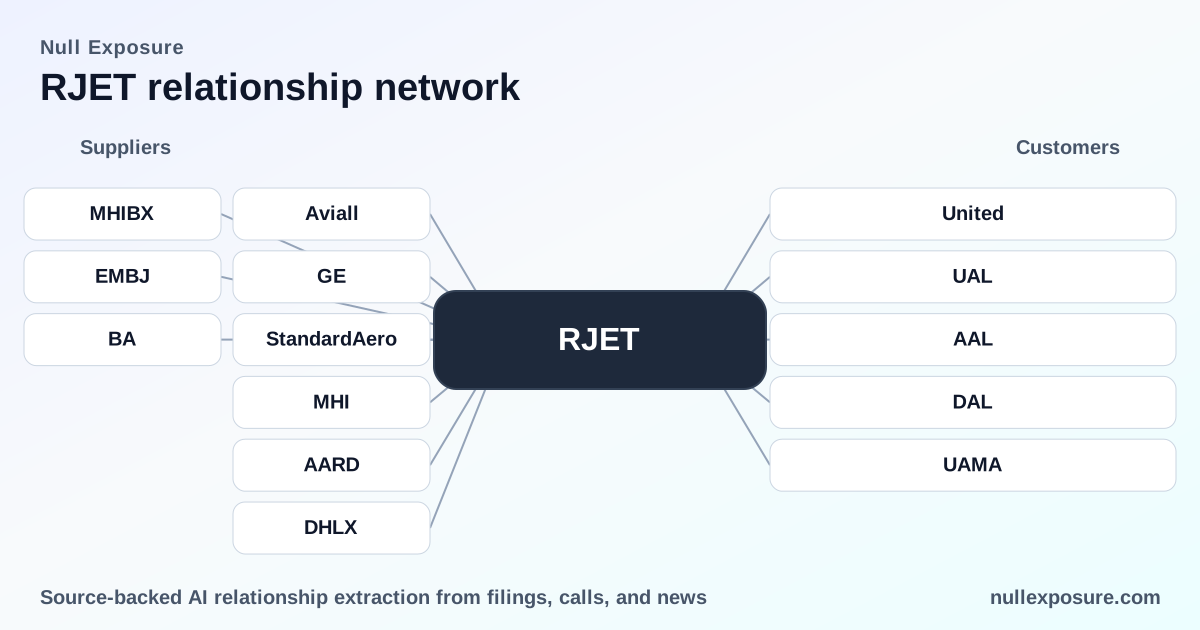
Republic Airways (RJET) — supplier relationships and operational risk profile
Republic Airways operates scheduled passenger services using a fleet sourced from a small group of aircraft and engine manufacturers and outsources heavy maintenance and parts services to a set of established aviation suppliers. The company monetizes by operating aircraft for commercial routes and contracts that convert flying capacity into revenue; its cost structure is therefore directly sensitive to parts, maintenance and engine support arrangements. Learn more about vendor risk for aviation portfolios at https://nullexposure.com/.
Why suppliers drive Republic’s margin and operational risk
Republic’s operating model is inherently asset- and supplier‑intensive: aircraft and engines are concentrated across a few manufacturers, and heavy maintenance, parts procurement, and component overhaul work are performed by third‑party vendors. Those arrangements control both fixed and variable cost exposure and influence aircraft availability — the primary driver of revenue for a regional carrier. The FY2024 10‑K makes this explicit: Republic uses third‑party vendors for heavy airframe and engine maintenance and relies on a small set of manufacturers for aircraft and engines.
- Concentration: Republic depends on MHI, Boeing and Embraer as the sole manufacturers of its aircraft and on GE as the sole engine manufacturer, which creates supplier concentration risk. (FY2024 10‑K)
- Contracting posture: The company relies on fixed‑rate parts procurement and component overhaul services with AAR and Aviall, establishing predictable unit costs but locking exposure to those providers. (FY2024 10‑K)
- Criticality and maturity: Heavy maintenance and engine overhauls are outsourced to established MROs (AAR, StandardAero, Aviall), a standard industry practice that transfers operational complexity but concentrates counterparty risk. (FY2024 10‑K)
If you evaluate portfolio exposure to operational counterparties in aviation, this one‑page supplier map clarifies the counterparty surface: https://nullexposure.com/.
Vendor-by-vendor breakdown: what the filings say
Below are plain‑English descriptions of every supplier relationship listed in Republic's FY2024 10‑K, with concise source notes.
Aviall
Republic uses Aviall for parts procurement and component overhaul services under fixed‑rate arrangements that shape its maintenance cost profile. According to the FY2024 10‑K, Aviall is one of the third‑party vendors providing parts procurement and overhaul services. (Republic 2024 10‑K)
GE
GE is the sole manufacturer of Republic’s aircraft engines and provides engine support services referenced separately as part of the company’s outsourced maintenance strategy. The FY2024 10‑K states that GE is the sole engine manufacturer and a provider of engine support. (Republic 2024 10‑K)
StandardAero
StandardAero is named among the MRO vendors Republic engages for heavy airframe and engine maintenance as part of its outsourced overhaul program. The FY2024 10‑K lists StandardAero as a third‑party vendor used for heavy maintenance and component overhaul. (Republic 2024 10‑K)
MHI (Mitsubishi Heavy Industries)
Republic identifies MHI as one of the sole aircraft manufacturers for its fleet, meaning Republic sources entire aircraft from MHI alongside Boeing and Embraer. The FY2024 10‑K lists MHI among the sole manufacturers of aircraft used by the company. (Republic 2024 10‑K)
AAR
AAR provides fixed‑rate parts procurement and component overhaul services and is cited alongside Aviall as a key vendor for Republic’s maintenance and spare parts strategy. The FY2024 10‑K specifies AAR’s role in fixed‑rate parts procurement and overhaul. (Republic 2024 10‑K)
DHL
DHL is mentioned in the FY2024 10‑K in the context of an MPD (maintenance-related) cost note: the company records that fuel expenses relating to MPD are paid by the Company, a disclosure that ties DHL’s mention to a cost accounting point rather than a long‑term maintenance contract. (Republic 2024 10‑K)
Embraer
Embraer is listed as one of the sole manufacturers of aircraft in Republic’s fleet, contributing to the manufacturer concentration the company discloses. The FY2024 10‑K names Embraer as a sole aircraft manufacturer for the company. (Republic 2024 10‑K)
Boeing
Boeing is identified as a sole aircraft manufacturer for Republic alongside MHI and Embraer; supplier concentration with Boeing is a strategic dependency cited in the filing. The FY2024 10‑K includes Boeing among the aircraft manufacturers depended upon by the company. (Republic 2024 10‑K)
What the constraint language tells investors about resilience
Republic’s FY2024 risk disclosures include a clear company‑level constraint: “A change to the operations of the Company's significant vendors could have a material adverse effect on the Company's financial condition, results of operations, and cash flows.” That is an explicit recognition that vendor operational issues — from supply interruptions to cost increases — are economically material to Republic.
Translate that into investor terms:
- High counterparty criticality: With sole-source manufacturers and concentrated MRO suppliers, operational interruption at a vendor can reduce aircraft availability and revenue faster than it reduces fixed costs.
- Locked‑in cost exposure: Fixed‑rate procurement with AAR and Aviall gives cost certainty but limits the company’s ability to benefit from market price declines or to re‑price quickly if vendor costs move higher.
- Mature vendor set, concentrated downside: Outsourcing to established vendors transfers execution risk but concentrates downside across a small number of counterparties.
Midway check: if your model stresses supply disruption or engine support shocks, these supplier lines are the natural place to apply scenario impacts. For a vendor risk deep dive, visit https://nullexposure.com/.
Practical investment takeaways
- Supplier concentration is a primary operational risk for Republic: aircraft and engine sourcing is concentrated among a handful of manufacturers and MROs (GE, MHI, Boeing, Embraer, AAR, Aviall, StandardAero). (FY2024 10‑K)
- Fixed‑rate maintenance arrangements provide predictability but embed counterparty dependency with AAR and Aviall. (FY2024 10‑K)
- Materiality language in the 10‑K confirms that changes in vendor operations would have a material financial impact, making vendor monitoring critical for downside scenarios.
For investment teams underwriting aviation exposure, incorporate vendor outage and cost shock scenarios into cash‑flow models and track counterparty health metrics for these named suppliers. Learn more about supplier signal tracking at https://nullexposure.com/.
Bottom line
Republic’s supplier map is succinct and concentrated: a small set of manufacturers and a handful of established MROs deliver the parts, maintenance and engine support that convert installed aircraft into revenue‑generating capacity. That concentration creates clear operational leverage — both positive when vendors perform and negative when they do not — and the company’s own filing treats vendor disruption as financially material. Investors should price this counterparty risk explicitly when evaluating equity or credit positions in RJET.