Raymond James Financial (RJF): what supplier ties tell investors about resilience and exposure
Thesis — Raymond James Financial operates as a diversified independent investment bank and wealth manager that monetizes through advisory and asset management fees, trading and underwriting revenue, and interest/net lending activity across its subsidiaries; supplier and partner relationships are therefore a mix of distribution, fund servicing and short-term financing that materially affect margins and capital efficiency. For investors and operators evaluating RJF as a counterparty or platform, the firm’s supplier footprint signals a hybrid contracting posture — long-term committed credit for stability, heavy short-term funding activity for trading liquidity, and large-scale public debt for balance-sheet funding. Learn more at https://nullexposure.com/.
A pragmatic snapshot: scale, margin and why suppliers matter
Raymond James is a large-cap financial-services firm with roughly $28.4 billion market capitalization and $14.2 billion in trailing twelve‑month revenue, operating across wealth management, capital markets, and asset management. Its profitability and capital intensity mean suppliers and counterparties — from fund advisors and distributors to repo counterparties and credit providers — influence funding cost, product distribution and the firm’s ability to underwrite and warehouse risk. Supplier ties here are not peripheral vendor relationships; they are operational levers that affect liquidity, product go‑to‑market and funding flexibility.
What we see in RJF’s supplier relationships
Below are the relationships surfaced in the supplier scope, each described in plain English with sourcing.
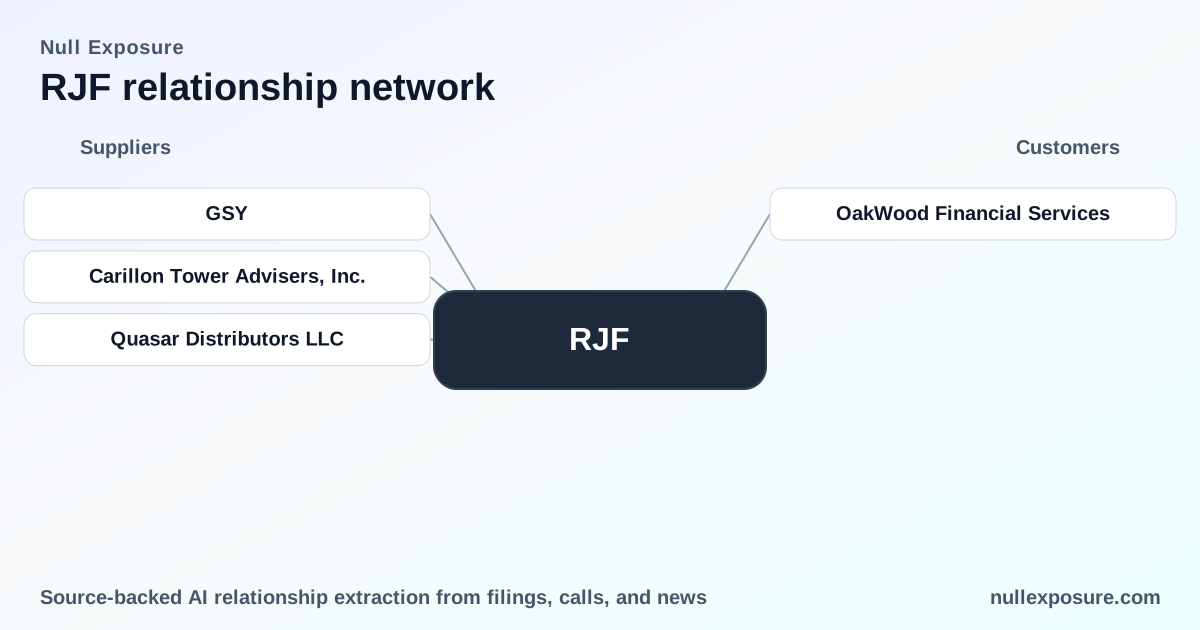
Invesco Ultra Short Duration ETF (GSY)
Raymond James Financial increased its holding in the Invesco Ultra Short Duration ETF by 16.7% in the second quarter, reflecting active balance-sheet management of short-duration cash and liquidity positions. This transaction was covered in a March 2026 news item on DefenseWorld reporting the stake increase. (DefenseWorld, March 3, 2026)
Carillon Tower Advisers, Inc.
Carillon Tower Advisers is listed as the primary advisor to an open‑ended fund launched under the Raymond James brand (inception Oct 2, 2025), indicating RJF outsources fund management to specialty advisors where it provides the issuer/distribution wrapper. This role was detailed on the TradingView listing page for AMEX:RJDI. (TradingView, listing summary for AMEX:RJDI, reported March 2026)
Quasar Distributors LLC
Quasar Distributors is identified as the distributor for the Raymond James–branded fund (inception Oct 2, 2025), a standard third‑party distribution relationship that routes product to retail and intermediary channels. The distributor attribution is noted on the same TradingView fund page for AMEX:RJDI. (TradingView, listing summary for AMEX:RJDI, reported March 2026)
What the company-level constraints reveal about RJF’s operating model
The supplier constraints surfaced in filings and disclosures provide clear operational signals:
-
Long-term committed credit: In September 2025 RJF amended a revolving credit facility to extend the term to September 2030, increase capacity to $1 billion and reduce pricing, which reveals a preference for multi-year committed liquidity to support wholesale operations and balance-sheet optionality. This is a company-level signal drawn from the firm’s disclosure on the credit facility amendment in September 2025.
-
Short-term funding activity: RJF uses reverse repurchase and repurchase agreements as part of its operating liquidity and market‑making activity, reflecting a continuous reliance on short-term secured funding to support trading, securities financing and inventory management. This is stated in RJF’s funding disclosures.
-
Large-scale public debt issuance: On September 11, 2025 the company issued $1.5 billion of senior notes across 2035 and 2055 maturities, a decisive balance-sheet funding action that signals willingness to access the public markets for long-dated capital. This is a company-level financing disclosure and demonstrates material spend/balance-sheet scale.
Taken together, these constraints indicate a mixed maturity profile: committed long-term credit for stability, short-term repo activity for day‑to‑day liquidity, and sizeable public debt issuance for strategic funding. For investors, that combination supports sustained market-making and product distribution while introducing sensitivity to market liquidity spreads and interest-rate moves.
How these relationships and constraints affect vendor strategy and risk
For operators evaluating RJF as a counterparty or supplier, the implications are practical:
-
Contracting posture is mixed but predictable. The firm maintains long-term facilities while running high-frequency short-term agreements; suppliers and counterparties should expect both enduring contractual relationships and rapid transactional flows.
-
Concentration is moderate but meaningful. Fund advisors and distributors (Carillon, Quasar) show RJF uses established third-party partners to scale product issuance, reducing the need for in-house fund-management density but increasing reliance on distribution agreements.
-
Criticality is operational, not hypothetical. Short-term repo lines and the committed credit facility are operationally critical to daily trading and funding; disruptions to these channels would materially affect liquidity operations.
-
Maturity profile is diversified. The blend of repo, revolving credit to 2030, and long-dated senior notes spreads maturity risk but leaves the firm exposed to term‑spread re-pricing and funding-cost volatility.
Key investor takeaways: counterparties should underwrite both the transactional volume (repo and ETF holdings) and the structural funding (credit facility and senior notes) when modeling RJF’s liquidity and counterparty exposure. For more detailed supplier risk modeling, visit https://nullexposure.com/.
Practical recommendations for investors and operators
- Incorporate both short-term liquidity metrics (repo usage, trading inventory) and long-term capital structure (revolving facility utilization, senior note covenants) into stress tests.
- Assess distributor/advisor agreements for clauses on exclusivity, termination and revenue sharing, since product distribution drives margins and durability.
- Monitor public filings around facility utilization and note issuance to detect shifts in funding strategy.
Final action: for professionals needing a consolidated view of RJF’s supplier exposures and a structured vendor-risk assessment, start with a platform-level scan at https://nullexposure.com/. If you want a tailored review showing how these relationships map into funding volatility scenarios, the team at NullExposure can prepare a focused brief on request.
Bottom line — Raymond James runs a hybrid supplier model that balances long-term committed credit with active short-term market funding and strategic use of third-party fund managers and distributors; investors should value that mix for stability while pricing in funding and market-liquidity sensitivity. Explore a deeper supplier map at https://nullexposure.com/.