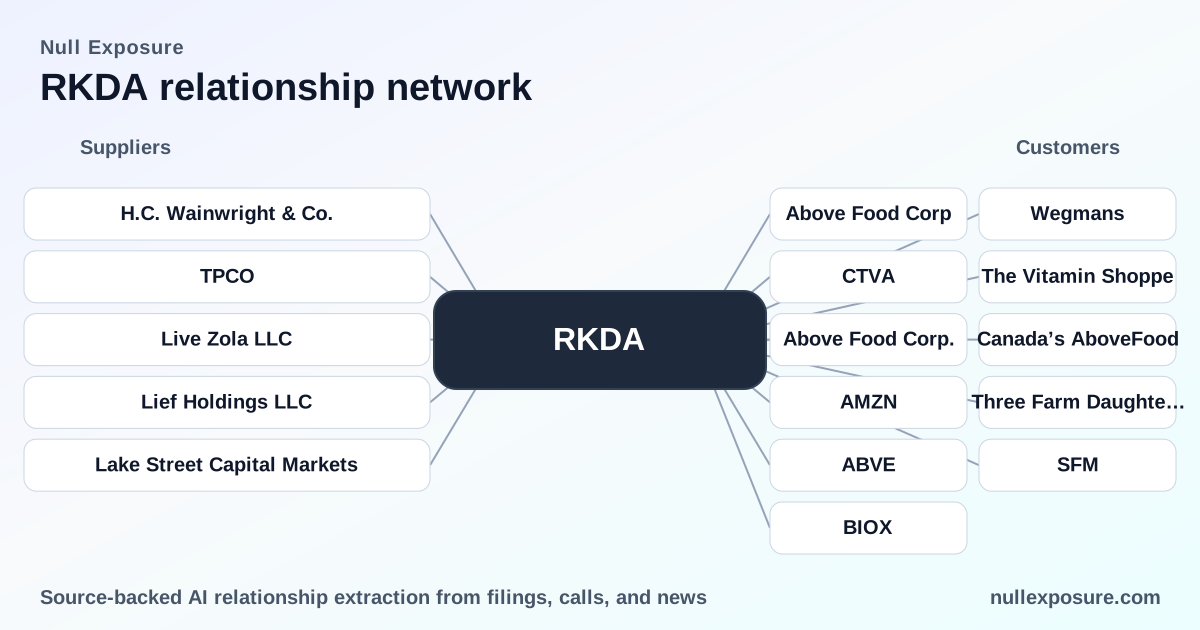
Arcadia Biosciences (RKDA) — supplier and partner map for investors
Arcadia Biosciences develops crop productivity traits and monetizes through a mix of licensing, product sales, strategic brand acquisitions in the hemp/CBD and wellness space, and periodic capital raises that rely on placement agents and financial advisors. The company’s operating model blends biotechnology R&D with consumer-facing brand management, which creates a hybrid revenue profile and recurring dependence on capital markets to fund operations and portfolio realignments. Investors evaluating supplier and advisor relationships should focus on capital-raising partners, deal advisors, and the provenance of acquired consumer assets as the primary drivers of liquidity, strategic direction, and geographic exposure. For a consolidated view of corporate supplier intelligence and partner disclosures visit https://nullexposure.com/.
Quick take: what matters to holders and counterparties
Arcadia is a small-cap, development-stage agritech company that uses outside financial intermediaries for capital transactions and relies on M&A to build consumer-facing revenue. Key business model implications are reliance on placement agents for financing, use of boutique advisors for asset sales, and acquisition of third-party wellness brands to diversify revenue. These relationships are operationally and financially material given negative EBITDA, thin market capitalization, and modest revenue scale reported in recent filings.
- Capital access is core: exclusive placement agent arrangements indicate a contracting posture that outsources capital-raising execution.
- Non-core consumer assets are a monetization lever: acquisitions and disposals of wellness and food brands shape short-term cash generation.
- Geographic sourcing signals matter: brand acquisitions can create APAC supply exposure and sustainability reputational considerations.
Explore more supplier-relationship analysis at https://nullexposure.com/ — useful for underwriting counterparties and stress-testing counterparty concentration.
What the relationships in the record show (each item)
Below are every named relationship surfaced in the supplier-focused records with a concise investor-facing summary and source reference.
-
H.C. Wainwright & Co.
Arcadia engaged H.C. Wainwright & Co. as the exclusive placement agent for an offering tied to the exercise of preferred investment options that generated roughly $2.1 million in gross proceeds, underscoring direct reliance on placement agents for near-term financing. This engagement is documented in the company’s January 2026 press releases and distribution channels. (GlobeNewswire / MarketScreener / FY2026). -
The Parent Company (TPCO)
Arcadia purchased the assets of Lief Holdings LLC and its wellness brands from The Parent Company, a transaction that brought a portfolio of CBD and wellness products into Arcadia’s consumer lineup, reflecting an M&A strategy to bolster consumer revenue. This acquisition was reported in a Proactive Investors release referencing FY2021 activity (Proactive Investors / FY2021). -
Live Zola LLC
Arcadia acquired select assets of Live Zola LLC as part of the same FY2021 acquisition activity, adding product lines and related intellectual property to its wellness brand portfolio. This was disclosed in contemporaneous reporting on the acquisition (Proactive Investors / FY2021). -
Lief Holdings LLC
Arcadia absorbed the assets and brand portfolio of Lief Holdings LLC, expanding its wellness and CBD product mix and consolidating acquired SKU rights and associated supply relationships under Arcadia’s commercial remit. The transaction was described in the FY2021 acquisition coverage (Proactive Investors / FY2021). -
Lake Street Capital Markets
Lake Street Capital Markets served as exclusive financial advisor to Arcadia for the sale of the GoodWheat brand to Above Food Corp for approximately $4 million, demonstrating the company’s practice of hiring boutique advisors for divestitures to realize cash from non-core assets. This advisory role is noted in reporting on the FY2024 transaction (igrownews / FY2024).
Operating model implications and company-level constraints
The relationship set reveals a company that operates with hybrid execution modes: biotech R&D in crops plus consumer brand management. From that, several operating constraints and characteristics emerge as company-level signals:
-
Contracting posture: Arcadia frequently relies on external specialized firms—placement agents for financing and boutique financial advisors for M&A—rather than maintaining sizable in-house investment banking capability. That signals a transactional contracting posture that is flexible but increases counterparty dependence.
-
Concentration and criticality: Financing concentration is high when a single placement agent is designated exclusive; that elevates short-term liquidity risk if that partner cannot complete transactions. Simultaneously, revenue concentration in newly acquired consumer brands can be material relative to Arcadia’s modest revenue base.
-
Maturity and capability: The use of advisors for both buy- and sell-side activity signals an organization calibrating corporate strategy through third-party execution rather than internal scale, consistent with a small public company transitioning assets in and out of a portfolio.
-
Geographic sourcing exposure (company-level): Constraint evidence indicates APAC sourcing linkages—an excerpt references Zola coconut water sourced from Thailand. This is a company-level supply signal that introduces geographic supply chain exposure and sustainability/reputation considerations across acquired brands.
Include an active monitoring plan for counterparties and suppliers with APAC ties and financing counterparties with exclusive agent status. For integrated supplier intelligence and due-diligence tools, see https://nullexposure.com/.
Risk and opportunity — how relationships change valuation dynamics
These partner ties directly influence Arcadia’s risk profile and optionality:
- Financing partners shape the company’s ability to bridge to commercialization windows; exclusive placement agent arrangements concentrate execution risk but can expedite capital when market windows open.
- M&A counterparties and advisors determine the pace at which Arcadia can pivot its consumer portfolio to generate cash; successful monetizations (like the GoodWheat sale) de-risk near-term cash needs.
- APAC sourcing implied by acquired brands expands addressable market but adds geopolitical, logistics, and reputational dimensions that require active supplier management.
Bottom line and recommended actions for investors and operators
Arcadia’s supplier and partner footprint shows a small-cap company trading execution risk for strategic flexibility: it leans on placement agents and boutique advisors to manage financing and portfolio turnover while acquiring consumer brands to diversify revenue. For investors, that means monitoring placement-agent mandates, M&A disclosures, and supplier-origin statements tied to acquired brands is essential to evaluate liquidity pathways and concentration risk.
If you are mapping counterparty risk for an investment or an operational partnership, begin with the filings and press releases for placement-agent terms and definitive asset purchase or sale agreements, and supplement with supplier-origin verification for acquired consumer brands. For tailored supplier and counterparty analysis tools, visit https://nullexposure.com/.
Key takeaway: Arcadia’s partner ecosystem is the lever that determines its near-term liquidity and the commercial fate of acquired brands — track placement agents, advisors, and geographic sourcing signals closely.