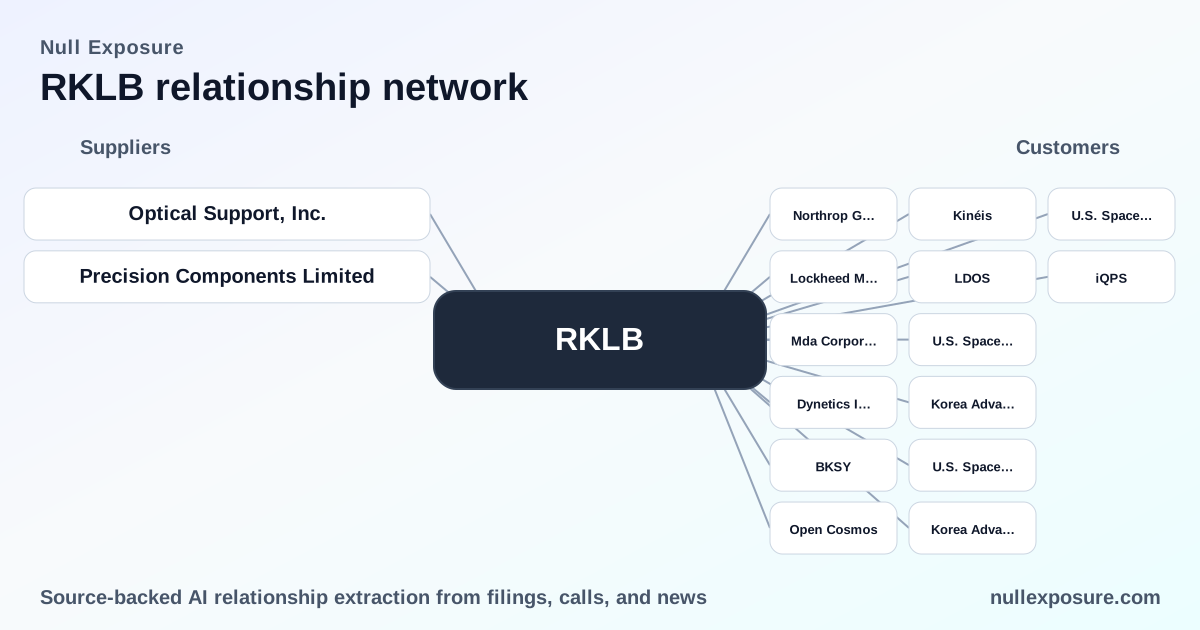
Rocket Lab (RKLB) — what its supplier footprint means for investors and operators
Rocket Lab is a vertically oriented small‑sat and launch systems company that monetizes through launch services (Electron), satellite platforms (Photon), integrated mission hardware, and growing defense contracts. Revenue derives from per-launch fees, integrated satellite sales and recurring mission services; strategic acquisitions of supplier firms fold capabilities in‑house to shorten delivery cycles and capture higher margins. For investors and procurement teams, the supplier map reveals a deliberate push toward control over optical and precision manufacturing capabilities, with direct implications for program risk and contract capture. For a deeper supplier risk view, visit https://nullexposure.com/.
The high-level supplier thesis: why Rocket Lab is buying its way toward vertical control
Rocket Lab’s recent supplier relationships and acquisitions show a pattern of integrating specialized subsystem providers into the corporate structure. The company is converting trusted external suppliers into internal capabilities to reduce procurement friction, accelerate qualification for defense work, and secure sensitive subsystems for space‑domain awareness and missile warning payloads. This strategy changes how investors should think about margins, CAPEX, and program delivery risk—moving from supplier management to operational integration.
Key takeaway: verticalization increases capture of downstream value but raises integration execution risk and capital intensity.
What the disclosed constraints say about operating posture and business model
Company-level disclosures provide explicit signals about Rocket Lab’s contracting and risk posture:
- Long‑term contracting posture: Company lease disclosures note a main office and production facility lease in Auckland through April 30, 2028, with renewal options—this is a company-level signal that installations and supply chains are planned on a multi‑year basis.
- Material supplier risk acknowledged: Risk language about natural disasters damaging supplier facilities is presented as a material business risk, indicating suppliers and facilities are critical to operations and that loss of supplier capacity would be consequential.
- Service provider relationships and security posture: The company engages third‑party assessors for penetration testing and industry‑standard framework evaluations, signaling an institutional approach to supplier and cyber risk management.
These constraints imply a maturing supplier management model: contracts are longer, core facilities and partners are treated as mission‑critical, and governance includes external security assessment. That combination supports stable program delivery but concentrates operational risk in key locations.
Supplier-by-supplier rundown
Optical Support, Inc. — acquisition strengthens national-security payload capability
Rocket Lab announced the acquisition of Optical Support, Inc., integrating OSI into Rocket Lab Optical Systems and citing extensive prior supplier relationships and trust with the OSI team. This formalizes a previously external, trusted supplier into an internal subsystem provider for defense and national security work. Source: Rocket Lab press release announcing the acquisition (March 10, 2026).
Precision Components Limited — New Zealand precision manufacturing brought in-house
During the Q4 2025 earnings call, Rocket Lab confirmed the acquisition of Precision Components Limited in New Zealand, describing the firm as a “known and trusted supplier” now part of Rocket Lab’s operations. This purchase signals consolidation of precision manufacturing capacity under Rocket Lab’s control. Source: Q4 2025 earnings call transcript (InsiderMonkey, reported March 2026).
Optical Support, Inc. — core role in space protection and tracking payloads
Rocket Lab has described Optical Support, Inc. technology as a key subsystem in payloads for space protection, space domain awareness, and missile warning and tracking defense applications—emphasizing the strategic, defense‑critical nature of the acquired capabilities. Source: Q4 2025 earnings call transcript (InsiderMonkey, reported March 2026).
What these relationships collectively reveal for investors and operators
The combined supplier actions form a coherent strategic move toward vertical integration of optical and precision subsystems. That has immediate operational implications:
- Criticality: Optical and precision suppliers now treated as core capabilities point to higher program criticality and dependence on internally managed facilities.
- Concentration: Physical footprint concentration—highlighted by a long Auckland lease—places supply continuity exposure in regional facilities; natural disaster language in disclosures elevates this as a material risk.
- Maturity: Acquiring established suppliers demonstrates an advanced procurement posture; Rocket Lab is moving from buyer to owner, which reduces external counterparty risk but increases integration and capital management demands.
- Contracting posture: Longer leases and acquisitions are consistent with multi‑year program delivery expectations, particularly in defense contracts where performance continuity and supply chain security are prerequisites.
Operational implication: Investors should model higher capital deployment and potential near‑term integration costs against longer‑term margin uplift and higher capture of defense contract value.
For a tailored supplier risk briefing or to compare RKLB supplier concentration across peers, see https://nullexposure.com/.
Risk posture, governance and what to watch next
Rocket Lab’s explicit engagement of third‑party assessors for penetration testing is a governance positive. It shows attention to cybersecurity and supply security—critical when subsystems are defense‑sensitive. Watch for the following near‑term indicators:
- Program integration timelines for OSI and Precision Components Limited, which will reveal execution risk and recurring cost patterns.
- Disclosures around facility hardening and business continuity planning for Auckland operations given the materiality of natural disaster risk.
- Margin reconciliation across launches and Photon platform sales as in-house manufacturing scales.
Red flag: Any delays in integrating suppliers into production workflows will compress near‑term margins and could affect delivery confidence on defense contracts.
Actionable conclusions for investors and partners
- Strategic investors: Reassess valuation drivers to reflect a tradeoff—short‑term integration and capex versus longer‑term higher margin and defensible market position in national‑security launches.
- Procurement and ops teams: Treat Optical Support and Precision Components as now‑internal capabilities; revise vendor management and continuity plans accordingly.
- Risk teams: Prioritize geographic risk mitigation and verify penetration‑testing and compliance evidence in upcoming filings and investor presentations.
For a deeper supplier risk report or to monitor RKLB’s evolving supplier footprint in real time, visit https://nullexposure.com/.
Final words: Rocket Lab’s supplier moves are deliberate and value‑accretive if integration proceeds on schedule. The company is converting supplier dependency into owned capability—an approach that expands addressable margins but concentrates program risk in a smaller set of critical assets. For hands‑on supplier and counterparty intelligence, check https://nullexposure.com/.