RKLZ: Who’s Behind the Fund and What That Means for Counterparties
Thesis: RKLZ is a leveraged short ETF product that monetizes through fund-level fees and trading activity, with revenue flowing to the sponsor and service providers via advisory fees, distribution arrangements, and spreads generated in secondary-market trading. The product’s economics are driven by sponsor fee capture, the adviser’s management arrangement, and the distribution channel that feeds liquidity — all of which determine counterparty exposure for suppliers and service partners. For a consolidated supplier-risk view, visit https://nullexposure.com/.
Market positioning and how money changes hands RKLZ is structured as a short, 2x daily leveraged ETF that profits its ecosystem through an expense structure and active trading demand. Sponsors collect sponsor/administration fees, advisers collect management fees, and distributors capture placement and servicing economics; market makers and exchanges internalize spread and flow. The product’s short, leveraged nature concentrates trading volume around rebalancing and market stress events, increasing operational sensitivity for custodians, distributors, and liquidity providers. Learn how these supplier linkages map to counterparty risk at https://nullexposure.com/.
Who the named relationships are and why they matter The public signal set identifies the key service providers and marketplace references tied to RKLZ. Below I cover every relationship in the available results with concise, sourced summaries.
-
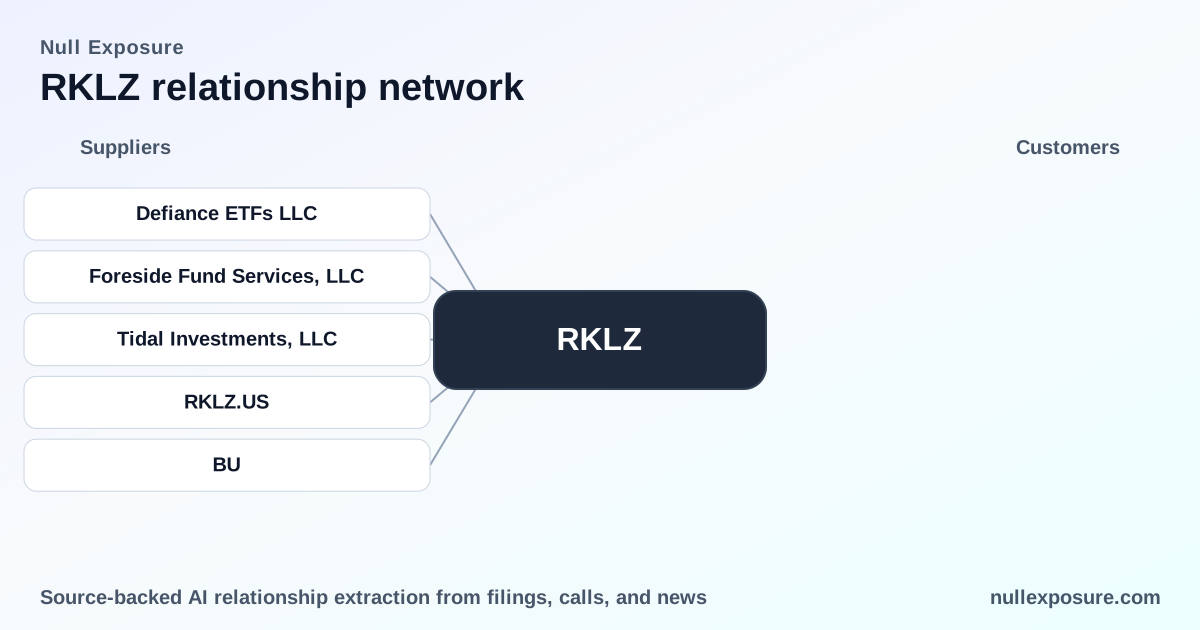
Defiance ETFs LLC — ETF sponsor and product originator. According to an ETFGI news release (Nov 2025), Defiance is the ETF sponsor that launched RKLZ as a 2x Short RKLB product, establishing primary responsibility for product design and fee structure. (Source: ETFGI, Nov 2025)
-
Foreside Fund Services, LLC — distributor / transfer agent role. The ETFGI report states the fund is distributed by Foreside, indicating Foreside handles sales support and fund distribution compliance functions that materially affect market access and intermediary relationships. (Source: ETFGI, Nov 2025)
-
Tidal Investments, LLC — investment adviser. ETFGI explicitly names Tidal as the fund’s investment adviser, placing it in charge of portfolio implementation, rebalancing mechanics, and the trading program that executes the fund’s leverage objective. This role is operationally critical for short/leveraged instruments. (Source: ETFGI, Nov 2025)
-
Defiance (market listing reference) — secondary market performance snapshot. A trade tracker reported RKLZ (RKLZ.US) dropped 20.22% with $38.79 million turnover, reflecting how concentrated flows and volatility drive secondary-market liquidity and counterparty exposure. (Source: Futunn, FY2025 / market tracker)
-
Defiance (market data listing) — tape / quote visibility. QuiverQuant lists RKLZ in real time under the Defiance family, showing the product is disseminated on market-data platforms and monitored by institutional data providers — a signal of active trading interest and distribution reach. (Source: QuiverQuant, FY2026)
Operating-model constraints and company-level signals The relationship footprint and source signal set deliver company-level constraints that shape supplier risk. No discrete contractual excerpts were provided in the dataset, so the following are company-level signals rather than relationship-specific contract statements.
-
Contracting posture: Standard fund-sponsor model with externalized advisory and distribution functions. The sponsor outsources portfolio management and distribution, which reduces in-house implementation risk but concentrates counterparty reliance on advisers and distributors for execution and market access.
-
Concentration: Moderate concentration across a few named service providers. The public references show a small number of core vendors (adviser + distributor) that, if disrupted, would materially affect the fund’s operations and distribution. This is a supplier-concentration risk for counterparties evaluating exposure.
-
Criticality: High operational criticality for the adviser and distributor. For a 2x short product, adviser-driven rebalancing and distributor-managed flows are core to daily NAV integrity and liquidity; custody, NAV calculation, and distribution are critical single points of failure from an operational perspective.
-
Maturity and product lifecycle: New product/launch-stage dynamics with high early trading volatility. The fund’s launch in late 2025 and reported high turnover indicate a lifecycle stage where flows are concentrated and operational rhythms are still stabilizing, elevating both fee capture opportunity and implementation risk.
Implications for investors and suppliers
-
Operational risk is elevated for custodians, prime brokers, and market-makers because leveraged short funds generate outsized rebalancing activity and stress-driven flows. Supplier contracts should embed robust SLAs, contingency plans, and liquidity-provision terms.
-
Counterparty concentration requires active monitoring. With a compact set of named service providers, counterparties should assess replacement difficulty, contractual exit protections, and reputational correlations to Defiance’s product slate.
-
Revenue is fee- and flow-driven, not stable yield. Monetization depends on trading volume and short-term demand; partners should price services to reflect episodic volumes rather than steady-state AUM assumptions.
Tactical next steps for business leaders
- Conduct legal and operational due diligence on advisory and distribution agreements to confirm fee waterfall mechanics, indemnities, and transition clauses.
- Stress-test liquidity provision models against the turnover levels reported at launch, and ensure margin and collateral frameworks account for sudden rebalancing.
- Monitor fund-level disclosures and market-data feeds for concentration shifts and abnormal turnover spikes.
For a supplier risk scorecard and deeper provider mapping, visit https://nullexposure.com/ and see how these relationships compare across similar leveraged products.
Final assessment and recommended posture RKLZ is a purpose-built, leveraged short ETF distributed by a compact set of professional service providers. Sponsor-led design plus outsourced advisory and distribution creates efficient fee capture but concentrates operational risk into a small set of counterparties. For investors and operators, the priority is contractual rigor with adviser and distributor partners, liquidity stress testing, and continuous monitoring of trading volumes and NAV mechanics.
To review RKLZ’s supplier links alongside peer funds and run a comparative counterparty analysis, go to https://nullexposure.com/.
Key takeaway: RKLZ’s economics deliver fee upside in volatile markets, but counterparties face heightened operational and concentration risk tied to the adviser/distributor ecosystem — contract terms and contingency capabilities will determine real exposure.