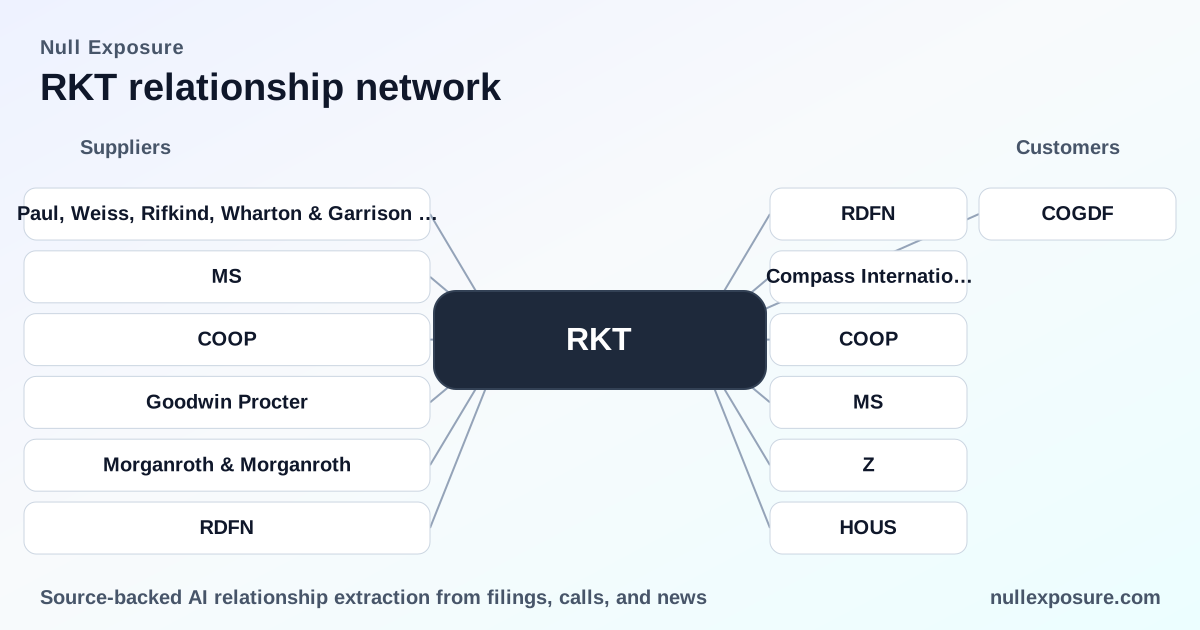
Rocket Companies (RKT): Supplier and advisor relationships that shape the next phase of growth
Rocket Companies operates as a technology-first mortgage and real-estate services platform that monetizes through origination fees, servicing revenue and the integration of adjacent e-commerce and home services; it funds origination pipelines with a mix of working capital and short-term funding facilities while expanding scale via strategic acquisitions. For investors and operators, the supplier map around RKT highlights a company that balances large-bank financing, adviser-led M&A, and an extensive third‑party services ecosystem—all of which determine execution risk and margin leverage. Learn more about how these relationships are tracked at Null Exposure: https://nullexposure.com/
How Rocket actually makes money and why supplier ties matter
Rocket generates revenue from mortgage origination and servicing, selling loans into secondary markets, and monetizing ancillary services. Capital and counterparties drive throughput: committed and uncommitted short-term funding facilities enable loan origination; external servicers, appraisers, and legal advisors enable scale and regulatory defense; and M&A activity (e.g., Redfin, Mr. Cooper) is used to acquire distribution, technology and servicing infrastructure. Public filings show revenue growth and mixed profitability metrics—revenue TTM roughly $7.07B, operating margin positive, but EPS negative, underscoring an emphasis on scale and platform integration over near-term earnings. For more supplier intelligence and relationship signals, visit https://nullexposure.com/
Supplier and adviser relationships observed (concise, sourced)
Below are every relationship surfaced in the collected signal set, with a short, plain-English summary and the source reference.
Paul, Weiss, Rifkind, Wharton & Garrison LLP
Paul, Weiss served as legal counsel to Rocket Companies in the Redfin acquisition, supporting the transaction alongside other advisors. A news article covering the Redfin deal referenced Paul, Weiss’s role in FY2025 (reported March 2026 on OnlineMarketplaces). Source: OnlineMarketplaces report on the $1.8B Redfin acquisition (March 2026).
Morgan Stanley & Co. LLC
Morgan Stanley acted as financial advisor to Rocket Companies on the Redfin acquisition, a material strategic transaction that expands Rocket’s consumer-facing footprint. This was reported in the same OnlineMarketplaces article detailing advisors to the transaction (March 2026).
Mr. Cooper
Rocket announced acquisition activity including Mr. Cooper during the 2025 Q4 earnings call; management stated “We acquired Redfin, we acquired Mr. Cooper,” indicating integration of Mr. Cooper’s servicing capabilities into Rocket’s operations (2025 Q4 earnings call, March 2026).
Redfin
Management explicitly confirmed the acquisition of Redfin during the 2025 Q4 earnings call, positioning Redfin as an owned brand and channel within Rocket’s consumer and brokerage strategy (2025 Q4 earnings call, March 2026). The Redfin purchase was also described in the acquisition press coverage (OnlineMarketplaces, March 2026).
Mr. Cooper Group Inc.
News coverage in FY2025 characterized the Mr. Cooper deal as enabling Rocket to integrate Mr. Cooper’s servicing platform into its operations, highlighting the strategic rationale for the acquisition and expected operational synergies (TradingView coverage, March 2026).
Goodwin Procter
Goodwin Procter is representing Rocket Mortgage in litigation against the U.S. Department of Housing and Urban Development, serving as outside counsel for the company in FY2026 as disclosed in a Rocket Companies press release (Rocket Companies press release, March 2026).
Morganroth & Morganroth
Michigan-based Morganroth & Morganroth is co-counsel with Goodwin Procter in Rocket Mortgage’s suit against HUD, named in the company’s FY2026 press materials as the local legal representative handling the case (Rocket Companies press release, March 2026).
What the relationship map tells investors about operating posture
The relationships above reveal a multi-dimensional supplier model:
- Contracting posture: short-term funding and adviser-driven transactions. Public statements and disclosures explain that Rocket relies on short-term committed and uncommitted funding facilities to originate loans, and the company’s historical RHI line of credit (maturing July 27, 2025) is cited in filings as an example of such short-term facilities. This underscores a funding model that prioritizes liquidity agility over long-term bank financing.
- Counterparty concentration toward large enterprises. Rocket’s disclosure that it sources financing “primarily through committed and uncommitted funding facilities… established with large global banks” indicates high counterparty concentration among large institutional lenders, which concentrates execution and counterparty risk.
- Service-provider criticality and scale. Multiple evidence excerpts highlight Rocket’s use of third-party appraisers, vendors, and a formal Vendor Risk Management Program—signaling that external service providers are operationally critical and subject to ongoing security and compliance oversight.
- Maturity and spend profile consistent with mid‑to‑large vendor engagements. Spend excerpts referencing recurring related-party expenses and affiliate payables/receivables at six‑figure to low‑seven‑figure annual levels point to meaningful but not outsized vendor spend (roughly $10M–$100M bands)—large enough to be material for operations, but not at monopoly scale.
These observations are company-level signals derived from filings and press disclosures rather than tied to any single supplier unless explicitly named.
Risk and opportunity implications for investors and operators
- Integration execution is the near-term value lever. The Redfin and Mr. Cooper acquisitions are structural: integrating a brokerage channel and a large servicing platform can drive higher margins through cross-sell and reduced third-party servicing costs. Morgan Stanley’s advisory role and Paul, Weiss’s legal support illustrate a deliberate, advisor-driven M&A program.
- Legal and regulatory exposure is active. Rocket Mortgage’s suit against HUD, with Goodwin Procter and Morganroth & Morganroth on the roster, increases legal spend and regulatory focus—this is a governance and reputational vector investors must track.
- Funding dependency is a double-edged sword. Reliance on short-term facilities and large-bank counterparties enables rapid origination growth but raises refinancing and liquidity risk in stressed markets; continued access to committed facilities will be essential to maintain origination volumes.
- Vendor management is operationally pivotal. Appraisal workflows, third‑party servicing agreements, and vendor security controls are core to throughput and regulatory compliance—weaknesses here would directly affect margins and regulatory standing.
For more granular supplier intelligence and to monitor how these relationships evolve, explore Null Exposure’s research tools: https://nullexposure.com/
Bottom line
Rocket is executing a growth-through-acquisition strategy while operating a funding model that depends on short-term capital and large institutional counterparties. Key suppliers and advisers—investment banks, national law firms, and servicing platforms—are central to execution and risk management. For investors, the thesis centers on successful integration of Redfin and Mr. Cooper, stable access to funding, and disciplined vendor governance; disruptions in any of these areas will affect throughput and margins. If you want ongoing tracking of these supplier linkages and how they affect credit and execution risk, start on our homepage: https://nullexposure.com/