Relay Therapeutics (RLAY) — supplier footprint and what investors should price in
Relay Therapeutics operates as a clinical‑stage precision drug company that monetizes its science through partnerships, milestone/licensing economics and, eventually, product commercialization. Today the firm generates limited revenue (Revenue TTM roughly $15.4M) while investing heavily in R&D and relying on third‑party partners to execute clinical development and manufacturing. For investors and operators evaluating supplier relationships, the critical lens is concentration and operational dependency: Relay outsources core functions that are essential to timelines and value realization.
Read more company supplier intelligence at https://nullexposure.com/.
How Relay’s operating model forces supplier reliance
Relay is structured to be asset‑light on manufacturing and heavily networked for research and clinical execution. The company does not own manufacturing facilities and contracts with contract research organizations (CROs), contract manufacturing organizations (CMOs), contract laboratories and medical institutions to run preclinical studies, clinical trials, and production activities. That operating posture means Relay’s value creation is tightly coupled to the performance and continuity of its external suppliers.
Two commercial realities follow directly from that posture:
- Concentration risk is intrinsic. The company relies on a small number of suppliers for APIs, starting materials and critical testing; interruption from a single supplier can delay programs and erode market value.
- Contractual horizons and real estate commitments reduce optionality. Relay holds long‑term leases for its lab and office space—this anchors operational scale but also fixes operating cost and location risk.
According to a company filing, Relay occupies significant leased lab space with lease expirations extending to April 30, 2029 and June 30, 2032, and options to extend under preset terms. That lease profile signals longer‑dated fixed costs and a commitment to maintaining in‑house discovery and labs while outsourcing manufacturing.
Constraints that drive supplier risk and what they mean for investors
Relay’s supplier constraints are not theoretical; they are explicit in public disclosures and shape contract negotiation leverage and program timelines.
- Long‑term contracting posture (company level signal). The disclosed lease expirations through 2029 and 2032 demonstrate a multi‑year operating commitment to Cambridge facilities that supports ongoing R&D but reduces flexibility to downsize or relocate quickly. This is a company‑level signal about strategic permanence and cost structure.
- Critical materiality for inputs. Relay states that APIs, drug products and starting materials are supplied primarily from single‑source suppliers; the company explicitly warns that failure by a supplier could “impede, delay, limit or prevent” development efforts. That language identifies supplier failure as a route to program stoppage and valuation impairment.
- Role concentration: manufacturer and service provider dependency. Relay confirms it will continue to rely on third parties for both manufacturing (CMOs) and clinical services (CROs, clinical investigators, contract labs). This creates two linked exposures: supply chain continuity for drug substance and operational execution risk for trials.
Each of these constraints is a signal investors can monitor through filings, supplier announcements, and milestone updates: the existence of single‑source supply, the roster of CMOs/CROs engaged, and any changes to lease terms or facility footprints.
The supplier relationship universe you need to track (one name)
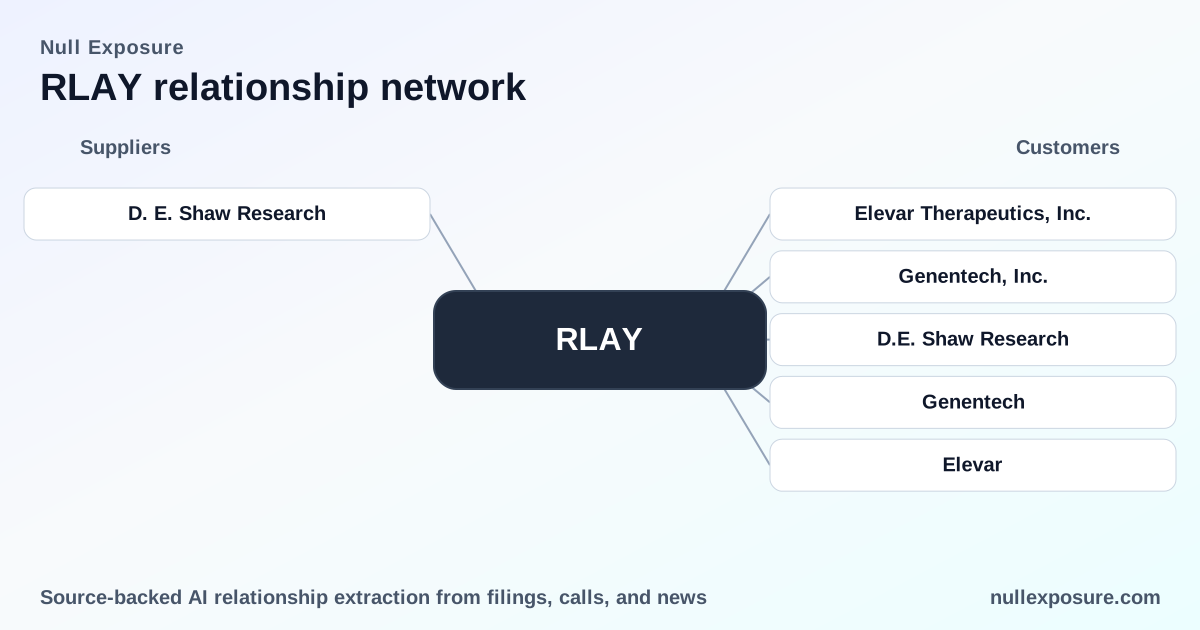
Relay’s public supplier relationship set in the reviewed results includes D. E. Shaw Research.
- D. E. Shaw Research: Relay leverages advanced computational modeling capabilities from D. E. Shaw Research to accelerate structure‑based design and candidate selection; a DirectorstalkInterviews article noted this collaboration and positioned it as part of Relay’s competitive tech stack (March 10, 2026). Source: DirectorstalkInterviews, March 10, 2026.
This single‑relationship entry in the results highlights a strategic partnership in discovery technology rather than a manufacturing or supply chain tie. Investors should treat computational partners differently from CMOs/CROs: computational collaborations accelerate candidate identification but do not insulate the company from downstream manufacturing or API supply risks.
What this combination of relationships and constraints means for risk/reward
Relay’s supplier posture creates a clear set of investor implications:
- Operational leverage to external timelines. Clinical progress, and therefore value unlocks, are contingent on the performance of CROs and CMOs. Missed batch deliveries or testing delays translate directly into delayed milestones and cash consumption.
- High single‑event risk. Single‑source APIs convert technical supplier incidents into program‑level crises. That elevates the event risk premium that should be applied when discounting Relay’s pipeline‑linked valuation.
- Strategic upside from computational partners, limited mitigation for manufacturing risk. Partnerships like D. E. Shaw Research materially improve discovery productivity and candidate quality; however, computational advantage does not reduce the company’s exposure to manufacturing and third‑party supply shocks.
Put simply: technology partnerships accelerate the top of the funnel; supplier concentration threatens the bottom line and timelines. Investors should price a premium for discovery differentiation and a discount for outsized single‑supplier exposure.
Read more supplier analysis and monitor updates at https://nullexposure.com/.
Practical monitoring checklist for investors and operators
To translate these observations into action, track the following signals quarterly:
- Filings and 8‑K/10‑Q disclosures for any changes to single‑source suppliers or new multiline sourcing agreements.
- Announcements of CMO/CRO engagements and their geographic footprints (redundancy across vendors reduces risk).
- Any amendments to long‑term lease commitments that signal scaling back or acceleration of in‑house lab activity.
- Milestone schedules tied to supplier deliverables (API batch dates, stability testing, and lot release).
Key operating metric to watch: number of suppliers categorized as single‑source for each program and any contingency plans documented around them.
Bottom line and recommended investor actions
Relay Therapeutics combines a powerful discovery engine with a materially outsourced execution model. Investors should value the computational partnerships—like D. E. Shaw Research—for their potential to raise program probability of success—while simultaneously applying a concentrated‑supplier haircut to near‑term program valuations. Continuous monitoring of CMO/CRO relationships, supplier redundancy plans, and lease amendments will be decisive for tracking downside risk.
For a concise supplier intelligence briefing and ongoing alerts on Relay’s partner and supplier changes, visit https://nullexposure.com/. For institutional access to our supplier risk dashboards and relationship mapping, see https://nullexposure.com/.