Radiant Logistics (RLGT): Supplier Relationships, Risks, and Where Value Lives
Radiant Logistics operates as a third‑party logistics (3PL) intermediary that purchases multimodal transportation from asset-based carriers and resells those services to shippers. The company monetizes by capturing gross margin between purchased carrier capacity and customer billing, plus fees from ancillary logistics services across truckload, intermodal, air and ocean, and managed logistics contracts. Investors should value Radiant on its gross profit per shipment, carrier network leverage, and margin sustainability rather than pure asset ownership. For more supplier-focused intelligence, visit https://nullexposure.com/.
Business model in plain language: how revenue flows and where the leverage is
Radiant converts carrier access into recurring revenue by acting as a reseller and coordinator of freight services. Key financial anchors: trailing twelve‑month revenue of $893M, gross profit of $155M, EBITDA roughly $32.4M, and a market capitalization near $326M (latest reporting). The company’s low capital intensity and reliance on third‑party carriers produce operating leverage when volumes normalize, while profit margins compress in periods of carrier cost pass‑through or spot market volatility. Radiant’s contracting posture is that of a service provider that transacts with many asset carriers and resells to customers, which makes carrier access and pricing the primary operational variable rather than fleet ownership.
Direct supplier relationships found in public records and news
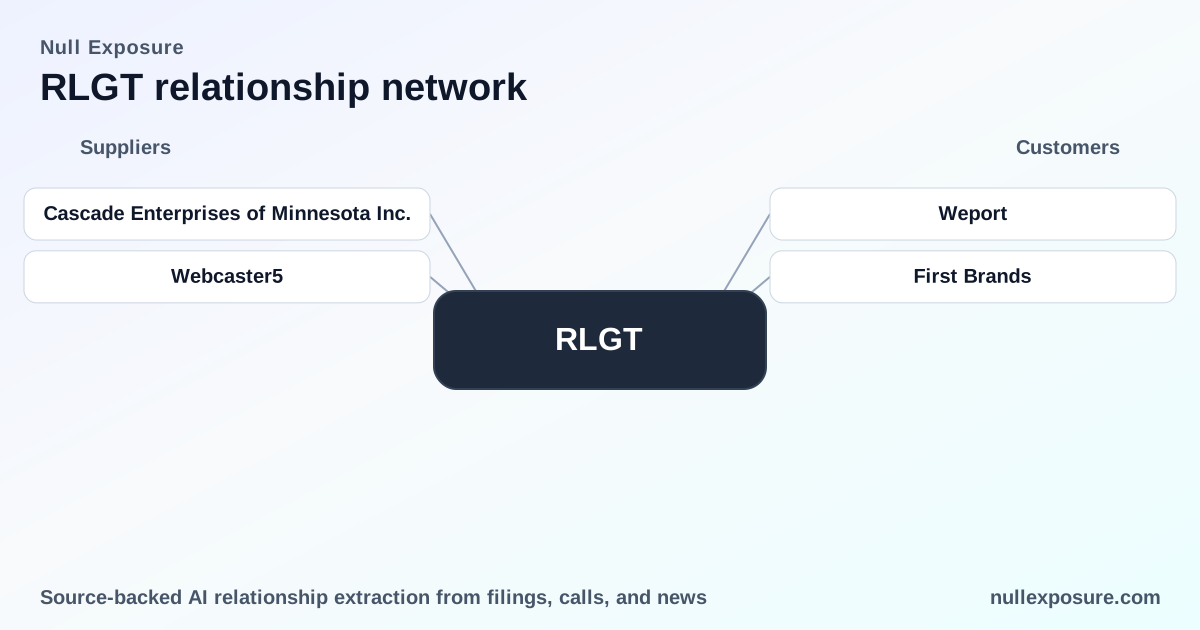
The records returned for supplier scope contain two specific relationships. Each is summarized below with source context.
Cascade Enterprises of Minnesota Inc.
Radiant acquired Cascade Enterprises of Minnesota Inc., an operating partner that had run under Radiant’s Airgroup brand for 15 years, folding a long‑standing strategic operator into Radiant’s platform. This transaction consolidates an existing operating partner and reinforces Radiant’s strategy of acquiring complementary carriers and brokers to deepen service coverage. Source: Tank Transport report on Radiant’s acquisition (Oct 2022) — https://tanktransport.com/2022/10/radiant-acquires-cascade-enterprises/.
Webcaster5 (webcast host)
Radiant used Webcaster5 as the third‑party webcast platform for investor calls, and the company’s investor call notices reference access through Webcaster5, indicating utilization of external event hosting services for investor communications. Source: Yahoo Finance investor notice referencing the Radiant webcast via Webcaster5 (FY2025) — https://finance.yahoo.com/news/radiant-logistics-host-investor-call-210500468.html.
What the relationship list implies for operators and investors
Both records are operationally modest but strategically informative. The Cascade acquisition signals an accretive roll‑up approach to scale operating partners and capture incremental margin through consolidation. The Webcaster5 reference is an administrative detail confirming Radiant’s use of external service providers for investor relations rather than an owned IR platform. Together these relationships illustrate a company that expands capability through acquisitions and outsources noncore services.
For deeper supplier intelligence or comparative supplier mapping, visit https://nullexposure.com/.
Constraints and what they reveal about Radiant’s operating posture
Public evidence categorizes Radiant’s supplier relationships under a service_provider role. This is a company‑level signal that provides several actionable characteristics for underwriting and operations:
- Contracting posture: Radiant operates as a reseller and coordinator; contracts are primarily commercial purchasing arrangements with carriers rather than capital leases or long‑term asset commitments. That posture reduces fixed cost but increases exposure to spot market pricing.
- Concentration: The business model distributes execution across a broad carrier network, which lowers single‑counterparty concentration risk but raises operational dependence on carrier availability and pricing discipline.
- Criticality: Carrier relationships are mission‑critical for revenue generation—loss of key carrier access in a lane or modality can immediately compress margins and service reliability.
- Maturity: The firm’s mix of organic service and bolt‑on acquisitions (e.g., Cascade) highlights a maturing roll‑up strategy; this enhances scale but requires disciplined integration to preserve gross margin.
These constraints are company‑level observations derived from Radiant’s described operating model and should be used to stress test contracts, payment terms, and contingency plans.
Financial context and single‑page risk assessment
Radiant’s valuation and operating metrics give a clear lens on supplier risk sensitivity:
- Revenue exposure: $893M TTM revenue concentrated in freight brokerage and logistics services makes gross margin a direct function of carrier cost pass‑through and freight demand cycles.
- Profitability: Operating margin is thin (operating margin TTM ~3.18%); small shifts in carrier pricing or customer mix impact EPS quickly. This magnifies supplier pricing risk.
- Balance of power: With over 50% institutional ownership and near 24% insider ownership, governance and strategic direction are stable enough to pursue acquisition roll‑ups, but integration execution is the main operational risk.
Investment takeaway: Radiant’s stock is effectively a play on execution of its carrier arbitrage model and M&A integration discipline; supplier contracts and carrier network stability are the lever points for margin expansion.
Practical implications for counterparties and investors
For suppliers and buyers negotiating with Radiant:
- Negotiate clear payment terms and dispute resolution conditioned on lane performance; Radiant’s reseller model makes timely settlement essential to preserve cash flow.
- For investors, track acquisition cadence and post‑close synergies: acquisitions like Cascade materially change route density and carrier leverage if integrated successfully.
- Monitor spot freight indices and carrier rate announcements because they translate directly into Radiant’s gross profit volatility.
Conclusion: what to watch and next steps
Radiant is a service‑oriented 3PL that monetizes carrier access and logistics orchestration rather than asset ownership. The company’s supplier footprint is built from operating partners it acquires and a broad carrier network that delivers execution flexibility at the expense of exposure to carrier pricing cycles. Investors and counterparties should prioritize monitoring carrier contracts, integration outcomes, and margin per shipment as the most predictive indicators of value creation.
For continued supplier and counterparty intelligence on Radiant and comparable logistics firms, explore our platform: https://nullexposure.com/.
Actionable next steps: review Radiant’s next quarterly commentary for integration updates, and benchmark freight rate trends against Radiant’s gross margin to model upside/downside scenarios. For immediate supplier mapping and risk scoring, visit https://nullexposure.com/.