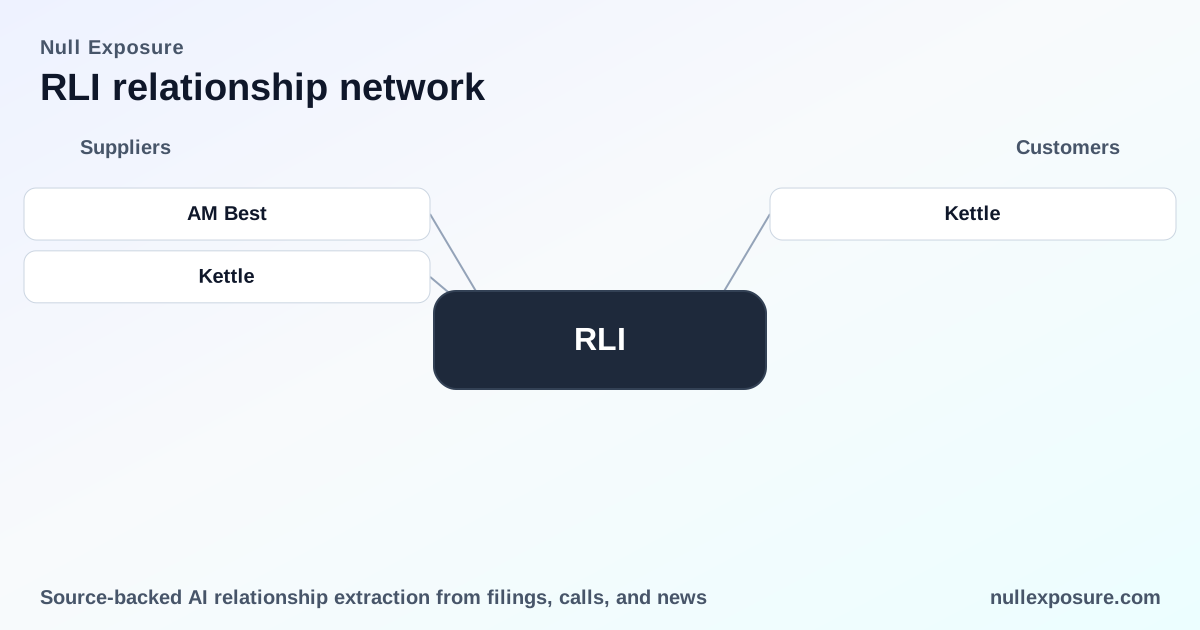
RLI Corp: supplier relationships that shape underwriting leverage and risk transfer
RLI Corp is a specialty property & casualty insurer that monetizes through underwriting margin and investment income, selling niche commercial property and specialty lines and selectively transferring peak catastrophe risk via reinsurance and strategic partnerships. The firm’s capital strength and underwriting discipline — reflected in solid margins, strong ROE and a modest P/E — underpin its ability to price hard-to-place risks and to form bespoke supplier arrangements that affect loss volatility and growth prospects. For investors evaluating supplier exposure, the most consequential recent developments are an AM Best credit upgrade and a commercial partnership with AI-enabled underwriter Kettle that expands wildfire and multi-peril product capability. Learn more about how these relationships change the risk profile at the company homepage: https://nullexposure.com/
What the news flow actually documents (each relationship, plainly)
AM Best — credit upgrade (FY2026). AM Best raised RLI Group’s Financial Strength Rating to A++ and Long-Term Issuer Credit Rating to aa+ in March 2026, reinforcing the group’s balance-sheet strength and counterparty standing with cedants and brokers. According to a reporting item dated March 10, 2026, this upgrade signals enhanced credit support for RLI’s reinsurance and market-facing counterparties. (AI Journ, Mar 10, 2026: https://aijourn.com/am-best-upgrades-credit-ratings-for-rli-corp-and-its-subsidiaries/)
Kettle — parametric wildfire component (Bermuda Reinsurance Magazine, FY2026). Kettle announced a partnership with RLI to roll out a parametric wildfire cover embedded in a multi-peril commercial property solution, combining Kettle’s catastrophe models with RLI’s distribution and underwriting capacity. The Bermuda Reinsurance Magazine article highlighted the joint product and the operational pairing of AI-driven modeling with RLI’s financial strength. (Bermuda Reinsurance Magazine, Mar 2026: https://www.bermudareinsurancemagazine.com/kettle-partners-with-rli-to-roll-out-parametric-wildfire-cover)
Kettle — strategic product launch (Carrier Management, Feb 23, 2026). Carrier Management reported that RLI and Kettle launched a multi-peril commercial property product including wildfire coverage targeted at regions where coverage has tightened, noting this as a deliberate move into difficult-to-place commercial risks. The story frames the relationship as distribution plus model-enabled underwriting for challenging geographies. (Carrier Management, Feb 23, 2026: https://www.carriermanagement.com/news/2026/02/23/284893.htm)
Kettle — international re/insurance trade press coverage (Reinsurance News, FY2026). Reinsurance-focused outlets similarly documented the Kettle partnership as a market-facing product collaboration between an AI-enabled underwriter and a U.S. specialty insurer, underlining the joint go-to-market emphasis rather than a pure capital-transfer arrangement. (Reinsurance News, Mar 2026: https://www.reinsurancene.ws/kettle-and-rli-launch-new-multi-peril-commercial-property-insurance-product/)
Why these supplier links matter to RLI’s business model
These relationships illustrate two complementary dynamics in RLI’s operating model:
-
Balance-sheet credibility and counterparty confidence. The AM Best upgrade to A++ / aa+ is an explicit signal that RLI’s capital and reserving profile support higher-tier counterparty interactions, which eases the company’s ability to place reinsurance and to underwrite risk through broker channels. RLI’s financials — roughly $1.88B trailing revenue, ~21% profit margin, ~24% ROE, and a market cap above $5.6B — back this posture.
-
Product innovation through third-party capability rather than pure capital substitution. The Kettle partnership demonstrates RLI’s willingness to buy specialist modelling and distribution capability to expand underwriting into wildfire-exposed commercial property, rather than simply buying quota share capacity. That positions RLI to capture higher-margin niche business while keeping underwriting control.
These strategic relationships operate against observable company-level supplier constraints: the firm engages in short-term reinsurance renewals (evidence shows a large portion of reinsurance placements renewed January 1, 2025 with risk-adjusted rate changes down 10–20% in property treaties) and functions as a purchaser of reinsurance services (ceded amounts and recoverables are reported as assets and RLI remains liable to policyholders). Those constraints indicate a contracting posture that is renewal-driven and sensitive to pricing cycles, and a supplier role that is service-oriented rather than equity-based.
Explore how these supplier dynamics affect investment positioning at the RLI profile page: https://nullexposure.com/
Operational implications and risk vectors
-
Short-term contracting increases earnings volatility but preserves flexibility. Renewing property treaties annually creates exposure to pricing cycles — the 2025 renewal showed meaningful rate softening in higher layers — but it allows RLI to recalibrate retentions and limits each year to market conditions.
-
Reinsurance remains a mitigant, not an eliminator, of liability. RLI’s accounting practice of reporting ceded unearned premiums and recoverables separately emphasizes that the company retains ultimate policyholder obligation, so reinsurer counterparty strength and timely recoveries remain economically critical despite ceded protections.
-
Strategic partnerships shift loss-source composition. The Kettle arrangement introduces parametric components that can speed claims settlement and limit basis risk if calibrated correctly, but it also requires robust underwriting discipline and data integration to avoid unintended correlation with retained layers.
-
Credit upgrade reduces counterparty friction. The AM Best upgrade lowers perceived counterparty risk, enabling more favorable reinsurance access and possibly better treaty terms, which reduces one key tail risk in the supplier chain.
Investor takeaways and recommended monitoring
-
Positive: AM Best upgrade strengthens RLI’s counterparty profile and supports expansion into specialty products. Track reinsurance treaty terms and whether improved ratings translate into improved pricing or capacity in upcoming renewals.
-
Watch: reinsurance renewal cycles and rate trends. The company’s short-term contracting posture means underwriting volatility tracks annual market pricing; monitor the January reinsurance renewals and rate-on-line trends for property cat layers.
-
Opportunity: product partnerships like Kettle can expand addressable markets. Assess actual premium scale and loss experience from the Kettle launch to see whether this is an earnings lever or a boutique program.
-
Capital dynamics: earnings resilience vs. growth trade-off. RLI’s strong ROE and solid profit margin allow for selective underwriting growth; monitor combined ratio trends and ceded recovery performance.
For investors who want ongoing, structured insight into RLI’s supplier exposures and how counterparties affect underwriting risk, visit our research hub: https://nullexposure.com/
Final assessment
RLI’s supplier relationships in early 2026 reflect a balanced playbook: shore up balance-sheet credibility (AM Best upgrade) while extending product reach through strategic partners (Kettle), all within a short-term, renewal-driven reinsurance posture that preserves underwriting control. That combination supports stable returns in favorable cycles but requires active monitoring of treaty renewals and partner program performance to ensure growth does not dilute underwriting quality.
If you’re tracking specialty insurers and counterparty dynamics, our site curates these relationship signals and interprets their investor implications: https://nullexposure.com/