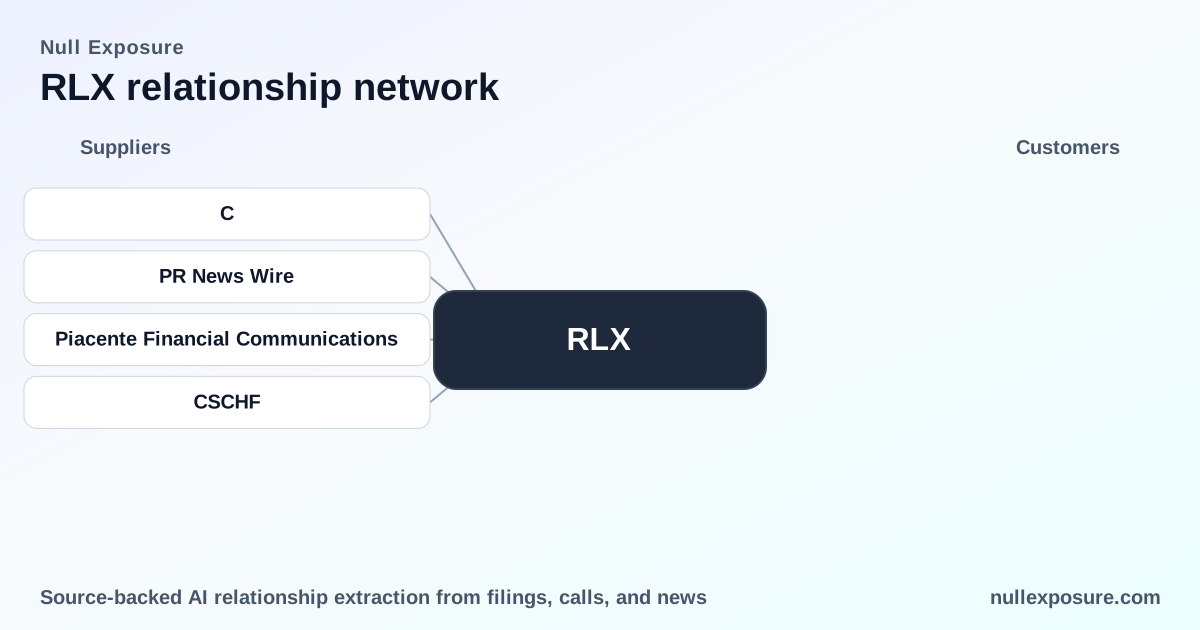
RLX Technology: Supplier and Capital-Relationship Map for Investors and Operators
Thesis: RLX Technology sells e‑vapor hardware and consumables in mainland China and monetizes through product sales and aftermarket consumables, supported by a public listing that channels capital and investor communications into the business. Understanding RLX’s supplier and capital‑market relationships clarifies where operational risk, reputational exposure, and contracting leverage concentrate — essential for investors and vendor managers evaluating counterparty risk and strategic sourcing. Learn more at https://nullexposure.com/.
How RLX runs the business and where cash flows come from
RLX manufactures, distributes, and sells e‑vapor products across the People’s Republic of China and recognizes revenue principally from device and consumable sales. Public filings show FY trailing revenue of roughly $3.62b and a gross profit margin near 33%, while the company is operating at scale with positive operating income and an EBITDA run‑rate that supports reinvestment and investor distributions. The NYSE listing provides access to capital and increases transparency, but also brings scrutiny on vendor selection and investor communications. For quick access to supplier intelligence, visit https://nullexposure.com/.
Supplier and capital‑market relationships that matter
Below I list each relationship captured in the supplier scope and explain the business relevance in plain English.
Citigroup Inc.
Citigroup served as a joint bookrunner on RLX’s NYSE offering, a capital‑markets role that provided underwriting, distribution, and institutional placement support for RLX’s public listing (Caixin, Jan 25, 2021): https://www.caixinglobal.com/2021-01-25/shares-in-e-cigarette-maker-rlx-surge-on-new-york-debut-101655558.html.
This relationship signals RLX’s use of major global banks for capital formation and distribution channels.
China Renaissance
China Renaissance co‑bookran RLX’s New York listing alongside Citigroup, performing a similar underwriting and placement function targeted at institutional investors (Caixin, Jan 25, 2021): https://www.caixinglobal.com/2021-01-25/shares-in-e-cigarette-maker-rlx-surge-on-new-york-debut-101655558.html.
The engagement with a China‑focused boutique underwriter underscores RLX’s need for on‑the‑ground capital markets expertise and local investor access.
PR News Wire
RLX distributes financial and operational results through PR News Wire services, using that channel to publish earnings materials and disclosures to the market (earnings transcript posted on InsiderMonkey, Q3 FY2025): https://www.insidermonkey.com/blog/rlx-technology-inc-nyserlx-q3-2025-earnings-call-transcript-1646055/.
Third‑party press distribution is a standard, centralized communications layer that vendors supporting IR and disclosure processes must satisfy.
Piacente Financial Communications
RLX directs investor contacts and some investor relations coordination through Piacente Financial Communications as part of its investor outreach and communications stack (Q3 FY2025 earnings transcript, InsiderMonkey): https://www.insidermonkey.com/blog/rlx-technology-inc-nyserlx-q3-2025-earnings-call-transcript-1646055/.
This indicates RLX uses retained external IR consultants for investor engagement and shareholder communications.
Constraints and company‑level procurement signals
There were no supplier constraints captured in the scope for RLX (no explicit contractual limits, exclusivity clauses, or supply covenants surfaced). Absent constraint excerpts, treat the following as company‑level operational signals rather than relationship‑specific findings:
- Contracting posture: RLX is a publicly listed company that used global and local underwriters during its listing, indicating a formal, compliance‑oriented contracting approach for capital‑market vendors and PR/IR partners.
- Concentration and control: Ownership metrics show a high insider percentage, which translates to centralized decision‑making and potentially rapid approval cycles for strategic vendor engagements; this is a corporate‑level signal rather than a supplier detail.
- Criticality and maturity: The company’s trailing revenue (
$3.62b), positive EBITDA ($369m), and strong quarterly revenue growth indicate suppliers supporting manufacturing, packaging, and distribution are operationally critical given scale and growth velocity. - Procurement maturity: Use of specialist IR and press‑distribution vendors suggests RLX engages external agencies for regulated communications, while capital formation was executed through established investment banks — a mix of outsourced specialist services and sophisticated bank engagements.
What these relationships mean for investors and supplier managers
- Capital markets partners (Citigroup, China Renaissance) are not recurring operational suppliers but are critical to liquidity and valuation events. Bank selection affects investor access, pricing, and the credibility of capital raises; vendor diligence should include reputational and regulatory assessments of underwriting partners.
- Communications layer (PR News Wire, Piacente) is a strategic control point for market narratives. Reliable distribution and IR response protocols reduce information‑risk and legal exposure; ensure contracts include SLAs, confidentiality, and escalation paths.
- High insider ownership and strong revenue growth create both agility and concentration risk. Operational decisions can be implemented quickly, but vendor dependency or single‑sourcing for critical inputs would translate into material execution risk given the company’s scale.
Operational risk checklist for counterparties
- Confirm underwriting and placement history when advising on future capital raises; bank selection drives syndicate reach and institutional demand.
- Ensure PR/IR vendors comply with cross‑border disclosure standards used by a NYSE‑listed issuer.
- For manufacturing or logistics vendors, prioritize redundancy and capacity planning to align with RLX’s revenue growth trajectory and market coverage.
For a deeper view into supplier exposures and how they connect to valuation and operational risk, visit https://nullexposure.com/.
Bottom line: concentrated capital‑market ties, outsourced investor communications, and operational scale
RLX combines rapid growth, public‑market discipline, and a mix of global and local vendors to support capital formation and investor communication. Bank relationships played the central role in the company’s NYSE listing, while retained IR and press distribution firms handle ongoing disclosure and outreach. There are no captured supplier constraints in this scope, so counterparty diligence should focus on vendor criticality, contractual terms, and regulatory compliance rather than disclosed supply covenants. Explore supplier intelligence and next steps at https://nullexposure.com/.
Key takeaway: investors and procurement teams should treat capital‑market partners and communications vendors as strategic risk nodes — they influence liquidity, market perception, and regulatory exposure more than routine operational suppliers in the information captured here.