Rallybio (RLYB): Supplier relationships that matter for investors
Rallybio is a clinical-stage biotech that monetizes primarily through in-licensing, clinical development, and eventual commercialization or partnering of biologic assets. The company acquires or licenses therapeutic candidates, advances them through clinical stages, and plans to convert development value into revenue via milestone payments, royalties and direct product sales or strategic exits. For investors evaluating counterparty exposure and operational resilience, focus on contractual reach (licenses and acquisitions), dependence on third‑party manufacturing and CROs, and market-access or exchange relationships that affect corporate liquidity and listing status. Learn more at https://nullexposure.com/.
Quick operational snapshot investors need
Rallybio is small but active: market capitalization roughly $49.8M, trailing twelve‑month revenue under $1M, and persistent operating losses (negative EBITDA and EPS). The company’s model is license-and-develop rather than vertically integrated manufacturing—Rallybio relies on third parties for critical functions such as drug substance manufacturing and clinical trial execution. That structure drives a predictable set of supplier counterparty types: licensors, CROs, contract manufacturers, transfer agents and the exchanges that govern listing status.
Supplier relationships pulled from recent records
-
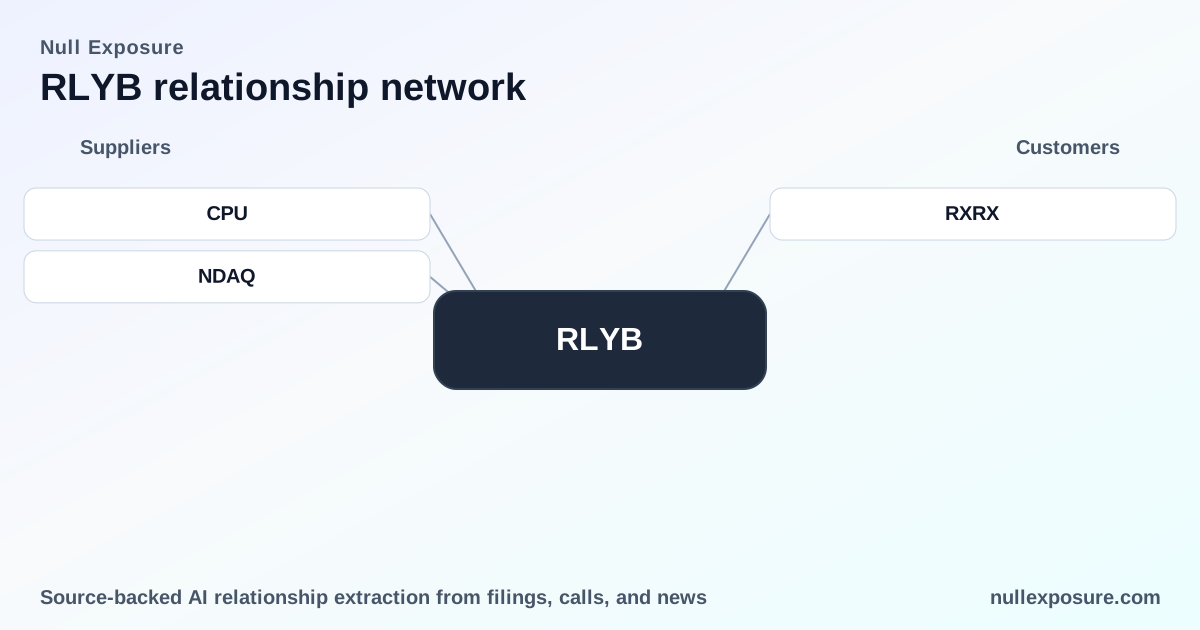
Computershare Trust Company, N.A.: Computershare is acting as exchange agent and transfer agent for Rallybio’s 1-for-8 reverse stock split, a corporate action intended to regain Nasdaq compliance. An RTTNews item dated March 10, 2026 described Computershare’s role in the reverse split process.
Source: RTTNews report, March 10, 2026. -
Nasdaq: Nasdaq approved Rallybio’s transfer to the Nasdaq Capital Market and extended the company’s compliance timetable, buying an additional 180 days after Rallybio missed an initial August 25, 2025 deadline. This regulatory/market relationship directly affects the company’s listing status and liquidity.
Source: RTTNews report, March 10, 2026.
What those supplier links mean in practical terms
Computershare’s participation is operationally critical for corporate actions: transfer agents ensure the legal and mechanical execution of splits, which in this case is being used to address listing compliance and shareholder recordkeeping. Nasdaq’s involvement is governance‑level pressure—transfer to a different market tier and extensions of compliance windows create both runway and signaling risk for equity holders. Both relationships are not revenue drivers but are material to corporate continuity, shareholder liquidity and financing options.
Explore structured supplier intelligence at https://nullexposure.com/ to track similar counterparty dynamics.
Contracting posture, concentration and maturity — company-level signals
-
Licensing is central to the business model. Company filings indicate Rallybio in‑licensed Affibody platform technology (the PLA) to develop RLYB116 and RLYB114, establishing a pattern where Rallybio acquires or licenses core biologic rights rather than building them internally. That creates dependence on licensors for pipeline access and on licensing terms for upside sharing and exclusivity.
Source: company licensing disclosures (PLA). -
Sanofi relationship is a named license pathway. Filings state that under a Sanofi License Agreement, Sanofi provided Rallybio IPE with worldwide exclusive rights to KY1066 (now RLYB331), confirming that Rallybio engages in large‑enterprise licensing arrangements as a licensee for late‑stage assets. This is a discrete example of Rallybio’s licensing strategy and exposes the company to counterparty bargaining power and milestone/royalty structures tied to big pharma terms.
Source: company filing referencing the Sanofi License Agreement. -
Rallybio is both buyer and seller of rights. The company has acquired assets from Prophylix and Sobi (e.g., rights related to plasma‑derived anti‑HPA‑1a immunoglobulin and certain C5 inhibitor compounds), illustrating a strategy of portfolio aggregation through acquisitions that supplements in‑licensing. These transactions make third‑party IP transfers a recurrent operational feature.
Source: historical acquisition disclosures in company filings. -
High outsourcing intensity for critical functions. Rallybio explicitly relies on CROs, contract manufacturers and contract vendors for clinical execution and cGMP supply because it lacks internal manufacturing facilities and sufficient manufacturing personnel. That creates operational concentration risk where manufacturing or CRO failures would delay programs and compress cash runway.
Source: company filings on manufacturing and clinical operations. -
Multiple relationship roles exist concurrently. Rallybio operates as licensee and seller, and engages service providers and manufacturers—this multiplicity raises contract management complexity, milestone timing sensitivity and counterparty credit exposure in parallel across programs.
Source: compiled firm disclosures.
Relationship-level details (every item from the records)
-
Computershare Trust Company, N.A.: Computershare is serving as the exchange agent and transfer agent for Rallybio’s announced 1-for-8 reverse stock split, responsible for implementing the mechanics of the split and updating shareholder records. Source: RTTNews, March 10, 2026.
-
Nasdaq: Nasdaq granted Rallybio an extension and approved a transfer to the Nasdaq Capital Market after Rallybio failed to regain compliance by the initial August 25, 2025 deadline, providing an additional 180 days through February 23, 2026 as management works to restore compliance. Source: RTTNews, March 10, 2026.
Investment implications and a practical risk checklist
- Governance and liquidity risk: Exchange actions (reverse split) and Nasdaq compliance pressure meaningfully affect float, tradability and the ability to raise capital; investors should treat the transfer agent and exchange interactions as material to valuation.
- Counterparty concentration: Heavy reliance on a small set of CROs and contract manufacturers is a single point of operational failure; disruptions can delay pivotal readouts and deplete cash.
- Licensing economics: The company’s upside is amplified by successful clinical outcomes but shared with licensors; royalties and milestone obligations will shape long‑term margin capture.
- Balance of strategic flexibility and dependency: Buying and in‑licensing assets accelerates pipeline breadth but increases legal and integration work and places reliance on counterparties’ representations and warranties at signing.
- Actionable monitoring items: track upcoming compliance deadlines, reverse split implementation filings, milestone payments or transfers under licensing agreements, and any manufacturing or CRO notices that could indicate supply disruption.
Bottom line and next steps
Rallybio’s supplier ecosystem is characteristic of a license‑and‑outsource biotech: licensors and manufacturing/CRO partners drive program progression while transfer agents and exchanges determine capital market access. For investors and operators, the priorities are monitoring licensing terms, manufacturing continuity and regulatory/listing developments that directly influence valuation and execution risk.
If you want a regularly updated view of Rallybio’s counterparty map and how supplier events translate to financial risk, visit https://nullexposure.com/ for ongoing supplier intelligence and alerts.
Act now — assess Rallybio’s counterparty exposures and get supplier-validated signals at https://nullexposure.com/.