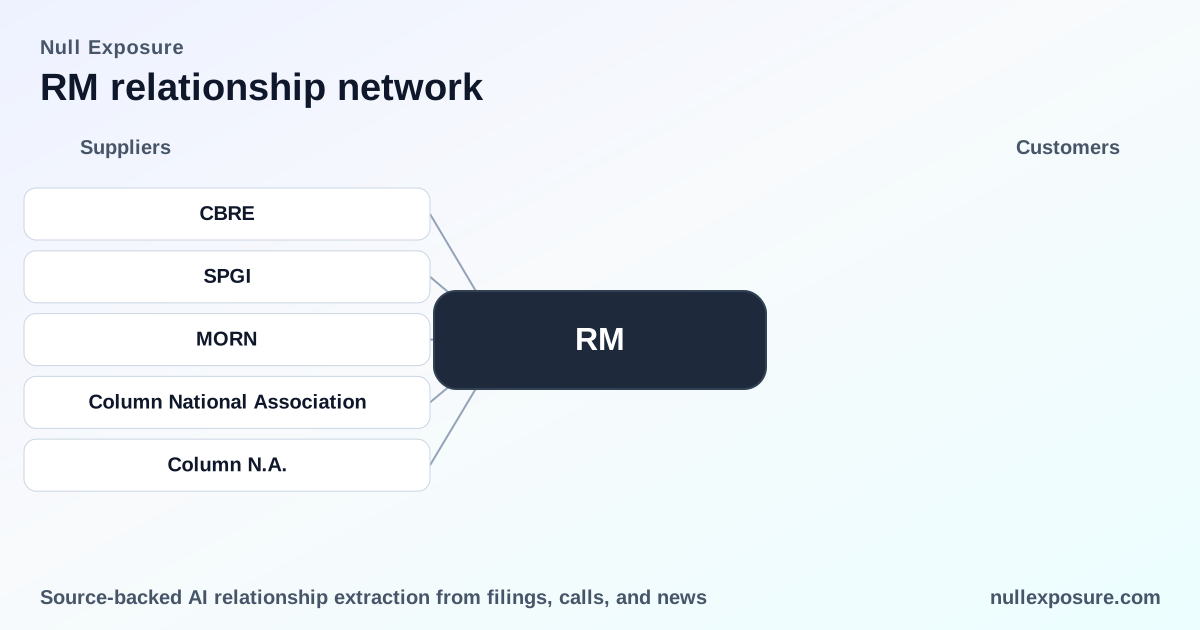
Regional Management (RM): a quick read on suppliers that matter to investors
Regional Management Corp (RM) originates and services small-balance installment loans to consumers underserved by mainstream banks, monetizing through loan interest and fees, recurring servicing income, and periodic securitizations of receivables that lower funding costs and free up capital. The company’s funding model increasingly leans on rated asset-backed transactions and third-party lending partnerships while operationally relying on external consultants and service providers for cybersecurity, project management, and real estate execution. Investors should evaluate RM through two lenses: credit/funding counterparties that determine cost of capital, and operational service providers that determine execution and resiliency. Read more at https://nullexposure.com/ for additional supplier due diligence and partner mapping.
How RM’s supplier footprint drives the business — a concise view
RM’s core operating model is capital-intensive and partnership-driven. The firm securitizes originated loans to institutional investors, which requires external ratings agencies and capital-market intermediaries; it also uses external lenders and warehouse partners to scale originations and sells or funds loans in partnership with third-party firms. On the operational side, RM contracts consultants for cybersecurity testing and engages external firms for project management and real estate needs. These relationships are critical to both funding cost and operational continuity: rated securitizations reduce funding spreads, while high-quality service providers protect loan servicing continuity and regulatory compliance.
- Contracting posture: The company explicitly uses third-party consultants for security testing and engages external vendors for project management and real estate—indicating formal, recurring vendor contracts rather than ad‑hoc relationships.
- Concentration and criticality: Ratings firms and lending partners are strategically critical because RM’s capital structure relies on securitization and external credit capacity. Operational vendors (cybersecurity consultants, property brokers) are mission‑critical for continuity but not primary drivers of funding.
- Maturity and timeline: Supplier relationships range from long-standing commercial real estate engagements (dating back to FY2016) to newly announced lending and project-management arrangements in FY2025–FY2026.
Visit https://nullexposure.com/ for supplier risk scoring and comparative vendor profiles that illuminate exactly how these counterparty exposures affect RM’s funding and operational resilience.
Detailed roster: every supplier relationship surfaced in public reporting
CBRE / CRBE (commercial real estate representation)
Charles Gouch of the CRBE/CBRE commercial real estate firm served as RM’s representative for its office expansion, indicating RM uses external brokerage expertise for real estate transactions and site selection; this is a tactical, capital‑management relationship tied to corporate facilities. Reported in Greenville News in 2016 (FY2016). Source: GreenvilleOnline article on RM’s move to Greer, FY2016 — https://www.greenvilleonline.com/story/news/2016/08/11/finance-company-moves-headquarters-greer/88565986/
Standard & Poor’s (ratings for securitization)
Standard & Poor’s provided a top rating of “AAA” to the Class A notes in RM’s $253 million asset-backed securitization, directly lowering RM’s cost of capital for that tranche and enabling deeper institutional distribution. This rating drove the structure and investor acceptance for the FY2025 deal. Source: Greenville Business Magazine coverage of RM’s FY2025 securitization — https://www.greenvillebusinessmag.com/2025/11/04/552972/regional-management-corp-completes-253-million-asset-backed-securitization
Morningstar DBRS (co‑rater for the securitization)
Morningstar DBRS also assigned a top rating to the Class A notes alongside S&P, providing independent validation that supports RM’s access to lower‑cost institutional funding and wider investor appetite for the transaction. This co‑rating reinforces RM’s strategy of relying on rated securitizations in FY2025. Source: Greenville Business Magazine coverage, FY2025 — https://www.greenvillebusinessmag.com/2025/11/04/552972/regional-management-corp-completes-253-million-asset-backed-securitization
Column National Association (project management agreement per SEC filing)
RM filed a project management agreement with Column National Association under SEC disclosure, indicating RM contracts outside firms for discrete program or platform implementation work; this is an operational services engagement that feeds into execution of growth initiatives or systems upgrades in FY2026. Source: reporting based on RM’s SEC filing as cited on Bitget, FY2026 — https://www.bitget.com/amp/news/detail/12560605242396
Column N.A. (new lending partnership to support originations)
RM announced a lending partnership with Column N.A. to support growth and returns, reflecting a funding or structured-lending arrangement that increases RM’s originations capacity and spreads risk with an institutional lending counterparty in FY2026. This relationship is strategic to RM’s revenue growth and capital efficiency. Source: Finviz news item on RM and Column N.A. partnership, FY2026 — https://finviz.com/news/328352/regional-management-rm-achieves-record-revenue-and-33-net-income-growth
Operating model constraints and what they imply for supplier risk
Public disclosures and evidence excerpts present several company-level signals about RM’s supplier posture:
- Service‑provider reliance: RM uses third‑party software, security consultants (including annual penetration testing), and non-file insurance purchased from unaffiliated insurance companies — indicating a reliance on external vendors for both security assurance and certain collateral/insurance arrangements.
- Active supplier stage: Evidence indicates these service relationships are active and recurring (e.g., annual penetration testing), implying ongoing vendor management obligations and recurring contract renewals.
- Implication for investors: Externalized controls lower fixed-cost staffing but increase vendor concentration and counterparty management risk; investors should monitor vendor contracts, insurance arrangements, and continuity provisions in procurement and SEC filings.
Investment implications — what to watch and why it matters
- Funding risk vs. funding advantage: The AAA ratings for FY2025 securitization are a clear positive—they materially reduce RM’s funding costs and support higher leverage/returns. Continued access to rated securitizations is a core value driver.
- Counterparty concentration: New and active lending partnerships such as Column N.A. materially scale originations but create counterparty credit exposure and execution dependency; monitor the terms and any exclusivity or commitment features.
- Operational resiliency: Active use of external cybersecurity consultants and project managers strengthens RM’s control posture but creates vendor-management execution risk; confirm contractual SLAs, indemnities, and incident-response roles.
- Non-core exposures: Real estate brokerage engagements are operationally relevant but financially non-material compared with securitization and lending counterparty relationships.
For a structured vendor risk scorecard and scenario analysis on how each counterparty affects RM’s funding spread and operational continuity, see our platform: https://nullexposure.com/
Bottom line: supplier relationships are a lever for growth—and a source of risk
Regional Management’s supplier ecosystem shows a deliberate mix of capital-market counterparties (ratings agencies and lending partners) that lower funding costs and enable growth, plus operational service providers that maintain execution and security. Investors should prioritize transparency on securitization cadence, lending-partner commitments, and vendor contract terms for cybersecurity and project execution. For active monitoring, vendor scoring, and ongoing alerts on counterparties that shape RM’s cost of capital and operational resilience, explore more at https://nullexposure.com/.
Key takeaway: RM’s strategic suppliers—ratings agencies and lending partners—are central to its economics; operational vendors are necessary enablers. Investors should treat counterparties as first‑order drivers of both upside and downside.