RE/MAX Holdings (RMAX): Supplier Relationships That Shape Distribution and Margin
RE/MAX Holdings is a franchisor that monetizes its brand and network through franchise and royalty fees, ancillary services to broker/agent offices, and selective referral and mortgage partnerships. The company extracts recurring revenue from platform services while managing a lean corporate cost base, relying on third-party MLS data, agent-facing technology, referral networks and franchised mortgage processing to keep its system sticky. For investors, the supplier map reveals where operating leverage and integration risk live: technology vendors and referral partners influence agent productivity and margins, while MLS/data arrangements and mortgage partners affect growth of non-franchise revenue. Explore full supplier intelligence on NullExposure.
How RE/MAX turns supplier relationships into economic advantage
RE/MAX’s commercial model centers on franchised distribution: the company charges network participants for brand use and offers paid back-office and lead-generation services. That structure gives the company high leverage to vendor-supplied technology and services—a change in platform costs or a lost referral partner propagates quickly across thousands of agents. Financially, RE/MAX reports $291.6M in trailing revenue and a modest 2.8% profit margin; operational efficiency and vendor cost management are therefore material to incremental EBIT.
The supplier constraint data flags a vendor spend band between $10M and $100M, while an excerpt lists “Vendor contracts (5) $33,435.” This combination reads as a company-level signal that RE/MAX runs a small number of contract relationships but with relatively low per-line-item disclosure, implying centralized contracting that aggregates vendor exposure even if individual line items look modest. Those characteristics point to a contracting posture that is centralized and discrete, with moderate aggregate vendor spend and high operational criticality for a handful of partners.
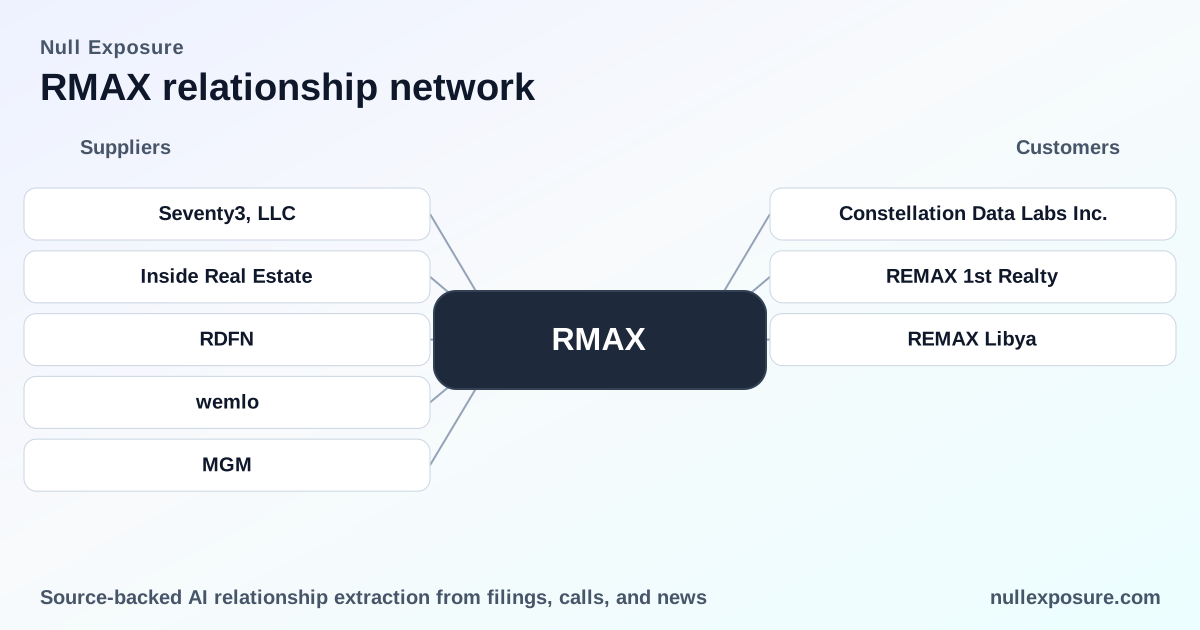
Supplier map: five relationships investors should price in
Below I cover every supplier relationship surfaced in the record, each with a concise plain-English takeaway and the public source.
-
Seventy3, LLC — MLS data provider for RE/MAX. According to MarketScreener’s RE/MAX National Housing Report (September 2025), MLS data is provided by Seventy3, LLC, a RE/MAX Holdings company, indicating in-house control of critical listing data used across reports and agent tools (https://www.marketscreener.com/news/remax-national-housing-report-for-september-2025-ce7d5adcdc80f521).
-
Inside Real Estate — agent/broker tech platform (kvCORE) supplier. RE/MAX began rolling out Inside Real Estate’s kvCORE to replace the former booj products, a strategic tech consolidation intended to unify agent tools and reduce in-house product maintenance costs (Atlanta Agent Magazine, July 2022: https://atlantaagentmagazine.com/2022/07/08/re-max-begins-major-push-for-new-brokerages-layoffs-to-come-with-third-party-tech-adoption/).
-
Redfin (RDFN) — exclusive referral partner in U.S. and Canada for coverage gaps. In markets where Redfin lacks capacity, the firm refers customers to approved partner agents, including participating RE/MAX agents, formalizing a referral channel that can supply inbound demand to the RE/MAX network (press release, 2019: https://www.newswire.ca/news-releases/re-max-and-redfin-announce-exclusive-referral-relationship-in-u-s-and-canada-836086951.html).
-
wemlo — mortgage processing services for franchised mortgage brand (Motto Mortgage). RE/MAX’s franchised mortgage operation requires use of wemlo’s processing services in many Motto Mortgage franchise agreements, creating a predictable service flow and a captive revenue stream for mortgage-processing supply (Atlanta Agent Magazine, July 2022: https://atlantaagentmagazine.com/2022/07/08/re-max-begins-major-push-for-new-brokerages-layoffs-to-come-with-third-party-tech-adoption/).
-
MGM Grand Hotel & Casino (MGM) — event and conference host for R4 global gathering. The R4 conference, RE/MAX’s largest global network event, was scheduled at the MGM Grand in Las Vegas (FY2026 reporting), demonstrating reliance on large venue partners for network cohesion and agent engagement programs (Finviz news, FY2026: https://finviz.com/news/298204/annual-remax-r4-conference-brings-one-global-network-together-for-masterminding-networking-and-business-growth).
Dig deeper into supplier profiles and implications at NullExposure.
What these relationships mean for margins and growth
There are three investment-relevant themes that flow from the supplier list:
-
Operational centralization around third-party tech. Replacing booj with kvCORE (Inside Real Estate) signals a strategic move to outsource ongoing development and support—trading capex and in-house engineering for predictable vendor fees. That shift compresses operating variance but increases vendor dependency; the net effect is improved operating margin predictability if contract terms are favorable.
-
Control of critical data assets. Seventy3 running MLS data functions as an internalized source of truth for listings and market reports. Owning or closely controlling MLS data reduces recurring licensing friction and enhances RE/MAX’s product differentiation across reports and agent tools.
-
Monetization beyond franchising via referral and mortgage partners. The Redfin referral agreement and wemlo mortgage processing tie RE/MAX to demand-generation and financial-services take-rates. Those agreements convert network scale into fee revenue, and under a stable referral cadence they are higher-margin complements to franchise royalties.
Risk profile tied to supplier posture and concentration
- Concentration risk: The supplier map shows a small number of high-impact relationships (tech, MLS, mortgage, referral). A material contract disruption with Inside Real Estate, Redfin, or wemlo would affect agent productivity, lead flow, or mortgage revenue—directly pressuring earnings.
- Contracting posture: The constraint signal of a mid-range vendor spend band combined with a low disclosed per-line contract value suggests centralized, aggregated vendor commitments rather than many small, independent buys; this raises the importance of contract terms and renewal cadence.
- Maturity and criticality: Seventy3’s integration and the global R4 event relationship with venue partners indicate mature, embedded partnerships; kvCORE adoption marks a discrete migration event with near-term execution risk but longer-term standardization benefits.
Actionable investor takeaways
- Monitor kvCORE rollout and vendor contract terms—favorable pricing and smooth migration will improve operating margins; protracted migrations or agent pushback will increase churn risk.
- Treat Redfin and wemlo as growth levers, not marginal niceties; both create fee revenue paths that compound with franchise scale.
- Watch vendor spend disclosures for renewals—the constraint flag indicating $10M–$100M in vendor exposure suggests renewal cycles could produce outsized P&L moves.
For a tactical read on how supplier events can change valuation assumptions, visit NullExposure’s home page.
In summary: RE/MAX’s supplier ecosystem is compact but strategically critical—technology and referral/mortgage partners amplify the franchisor’s ability to convert network scale into recurring fees, while centralized vendor contracting concentrates execution risk. Investors should prioritize tracking vendor contract renewals, kvCORE implementation milestones, and referral volume metrics as leading indicators of margin expansion or contraction.
Review the supplier intelligence overview and alerts on NullExposure.