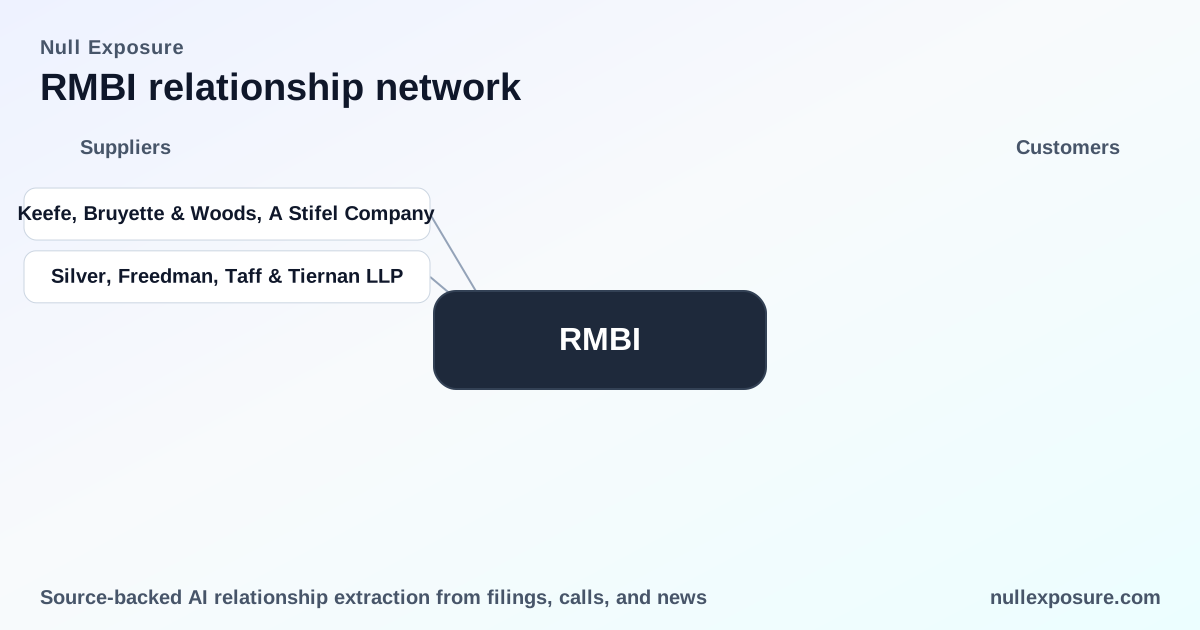
Richmond Mutual Bancorporation (RMBI): Supplier relationships that matter for deal and operational risk
Richmond Mutual Bancorporation operates as the holding company for First Bank Richmond, generating net interest income and fee revenue through regional commercial and retail banking, lease financing, and community lending; the company monetizes via interest spreads, lease origination margins and a modest dividend return to shareholders. Recent transaction work—most notably advisory and legal support for a strategic combination with Farmers Bancorp—highlights how external advisors and law firms plug directly into RMBI’s corporate strategy and execution. For more supplier intelligence and relationship mapping, visit https://nullexposure.com/.
Why supplier relationships matter for investors evaluating RMBI
Supplier relationships for a regional bank are not ancillary: they are instrumental to M&A execution, lease origination, and day-to-day operations. RMBI relies on external financial advisors and outside counsel for material corporate transactions, and it relies on brokers and third-party originators for the bulk of its lease pipeline. That combination drives both value creation (through advised transactions) and concentration risk (through third-party flow dependence).
Key company-level signals:
- Contracting posture: The company reports operational leases with tenors of five to 15 years, indicating a portfolio of longer-duration property commitments alongside shorter term liquidity facilities.
- Liquidity facilities: RMBI maintains a $10 million FHLB line of credit that expires April 2025 and renews annually, reflecting a short-term funding element that requires active rollover management.
- Operational dependence and concentration: As of December 31, 2024, the top 25 brokers/third-party originators accounted for 83.6% of the direct financing lease portfolio, with the largest single originator representing 12.2%—a material concentration that impacts originations and credit flow.
- Relationship role and maturity: The firm describes a dependence on external vendors for day-to-day operations and third-party originators for lease generation, and current disclosures classify these relationships as active.
Keefe, Bruyette & Woods, A Stifel Company — the fairness adviser investors should note
Keefe, Bruyette & Woods acted as financial advisor to Richmond Mutual and delivered a fairness opinion to the board in connection with the combination with Farmers Bancorp. This engagement places KBW at the center of valuation and deal structuring for the transaction announced in March 2026. A press release on Yahoo Finance (Mar 10, 2026) and an industry write-up on Pulse2 (Mar 10, 2026) recorded the advisory role and fairness opinion.
Silver, Freedman, Taff & Tiernan LLP — legal counsel on the transaction
Silver, Freedman, Taff & Tiernan LLP served as legal counsel to Richmond Mutual in the same transaction process, handling deal documentation and regulatory navigation. The engagement is documented in the March 2026 announcements covering the merger with Farmers Bancorp, including Yahoo Finance and Pulse2 reporting.
What these relationships reveal about RMBI’s operating model and risks
The engagement of a recognized investment bank for a fairness opinion and retained legal counsel signals a deliberate, transaction-focused posture. When a small regional bank hires external advisors for a merger, those suppliers become critical to both regulatory approval and shareholder perception. At the same time, the bank’s dependence on third-party originators for lease generation introduces counterparty concentration risk in revenue sourcing.
Operational and contractual characteristics to consider:
- Criticality: Advisory and legal firms are mission-critical for deal execution; failure or dispute with these suppliers would impact transaction timing and shareholder outcomes. The fairness opinion shapes board approval rationale and investor reception.
- Concentration and single-source exposure: The lease-originator concentration (top 25 = 83.6%) is a company-level signal that lease flow is highly concentrated, even if the named advisors are not the originators. That concentration increases sensitivity to shifts in broker behavior or termination of key originator contracts.
- Contract maturity mix: Long-term leases (five to 15 years) create embedded cost commitments and operational footprint stability, while the short-term FHLB line requires active management to avoid funding stress. Both elements influence capital planning and funding flexibility.
- Service-provider posture: Disclosures describe the relationships as service providers and active, indicating ongoing, operational-level dependence rather than one-off engagements.
For in-depth supplier mapping and counterparty exposure monitoring, see https://nullexposure.com/.
Practical implications for investors and acquirers
These supplier signals change the diligence checklist for RMBI:
- Confirm the scope and independence of the fairness opinion from Keefe, Bruyette & Woods and obtain the adviser’s valuation assumptions used in the fairness analysis.
- Review engagement terms with Silver, Freedman, Taff & Tiernan LLP for regulatory workstreams and indemnities tied to closing conditions.
- Quantify originator concentration risk by counterpart and evaluate transition plans if a top originator reduces flow; top-25 concentration at 83.6% is actionable risk.
- Monitor renewal risk on the FHLB line expiring April 2025 and the lease portfolio renewal schedule (five–15 year tenor window) to assess near-term liquidity and long-term fixed-cost commitments.
Practical checklist:
- Validate KBW fairness-opinion assumptions and scope.
- Review legal engagement letters for regulatory and indemnity exposure.
- Stress-test cash flow sensitivity to the departure of the largest broker (12.2% of lease flow).
- Confirm the bank’s contingency plan for the FHLB line renewal.
Investor takeaway and next steps
RMBI’s supplier relationships are strategically important: external advisors are directing transaction outcomes while broker dependencies shape core revenue generation. The combination of long-dated lease commitments and a renewable short-term FHLB facility demands active funding management. For deal investors and counterparty risk analysts, the dual focus is clear: validate adviser deliverables and quantify broker concentration.
If you are mapping supplier risk across regional banks or preparing transaction diligence, explore supplier profiles and relationship signals at https://nullexposure.com/. For targeted supplier intelligence and board-ready summaries, see https://nullexposure.com/.
Concluding thought: advisory and legal suppliers directly influence RMBI’s strategic execution, while broker concentration controls the pace of lease-originated revenue; both vectors are decisive for valuation and operational resilience.