Rocky Mountain Chocolate Factory (RMCF): how supplier and technology partners influence margins and franchise economics
Rocky Mountain Chocolate Factory is a franchisor, manufacturer and retail operator that monetizes via product sales to franchised and company stores, franchise fees, and retail revenue from company-operated locations. Over the last year management has prioritized an omnichannel rollout—integrating centralized order-management and third‑party storefronts—to directly improve unit‑level economics and same‑store accessibility. For investors, the core trade is straightforward: execution of delivery and POS integrations is the primary operational lever to convert modest top‑line growth into sustainable margin improvement. Learn more about supplier signaling and competitive implications at https://nullexposure.com/.
A compact financial snapshot investors should hold in mind
Rocky Mountain Chocolate Factory reported TTM revenue of ~$30.0M with a negative EPS of -$0.62 and an operating margin around -7%. Market capitalization is roughly $12.6M, with material insider ownership and ~44% institutional ownership. These figures frame why management is prioritizing low‑cost, revenue‑accretive distribution and technology partners rather than large capital investments.
What supplier signals tell you about the business model
RMCF’s supplier posture is defined by four practical characteristics:
- Short‑term contracting: Management discloses purchase contracts for chocolate and certain nuts that are typically 6–18 months, indicating operational flexibility but routine renegotiation and exposure to commodity swings.
- Low supplier concentration: The company states that alternative sources exist for most essential ingredients, which signals limited single‑supplier dependency and therefore lower supplier‑specific disruption risk.
- Buyer orientation: RMCF acts as a buyer for key raw ingredients and technologies, focusing on reliability and consistency for franchised production.
- Moderate spend profile: Disclosed contracted raw‑material commitments total about $2.3M, placing supplier spend in the $1M–$10M band—material to operations but manageable relative to the firm’s revenue base.
Together these constraints indicate a mature, low‑capital intensity operating model that prioritizes flexibility over long‑dated supplier lock‑ins, which aligns with a franchisor/manufacturer hybrid that needs consistent inputs but not large bespoke supplier investments.
The partner landscape investors need to read closely
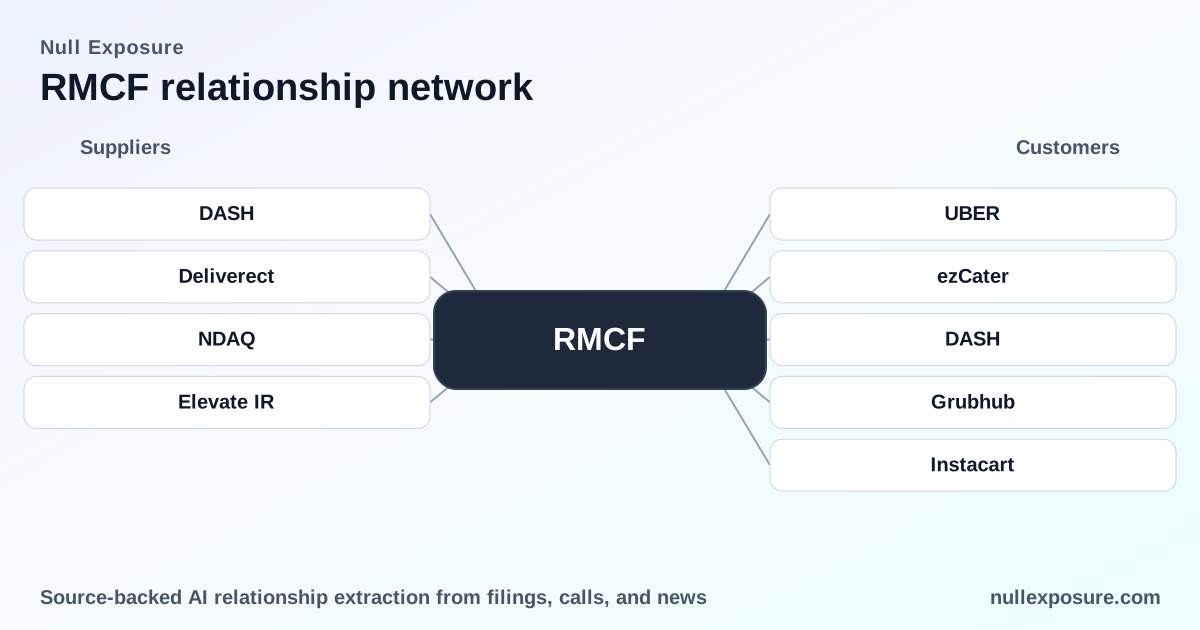
DoorDash — distribution partner with storefront economics
RMCF reports active partnerships with DoorDash to standardize store listings and menu data across the system and to deploy DoorDash storefronts that are white‑labeled and zero‑commission, designed to enhance franchisee unit economics. This is documented in company call transcripts covering FY2025 and FY2026 (InsiderMonkey transcript, Mar 2026; TradingView/Zacks coverage, Mar 2026) and summarized in market press (Yahoo Finance, Mar 2026). Links: https://www.insidermonkey.com/blog/rocky-mountain-chocolate-factory-inc-nasdaqrmcf-q2-2026-earnings-call-transcript-1628249/ and https://www.tradingview.com/news/zacks:c968efdd6094b:0-rocky-mountain-stock-slips-post-q3-earnings-despite-margin-improvement/ and https://sg.finance.yahoo.com/news/rocky-mountain-stock-slips-following-161900670.html.
Deliverect — centralized order management and marketplace integration
RMCF has engaged Deliverect for a centralized order management system that connects franchise locations to major marketplaces including Uber Eats, DoorDash, Grubhub and ezCater—part of the Phase One omnichannel rollout to streamline ordering and maintain pricing consistency across channels. This initiative is described in industry coverage and company press releases (Snack & Bakery and GlobeNewswire, Feb–Mar 2026). Links: https://www.snackandbakery.com/articles/115312-rocky-mountain-chocolate-factory-reveals-growth-strategy and https://www.globenewswire.com/news-release/2026/02/26/3245823/0/en/Rocky-Mountain-Chocolate-Factory-Launches-Omnichannel-Growth-Strategy-Systemwide-Rollout-Underway.html.
Nasdaq Global Market — public listing and disclosure platform
RMCF’s common stock is listed on the Nasdaq Global Market under the ticker “RMCF,” a basic but important relationship for liquidity, disclosure cadence and investor access; this is noted in company press releases related to investor calls and filings (GlobeNewswire, Jan 2026). Link: https://www.globenewswire.com/news-release/2026/01/07/3214454/0/en/Rocky-Mountain-Chocolate-Factory-Schedules-Fiscal-Third-Quarter-2026-Conference-Call-for-January-14-2026-at-9-00-A-M-ET.html.
Elevate IR — investor relations contact for market communications
Rocky Mountain Chocolate Factory uses Elevate IR as its investor relations contact, which centralizes communications to analysts and investors and supports the company’s public messaging around the omnichannel strategy (GlobeNewswire investor‑contact disclosure, Jan 2026). Link: https://www.globenewswire.com/news-release/2026/01/07/3214454/0/en/Rocky-Mountain-Chocolate-Factory-Schedules-Fiscal-Third-Quarter-2026-Conference-Call-for-January-14-2026-at-9-00-A-M-ET.html.
What these relationships mean for margins and franchise economics
The combination of Deliverect and DoorDash integrations is a direct operational lever for Rocky Mountain Chocolate Factory: improved order flow, standardized menus, and zero‑commission storefronts should increase digital penetration without a proportionate increase in marketing spend. Because the company contracts raw materials on short horizons and retains alternative suppliers, ingredient supply is not a single point of failure; however, short‑term contracts create ongoing exposure to commodity cost swings that will flow through to margins until franchised pricing absorbs them.
- Execution risk is operational, not supplier concentration risk—the company’s statements indicate alternatives exist for ingredients, so the critical path is successful rollout across franchises, POS adoption and loyalty activation.
- Technology partners are high‑impact, low‑capex—integrations are scalable across the store base and improve unit economics more rapidly than traditional store openings.
- Spend profile is manageable—$2.3M of raw‑material commitments sits within a $1M–$10M band, consistent with a franchisor managing working‑capital rather than making large, bespoke supplier investments.
For a deeper read on partner exposure and procurement posture, visit https://nullexposure.com/.
Investor actionables
- Monitor execution metrics: track POS adoption across stores, Deliverect rollout milestones, and DoorDash storefront activation to assess revenue per store and contribution‑margin improvement.
- Watch commodity cost disclosures: because RMCF uses short‑term contracts for chocolate and nuts, quarterly procurement disclosures and gross‑margin trends will show real time impact.
- Assess franchise economics: if white‑labeled DoorDash storefronts and a loyalty program materially improve unit economics, the company should convert modest revenue growth into sustainable operating leverage.
For continued coverage of RMCF supplier linkages and execution signals, visit https://nullexposure.com/.
Bottom line
RMCF’s supplier and technology relationships are strategic enablers rather than existential dependencies. The Deliverect and DoorDash integrations are the operational focal points that will determine whether modest top‑line growth translates into durable margin improvement across a franchised store base that benefits from short‑term procurement flexibility and moderate supplier spend. For investors analyzing supplier risk and the cadence of execution, these partnerships provide clear, observable milestones to track.