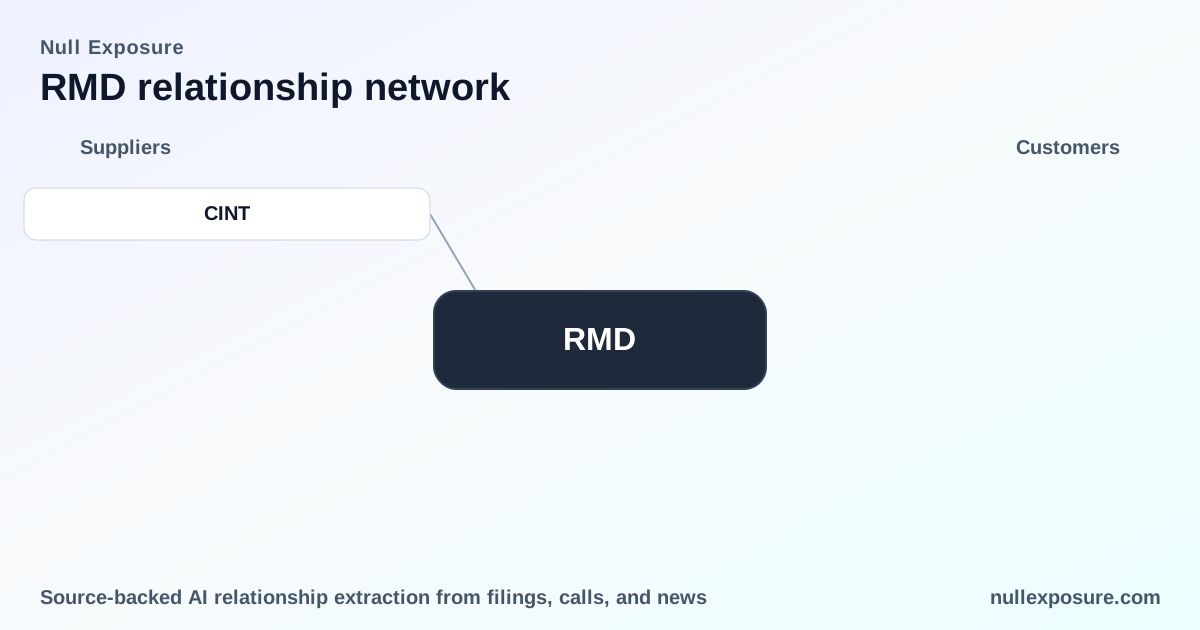
ResMed (RMD) — supplier relationships that shape margin durability and operational risk
ResMed monetizes by selling cloud-connected respiratory devices and recurring software-enabled services for sleep apnea and chronic respiratory care, capturing device margin up front and recurring revenue through cloud subscriptions, consumables and managed care arrangements. The company’s supplier posture—long-term purchase commitments, mixed reliance on single-source components, and outsourced manufacturing and services—directly conditions resilience of gross margins and the predictability of recurring revenue flows.
For a practical investor read on the supplier signals, the single external relationship captured in public reporting, and the company-level constraints that determine where operational and procurement risk concentrates. If you’re evaluating counterparty risk for procurement or thinking about supplier diligence, compare these findings to your internal vendor scorecards and visit https://nullexposure.com/ for deeper supplier intelligence and monitoring.
What the supplier map tells an investor: concentrated inputs, durable commitments
ResMed runs a manufacturing-light, outsourced assembly and component supply model for many device lines while retaining software distribution and device firmware in-house. That structure produces three defining procurement characteristics:
- Contracting posture: ResMed reports agreements that are "not cancelable without penalty," indicating legally binding minimum purchase obligations that lock in spend for planning and capacity; this drives cost predictability but also creates downside if demand softens.
- Concentration risk: The company purchases uniquely configured components from some single-source suppliers, which creates operational leverage for those vendors and potential single-point failure risk for ResMed’s production lines.
- Service dependency: Distribution of Residential Care Software depends on external technical operations and third-party services, making uptime and data integrity dependent on vendor continuity and SLAs.
These are not theoretical: the company reported meaningful minimum purchase obligations and explicitly acknowledges reliance on third-party manufacturers and service providers in its filings.
One recorded supplier relationship: Cint
Cint — market research / survey services provider (inferred ticker CINT).
ResMed used Cint to field a survey between 11 December 2025 and 14 January 2026, indicating a contracted research engagement during FY2026; the engagement is documented in a Ritzau press release dated March 10, 2026. The interaction reads as a research services purchase rather than a production-critical supply relationship, useful for customer feedback and market intelligence. (Source: Ritzau press release, March 10, 2026.)
This single-entry in the supplier results is narrow in scope but relevant: it confirms that ResMed sources specialized external services for customer and market research, consistent with its product-led growth and software monetization strategy.
Company-level constraints that drive procurement strategy
The filings and excerpts surface specific constraints that form a coherent operating model. Presenting these as company-level signals:
- Large counterparty counterparties for derivatives (company-level signal): ResMed limits counterparty credit risk by transacting derivatives with major financial institutions, signaling conservative treasury operations and an appetite to hedge FX/interest exposures using high-credit counterparties. The company states it "does not expect material losses as a result of default by our counterparties." This reduces treasury counterparty risk but concentrates exposure to major banks. (Source: company filing language.)
- Buyer posture with binding purchase obligations: ResMed explicitly documents agreements to purchase goods or services "not cancelable without penalty," primarily linked to supply arrangements; this creates locked-in spend and predictable supplier revenue streams but reduces flexibility if demand deviates. (Source: company filing language referencing purchase agreements.)
- Manufacturing reliance and single-source components: ResMed acknowledges reliance on third-party manufacturers if company facilities are affected by disruptions and that some components are obtained from single-source suppliers, elevating concentration and operational continuity risk for specific part families. (Source: company filing language on third-party manufacturers and single-source suppliers.)
- Service-provider dependence for software distribution: The Residential Care Software products are distributed via the internet relying on "services from various third parties" and internal technical operations infrastructure, making service provider SLAs a security and availability dependency. (Source: company filing language on technical operations and third-party services.)
- Material committed spend: Obligations under purchase agreements as of June 30, 2025 are reported as Minimum purchase obligations $963,763 (reported in thousands), which translates into a company-level committed spend profile in the high hundreds of millions, confirming the enterprise scale of supplier commitments and validating the “100m_plus” spend band signal. (Source: company filing obligations table, June 30, 2025.)
Together these constraints portray a mature, high-commitment procurement posture: the firm secures supply and risk transfer through long-term commitments and high-credit counterparties, while accepting concentration in certain specialized components and dependence on external service providers for its software channel.
Operational and investment implications
- Margin durability depends on supply continuity. ResMed’s strong gross margins and operating margins reflect scale and product mix, but reliance on single-source components means a supplier disruption could compress margins quickly for specific product families. Supply chain continuity is a core earnings sensitivity.
- Committed spend is both an asset and a liability. Minimum purchase obligations of the magnitude disclosed give ResMed bargaining leverage with suppliers when demand is robust, but they create inventory and fixed-cost risk if market demand weakens. Forecast accuracy and demand smoothing are therefore critical.
- Service vendors are critical to recurring revenue delivery. Third-party hosting or technical operations are directly tied to subscription and cloud revenue collectability; outages would have both operational and reputational costs. Operational SLAs and cybersecurity posture of vendors should be part of supplier diligence.
If you need supplier-level monitoring and alerts for changes to these dynamics, view services and intelligence at https://nullexposure.com/ to track counterparties and contract signals in real time.
What investors and operators should watch next
- Monitor procurement disclosures in 10-Q/10-K for updates on single-source supplier identities and the extent of substitution options; absence of disclosures increases opacity.
- Watch minimum purchase obligations and inventory levels on future balance sheets for signs that purchase commitments are leading to inventory build or that demand is softening.
- Track vendor SLA incidents or third-party outages tied to Residential Care Software distribution—these are direct earnings risk events.
- For treasury and counterparty risk, review the schedule of derivative counterparties and collateral arrangements in filings to confirm credit exposure limits.
Bottom line and actions
ResMed operates with highly committed procurement and a mix of outsourced manufacturing and software delivery, producing stable margin profiles but concentrated operational risk in single-source components and third-party services. For investors assessing supplier risk or for operators building resilience plans, the company disclosures give clear signals: enforce rigorous vendor due diligence, prioritize contingency capacity for single-source parts, and treat service providers as mission-critical partners.
Explore full supplier insights and continuous monitoring at https://nullexposure.com/ to integrate these supplier signals into your investment or operational workflows.
For procurement teams and analysts requiring an actionable supplier risk snapshot, subscribe and compare ResMed’s supplier posture across peer groups at https://nullexposure.com/.