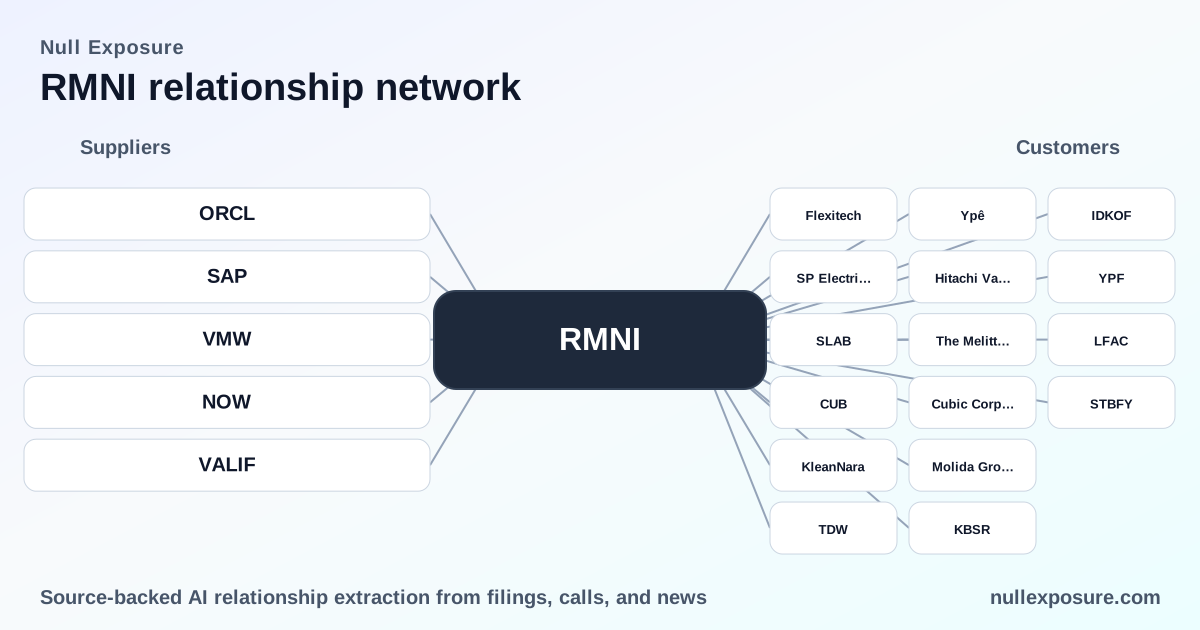
Rimini Street (RMNI): Supplier relationships that underwrite a third‑party ERP support franchise
Rimini Street monetizes by delivering third‑party support and AI‑enabled overlays for legacy ERP and enterprise software — charging clients to replace vendor support contracts while adding new revenue streams from agentic AI solutions. The company's commercial model depends on integration with major application and platform vendors (Oracle, SAP, VMware) and on partnerships with AI and security platform providers (ServiceNow, Vali) that let Rimini sell higher‑margin services on top of existing customer stacks. This supplier map is critical for investors gauging revenue durability, product roadmaps, and operational risk. For deeper supplier intelligence, visit https://nullexposure.com/.
How Rimini gets paid and why partner relationships matter
Rimini's revenue base (~$421.5M TTM) is primarily recurring support fees that replace or outcompete vendor maintenance contracts with Oracle and SAP; the firm then upsells agentic AI capabilities and overlays that do not require customers to migrate platforms. That structure drives a predictable subscription-like cash flow while exposing Rimini to platform compatibility, vendor legal and technical pressures, and concentrated partner dependencies. Financially, pricing power and margin expansion depend on maintaining interoperability with those larger vendors and integrating third‑party AI/security partners into usable products.
The supplier relationships investors need to track
Oracle — core source of addressable customers
Rimini is a leading third‑party support provider for Oracle software, and the company markets its Rimini Smart Path™ as an alternative to vendor maintenance for thousands of organizations. According to a Rimini press release distributed via AIJournal in March 2026, thousands of organizations have adopted the Rimini Smart Path™ specifically for Oracle environments. Source: Rimini press release (AIJournal), March 10, 2026.
SAP — another anchor for legacy ERP support
SAP customers constitute a parallel revenue pool to Oracle accounts; Rimini positions the same third‑party support and agentic ERP overlays as turnkey alternatives for SAP customers. The March 2026 company announcement referenced widespread adoption of Rimini’s Smart Path™ across both Oracle and SAP customer bases. Source: Rimini press release (AIJournal), March 10, 2026.
VMware — infrastructure compatibility and security touchpoints
Rimini supports VMware environments as part of its third‑party support scope and references VMware in product launch materials highlighting cross‑vendor coverage. Investor communications in early 2026 reiterate VMware as a covered vendor for Rimini’s support and agentic service offerings. Source: Finviz news and AIJournal reporting, March 2026.
ServiceNow — platform partner for agentic AI overlays
Rimini’s new Rimini Agentic UX™ solutions are explicitly built “powered by ServiceNow,” enabling Rimini to deliver workflow automation and AI‑driven UX overlays over existing ERP releases without migrations. A Morningstar distribution of Rimini’s January 2026 press release and subsequent earnings‑call commentary in March 2026 highlight ServiceNow as the AI platform partner enabling these capabilities. Source: Business Wire / Morningstar (Jan 22, 2026) and Q4‑2025 earnings discussion (InsiderMonkey), March 2026.
Vali — third‑party security integration for hypervisor protection
Rimini references enhanced hypervisor security via “Rimini Protect Advanced Hypervisor Security powered by Vali,” signaling that Vali supplies security technology that Rimini bundles into its VMware/hypervisor protection offerings. This relationship shows Rimini’s approach of augmenting support with third‑party security IP. Source: TradersUnion news coverage, March 2026.
What these relationships tell investors about the operating model
- Contracting posture: Rimini contracts as a downstream service provider — it depends on continuing technical interoperability with major platform vendors and on licensing/partner agreements with AI and security vendors. The company explicitly states reliance on third‑party systems and software to deliver support services, which frames its vendor management as a strategic, operational priority. This is a company‑level signal from corporate commentary and filings, not a relationship‑specific excerpt.
- Concentration: Revenue is concentrated in the legacy ERP ecosystem (Oracle/SAP/VMware). That concentration creates both a defensible niche — given incumbent lock‑in — and a dependency risk if vendors change licensing, access or product architectures.
- Criticality: For customers, Rimini’s services are critical when they choose to exit vendor support; for Rimini, maintaining vendor compatibility is critical to avoid revenue attrition. Partnerships like ServiceNow and Vali increase product stickiness by adding features customers cannot obtain simply by staying on vendor maintenance.
- Maturity: Relationships with Oracle, SAP and VMware are long‑standing market realities for third‑party support providers; newer partnerships with ServiceNow and security vendors indicate a maturing product strategy that shifts Rimini up the value chain from pure break/fix support to AI‑enabled business process automation and managed security overlays.
The company also reports a direct operational reliance on third‑party providers’ systems and software, which confirms that Rimini’s delivery model is integrated rather than fully proprietary — a material, company‑level operational constraint affecting contract negotiation leverage and execution risk.
For further supplier intelligence and comparative maps, explore https://nullexposure.com/.
Investment implications and risks tied to supplier strategy
- Upside: Successful commercialization of agentic AI overlays (leveraging ServiceNow) can materially expand addressable revenue and improve margins without forcing customers into platform migrations. Rimini’s price multiples (trailing PE ~8.4, EV/EBITDA ~3.8) reflect a market that prices in operational risk relative to potential upside.
- Risks: The business will always be exposed to vendor policy shifts (licensing, access) and to the technical burden of supporting increasingly SaaS‑oriented stacks. Any degradation in relationships or technical access with Oracle, SAP or VMware would have immediate negative revenue implications.
- Mitigants: Partnering with recognized platform and security vendors (ServiceNow, Vali) diversifies the product set and creates alternative value propositions beyond pure cost arbitrage on maintenance fees.
Mid‑investor action: if supplier continuity is material to your thesis, perform targeted diligence on vendor interoperability clauses and on the economics of Rimini’s ServiceNow and Vali integrations; for procurement and supplier maps, see https://nullexposure.com/.
Bottom line and next steps
Rimini Street runs a third‑party support business that monetizes compatibility with Oracle, SAP and VMware while extending value through ServiceNow‑powered AI overlays and Vali‑powered security integrations. That combination creates a resilient recurring revenue base with levered upside from agentic AI products — balanced against execution risks tied to vendor interoperability and partner contract terms.
If supplier relationships and contractual posture are central to your RMNI investment case, prioritize documentable evidence of partner agreements and technical access commitments in the next diligence round. Learn more about supplier risk and relationship mapping at https://nullexposure.com/.