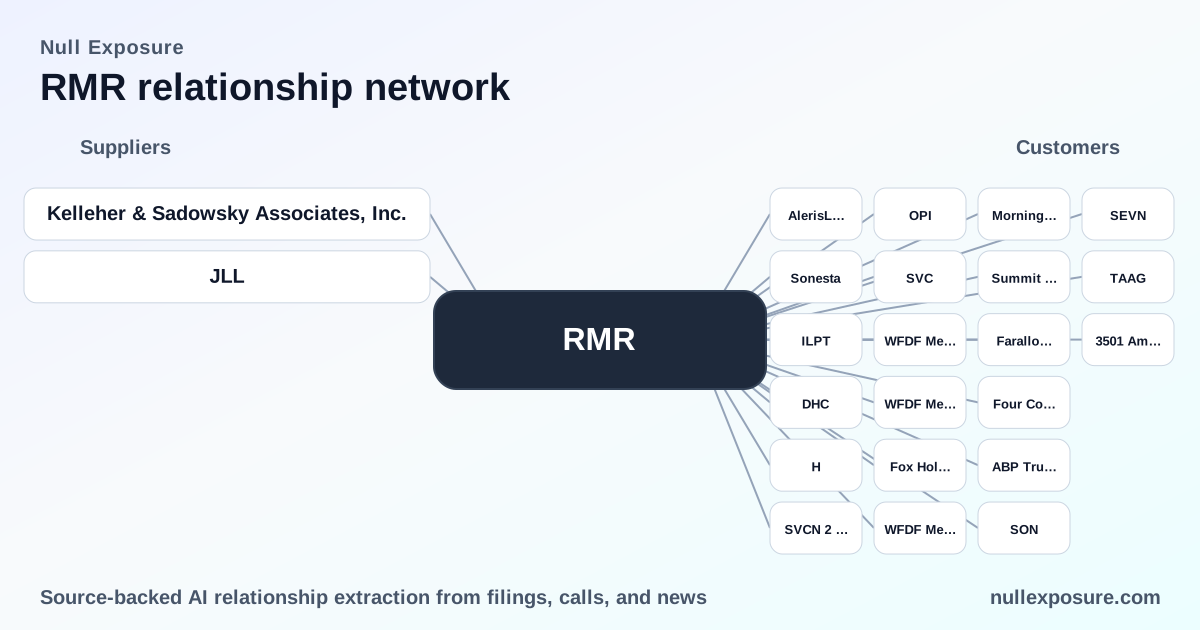
RMR Group Inc.: supplier relationships and what they mean for investors
RMR Group Inc. operates as a centralized property and business management platform that monetizes recurring fees and performance-linked income from managing third‑party and affiliate real estate assets through its subsidiary, The RMR Group LLC. The company’s value proposition is service-driven — fees scale with assets under management and operational performance — which makes supplier and broker relationships strategically important to both revenue stability and portfolio disposition outcomes. For a deeper supplier-risk view, see NullExposure’s coverage: https://nullexposure.com/.
How RMR’s operating model drives supplier importance
RMR is a publicly traded real‑estate services company (NASDAQ: RMR) with material recurring revenue: Revenue TTM was $219.5M with strong operating margin metrics (Operating Margin TTM 48.3%). That profile signals a fee-for-service business where operational continuity and third‑party intermediaries are economically critical — property brokers, local management contractors, and transaction advisors directly affect asset performance and liquidity. Institutional investors hold over 80% of the float, which intensifies scrutiny on governance, counterparty selection, and disposition strategy.
Key financial context that colors supplier relationships:
- Market capitalization around $278.6M and EBITDA of $97.5M indicate a mid‑cap, cash‑generative operating base.
- Dividend yield is meaningful (DividendPerShare $1.80; DividendYield 11.1% as reported), implying cash returns rely on steady fee inflows.
If you want a concise report on RMR’s supplier landscape and risk implications, start here: https://nullexposure.com/.
What the public record shows about named broker relationships
Below are the relationships surfaced in recent reporting. Each entry includes a plain‑English takeaway and a direct source reference.
Kelleher & Sadowsky Associates, Inc.
- RMR engaged local brokerage Kelleher & Sadowsky to execute disposition activity: the firm, together with former JLL professionals, sold twelve RMR Group properties in Central Massachusetts during the FY2020 cycle. This indicates RMR uses regional brokers to manage local sales flow and unlock liquidity from non‑core assets. — Boston Real Estate Times (Mar 10, 2026): https://bostonrealestatetimes.com/kelleher-sadowsky-adds-former-jll-managing-director-and-vice-president/
JLL (Jones Lang LaSalle)
- RMR worked with JLL’s Suburban Brokerage Group in FY2020 when JLL personnel partnered with Kelleher & Sadowsky to sell the same twelve properties, showing RMR leverages national brokerage expertise alongside local partners for larger execution mandates. — Boston Real Estate Times (Mar 10, 2026): https://bostonrealestatetimes.com/kelleher-sadowsky-adds-former-jll-managing-director-and-vice-president/
What these relationships imply for investors and operators
The two-name set of broker involvement tells a concise story about RMR’s disposition and sourcing strategy:
- Hybrid execution model: RMR combines national platform expertise (JLL) with local market brokers (Kelleher & Sadowsky) to maximize reach and locally tailored execution.
- Transactional criticality: Dispositions are an explicit lever for portfolio optimization; reliance on recognized brokerages supports price discovery and speed-to-market in regional assets.
- Contracting posture: The use of external brokers for sales implies RMR prefers outsourced transaction execution rather than in‑house selling teams for certain markets, conserving variable cost but increasing vendor dependency.
These dynamics are consistent with RMR’s financial profile: a fee‑heavy revenue mix and high operating margins favor outsourced, scalable supplier relationships rather than large fixed-cost internal sales organizations.
Company-level constraints and operational signals
There are no explicit constraints in the supplied relationship record that single out particular suppliers. As a company-level signal, the available data indicates the following characteristics about RMR’s supplier posture:
- Concentration: Institutional ownership at roughly 80% concentrates governance expectations and pressures, increasing the importance of transparent, high‑quality supplier relationships.
- Criticality: Management and brokerage services are critical to cash generation and portfolio liquidity; interruptions or poor execution would have immediate P&L and valuation consequences.
- Contracting maturity: RMR operates through an established subsidiary model (The RMR Group LLC) and is NASDAQ‑listed, suggesting standardized vendor contracting and institutional counterparty due diligence.
- Outsourcing tilt: Evidence of broker engagement for property sales indicates a preference for specialist external providers on transactional workstreams rather than fully integrated, in‑house capabilities.
Risk map for supplier exposures
Investors should focus on a few practical risk vectors:
- Execution risk: Broker selection and incentives affect time‑to‑sale and realized prices; dual engagement of national and local brokers is a mitigation tactic but creates coordination risk.
- Concentration of providers: If RMR relies on a small set of counterparties for disposals, that can introduce pricing leverage or availability issues.
- Governance and alignment: With high institutional ownership, counterparty disputes or suboptimal vendor performance can trigger rapid investor response given RMR’s visible dividend and cash profiles.
For a deeper vendor‑level diligence playbook tailored to RMR’s profile, visit https://nullexposure.com/.
Bottom line and investor action points
RMR’s supplier footprint is succinct in the public record: the company uses a combination of national and regional brokers to execute property sales, reflecting a cost‑efficient, market‑responsive operating model that is material to cash flow and value realization. The brokered sale of twelve properties via Kelleher & Sadowsky and JLL in FY2020 exemplifies that approach and highlights the operational importance of execution partners. — Boston Real Estate Times (Mar 10, 2026): https://bostonrealestatetimes.com/kelleher-sadowsky-adds-former-jll-managing-director-and-vice-president/
If you are evaluating RMR as an investor or counterparty, focus diligence on: contract terms with key brokers, historical disposition outcomes (price vs. book), and the company’s contingency plans for vendor replacement. For subscription access to structured supplier intelligence and ongoing monitoring, start here: https://nullexposure.com/.
Key takeaway: RMR runs a fee-oriented property management platform that depends on a small set of execution partners for disposals; those relationships directly affect liquidity and realized returns.