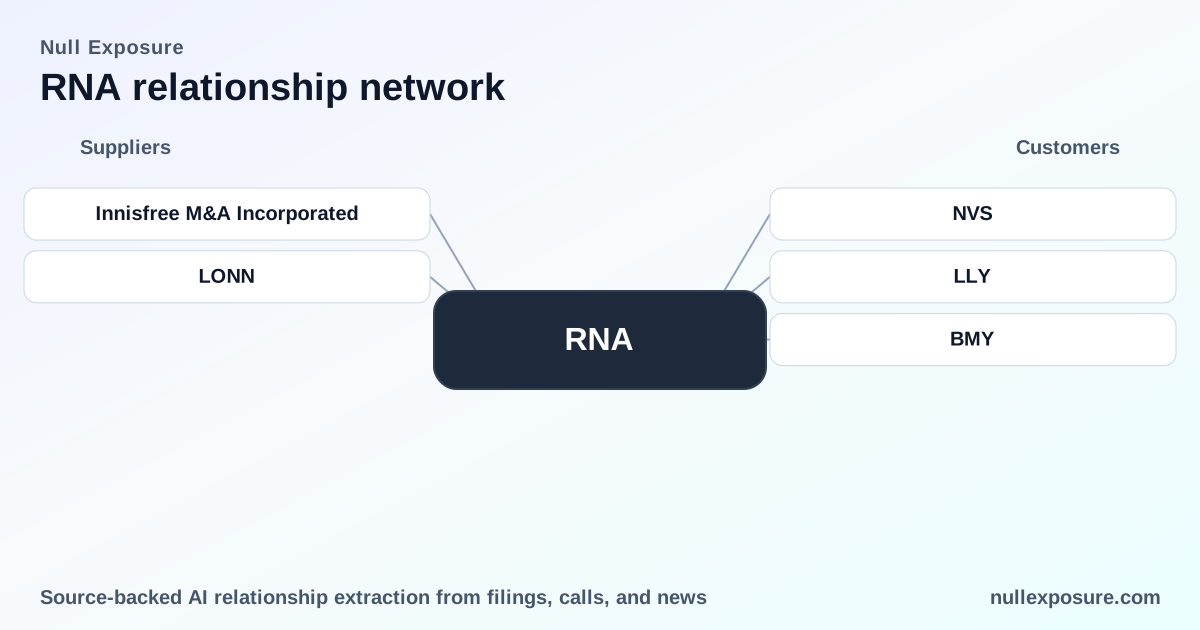
RNA (Avidity/Atrium) supplier relationships: what investors need to know
Avidity Biosciences operates as a drug developer focused on oligonucleotide-based therapies and monetizes by advancing candidates through clinical development toward commercial launch and partner or product revenue. The company outsources nearly all manufacturing and many clinical services to third parties, capturing value through successful regulatory progress, licensing, and eventual product sales rather than through owned manufacturing assets. Investors should evaluate counterparty concentration and the operational risks of an outsourced manufacturing model when sizing downside and time-to-market assumptions. For deeper supplier intelligence, visit https://nullexposure.com/.
How the business runs — an outsourced, partner‑dependent model
Avidity’s public disclosures make the operating model plain: the company does not own or operate manufacturing facilities and depends on external organizations for antibodies, oligonucleotides, linkers and finished product manufacture for preclinical, clinical and potential commercial supply. The practical implications for investors are straightforward:
- Contracting posture: Reliant on supplier agreements and manufacturing services contracts rather than captive capacity; operational control is mediated through vendor management and quality agreements.
- Concentration and criticality: Third‑party manufacturing and clinical service relationships are material to timelines; switching vendors introduces transition costs and schedule risk that can materially affect development milestones.
- Maturity and optionality: The company’s financials (negative margins, limited revenue) signal a pre‑commercial, development‑stage posture where supplier continuity is a gating factor for value realization.
These signals come directly from company disclosures warning that termination of third‑party relationships could prevent timely clinical progress, increase costs, and delay commercialization.
What the public relationships tell us
Below I cover every supplier and related third‑party relationship cited in the public results for RNA, with a concise market‑facing summary and source attribution.
Lonza — manufacturing partner for scale
Lonza is contracted under a Manufacturing Services Agreement to produce drug substances and finished products intended for future commercial use, a strategic move to secure scalability and supply chain stability for Avidity’s product candidates. This arrangement signals reliance on a large CDMO to deliver both process scale‑up and commercial manufacturing readiness. According to a TradingView note referencing Avidity’s SEC 10‑K for FY2026, the agreement is positioned to underpin commercial supply. (TradingView, referencing FY2026 10‑K, March 2026: https://www.tradingview.com/news/tradingview:9f2a3fd4d4473:0-avidity-biosciences-inc-sec-10-k-report/)
Innisfree M&A Incorporated — proxy solicitor for corporate governance events
Innisfree M&A Incorporated is acting as Avidity’s proxy solicitor in connection with a special stockholder meeting; investor communications instruct stockholders to contact Innisfree for voting information. This is a corporate services relationship rather than a manufacturing or clinical supplier, and it surfaces in multiple press communications relating to the company’s March 2026 special meeting. A PR Newswire release and corresponding coverage on BioSpace and InvestingNews reference Innisfree as the contact for voting assistance (PR Newswire, BioSpace, InvestingNews, March 10, 2026: https://www.prnewswire.com/news-releases/avidity-biosciences-announces-intention-to-adjourn-and-reconvene-special-meeting-of-stockholders-302694184.html; https://www.biospace.com/press-releases/avidity-biosciences-announces-intention-to-adjourn-and-reconvene-special-meeting-of-stockholders; https://investingnews.com/avidity-biosciences-announces-intention-to-adjourn-and-reconvene-special-meeting-of-stockholders/).
Operational constraints that shape supplier risk and valuation
Company disclosures include explicit constraints that function as company‑level signals for investors:
- Materiality: The firm states that losing key third‑party relationships could prevent sourcing acceptable replacements on commercially reasonable terms, increasing costs and delaying clinical timelines; management acknowledges that vendor transitions create a natural pause that can materially impact development schedules. This elevates supplier contracts to value‑critical status.
- Manufacturer role: Avidity confirms it does not plan to build clinical or commercial manufacturing facilities and will continue to rely on third‑party manufacturers for product candidates and raw materials. That contractual posture reduces fixed‑cost exposure but concentrates operational risk in external partners.
- Service provider dependency: The company relies on CROs, investigators and other service providers to run preclinical and clinical programs; these relationships are operationally essential to meet regulatory and protocol requirements.
Collectively, these constraints define a supplier risk profile marked by high criticality, moderate-to-high concentration, and an outsourcing posture that amplifies the importance of counterparty selection, contractual protections, and contingency planning.
What investors should watch next
- Contract coverage and terms: Confirm whether manufacturing agreements with Lonza include capacity guarantees, performance milestones, price escalators, and termination remedies — these are the levers that convert a third‑party relationship into reliable supply.
- Diversification actions: Monitor whether the company takes steps to qualify secondary suppliers or holds strategic inventories to blunt single‑vendor failure. Such moves materially reduce schedule risk.
- Clinical vendor performance: Given the reliance on CROs and investigators, operational KPIs (enrollment rates, site activation timing, audit outcomes) are leading indicators of timeline fidelity and thus of valuation re‑rating potential.
For full supplier risk profiles and ongoing monitoring, see the coverage at https://nullexposure.com/.
Investment implications — weigh execution risk against upside
Avidity’s model concentrates execution risk in external partners but preserves capital and lowers fixed costs relative to owning manufacturing assets. That tradeoff boosts leverage to successful clinical outcomes while increasing exposure to counterparty failure or supply disruption. Investors should appraise the company’s contractual protections with Lonza and the breadth of their clinical operations network when modeling timelines and probability of success.
If you are evaluating partnership exposure or operational counterparty risk as part of a valuation or due diligence exercise, a targeted supplier review is essential — start with the Lonza manufacturing agreement terms and the company’s contingency planning. Visit https://nullexposure.com/ for supplier intelligence and monitoring tools.
Final takeaway: Avidity’s outsourcing strategy is a deliberate capital‑efficient choice that accelerates development but transfers execution risk to suppliers; Lonza represents a critical node in that network and Innisfree’s role underscores active corporate governance events that investors should track.