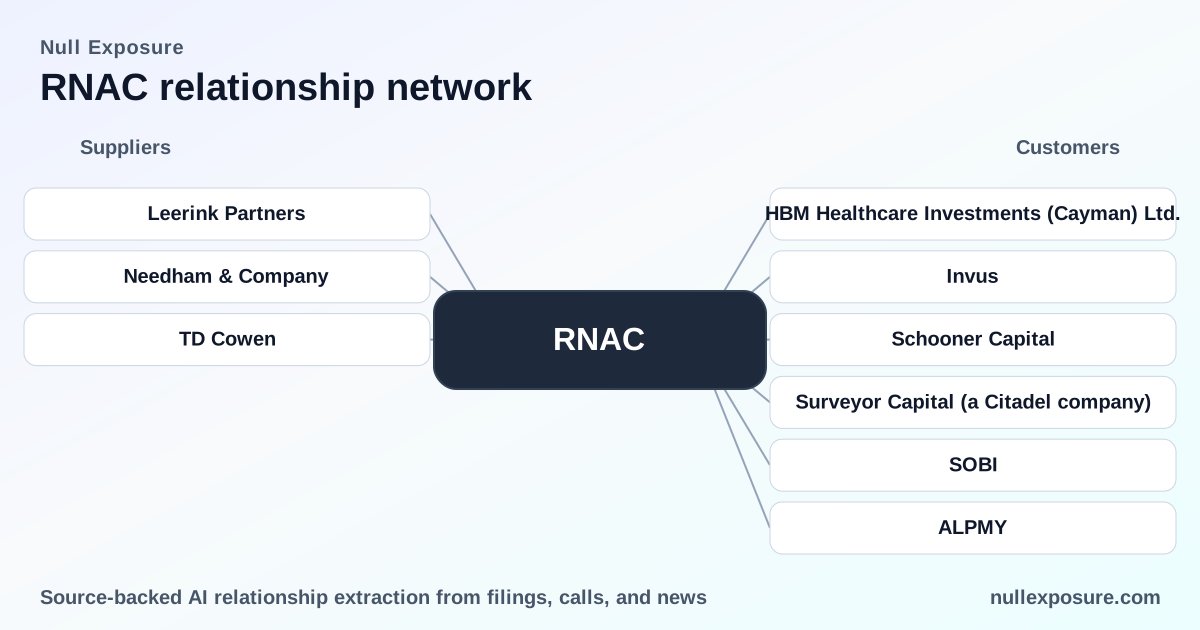
RNAC supplier map: what investors need to know about Cartesian Therapeutics’ external dependencies
Cartesian Therapeutics (RNAC) is a clinical‑stage biotechnology company that develops nanoparticle immunomodulators and monetizes primarily through equity financing, collaboration licenses, milestone payments and future commercial royalties tied to partnered products. The business is capital‑intensive, heavily reliant on third‑party development and manufacturing partners, and periodically taps the public and private markets to fund clinical progress, as evidenced by recent PIPE activity and contractual milestone obligations.
For a focused read on supplier counterparty risk and financing posture, visit https://nullexposure.com/ for structured supplier profiles and risk signals.
Financing partners that shape capital runway and investor dilution
Cartesian disclosed a $130 million private placement in mid‑2024; the underwriting syndicate and placement agents are important service suppliers because their involvement signals both access to capital and the cost of that access.
- Leerink Partners acted as a lead placement agent in the $130 million PIPE financing announced July 2, 2024; this positions Leerink as an active capital markets counterparty for RNAC’s near‑term funding needs, according to the company press release on GlobeNewswire (July 2, 2024).
- Needham & Company served as a placement agent on the same transaction, providing distribution and placement services for the deal, per the GlobeNewswire release (July 2, 2024).
- TD Cowen was named alongside Leerink as a lead placement agent on the July 2, 2024 PIPE, indicating a syndicate partnership to execute the equity financing, as disclosed in Cartesian’s press release on GlobeNewswire (July 2, 2024).
Key takeaway: these banks are not R&D or manufacturing vendors but material service providers that determine the cost and speed of RNAC’s equity access; their participation reduced short‑term cash profile stress while increasing shareholder dilution.
Contracting and operational constraints that affect supplier strategy
The public disclosures and company filings reveal a set of company‑level contract characteristics that shape how Cartesian sources and manages suppliers:
- Licensing posture and royalty economics. Cartesian has licensing commitments that include tiered royalties: the company is obligated to pay Ginkgo tiered royalties from low‑single digit to high‑single digit percentages on annual net sales of collaboration products, which will be expensed as commercial sales occur (company disclosure). This indicates a royalty‑heavy monetization plan for partnered products and future gross margin pressure when products reach market.
- Long‑dated intellectual property licenses. The NCI Agreement is structured to last through patent expiration dates (with certain families extending to March 15, 2033), reflecting multi‑year, long‑term licensing commitments that influence strategic supplier choices and product timelines.
- Domestic manufacturing requirements. Contractual language requires licensed products and processes to be manufactured substantially in the United States unless a waiver is granted by NCI, which drives supplier selection toward U.S.‑based manufacturers and can increase cost and reduce supplier pool.
- Supplier roles span manufacturing and specialized services. Filings reference obligations and risks associated with contract manufacturers, CROs and other third‑party service providers, signaling dependency on external manufacturing and clinical development suppliers.
- Contract maturity and termination events. The company terminated a Genovis agreement effective September 13, 2024, demonstrating active contract lifecycle management and the potential for supplier consolidation or replacement.
- Contingent milestone spend. Cartesian faces up to $15.0 million of contingent payments to 3SBio tied to clinical and regulatory milestones for ImmTOR‑containing products, placing the company in the $10m–$100m contingent spend band for strategic milestone liabilities.
Implication for operators and investors: these constraints reveal a company that is capital markets‑driven, royalty‑exposed, tied to long term IP licenses, and constrained by domestic manufacturing clauses, which together raise supplier cost, limit vendor arbitrage, and increase the importance of a reliable financing pipeline.
For a supplier risk scorecard and deeper counterparty traces, go to https://nullexposure.com/.
What the named relationships mean in plain terms
- Leerink Partners: Leerink acted as a lead placement agent on Cartesian’s $130 million private placement; their role was to lead institutional syndication and execution of the PIPE, which directly influenced the company’s immediate liquidity position (GlobeNewswire press release, July 2, 2024).
- Needham & Company: Needham participated as a placement agent on the same transaction, handling aspects of placement and distribution that supported the financing reach into buy‑side accounts (GlobeNewswire press release, July 2, 2024).
- TD Cowen: TD Cowen was listed as a co‑lead placement agent alongside Leerink for the $130 million PIPE, sharing responsibility for bookrunning and pricing the equity sale (GlobeNewswire press release, July 2, 2024).
Investor read: these three firms are short‑term financial service suppliers whose participation enabled a material capital infusion; they are less relevant to manufacturing or clinical execution risk but are critical to dilution dynamics and runway.
Risk map: concentration, criticality and operational maturity
- Concentration: Cartesian’s supplier footprint is skewed toward a mix of specialized biotech service providers and a small set of financial intermediaries for capital raising. High insider ownership (60.8%) and modest institutional ownership (20.1%) suggest a concentrated shareholder base that can influence financing terms and supplier selection.
- Criticality: Manufacturing and CRO partners are critical to clinical timelines and regulatory execution, especially given the NCI requirement for U.S.‑based manufacturing absent waiver. Termination of the Genovis agreement reduced a supplier touchpoint, but contingent milestone obligations to 3SBio preserve a downstream payment commitment that hinges on successful development.
- Maturity: Contractual arrangements include long‑term licensing and royalties, indicating mature, multi‑year commercial expectations rather than one‑off vendor engagements; at the same time, Cartesian’s operating metrics (negative EBITDA and minimal revenue) reflect early commercial immaturity and continued reliance on external capital.
Investment implications and action points
- Monitor financing counterparties and dilution. The July 2024 PIPE—and the lead agents behind it—directly affect cash runway and shareholder dilution; any future financing syndicate composition will continue to signal market appetite and pricing.
- Track milestone liabilities and royalty drains. The contingent $15 million to 3SBio and royalty obligations to Ginkgo are future outflows that will compress gross margins if products reach market. Budget for milestone payments and royalty structure in valuation models.
- Evaluate manufacturing risk against NCI constraints. The U.S. manufacturing requirement increases supply risk and cost; underwriters and credit counterparts will price that into any partner‑led programs.
If you want a concise supplier risk brief for RNAC or a comparative view across biotech suppliers, visit https://nullexposure.com/ to download the supplier intelligence pack.
Final thought
Cartesian’s supplier landscape is a mix of capital markets intermediaries and specialized biotech vendors, underpinned by long‑term licensing and contingent milestone economics. For investors, the story is one of execution risk — can the company convert clinical progress into partner revenue while managing milestone payments and manufacturing constraints — and capital risk — will future financings dilute value or stabilize the balance sheet? Assess counterparties across both axes to price RNAC appropriately.