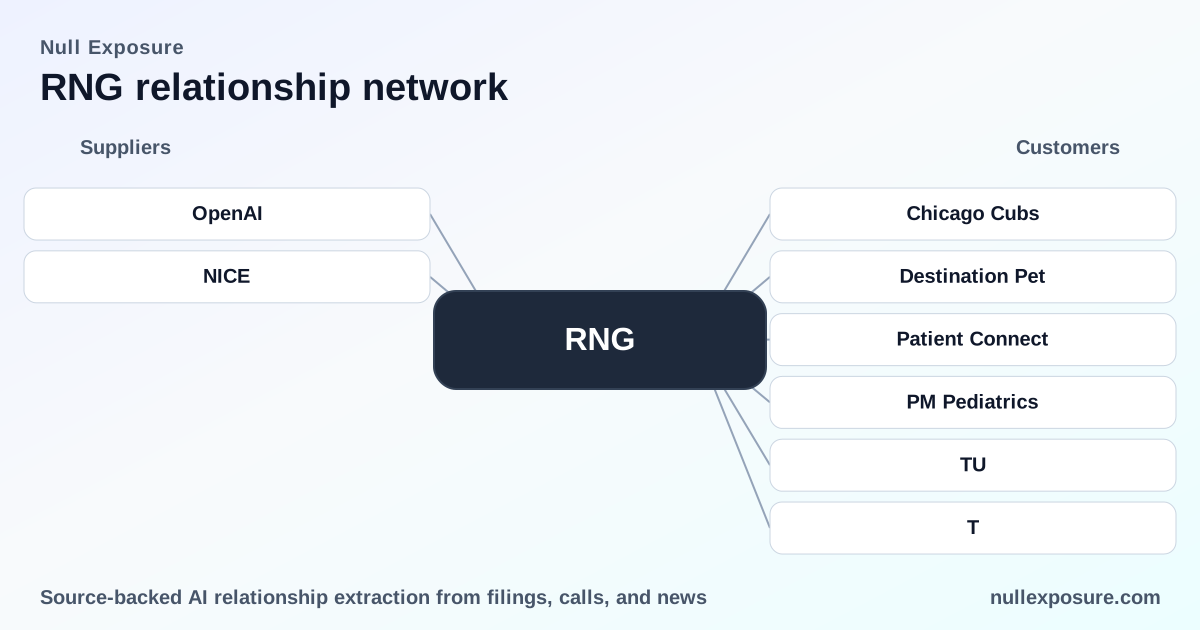
RingCentral (RNG): Supplier relationships shaping an enterprise communications franchise
RingCentral operates a cloud-native communications and collaboration platform sold primarily on a subscription basis to enterprises and mid-market customers; it monetizes through recurring licensing, premium voice and contact-center modules, device resale, and increasingly via enterprise AI integrations that add value to higher-tier voice and contact workflows. Investors should view RingCentral as a SaaS revenue engine with a growing strategic overlay in voice AI and contact-center partnerships—its supplier relationships directly influence product differentiation, cost structure, and operational resilience.
Explore supplier exposure and relationship signals at https://nullexposure.com/ to deepen diligence.
How RingCentral’s go-to-market and monetization hangs together
RingCentral sells unified communications (Message, Video, Phone) and contact-center capabilities as subscription software, with ancillary revenues from resold devices and managed services. The company reports Revenue TTM of $2.515 billion and a Market Capitalization near $3.20 billion, reflecting a business that has scaled recurring revenue while layering higher-margin enterprise features (voice AI, contact center integrations). RingCentral’s operating model is cloud-centric: it leverages third-party public cloud and managed hosting, leases co-location datacenter space globally, and outsources physical device manufacturing and fulfillment. These supplier choices compress capital intensity but embed vendor dependency that directly affects margins and service continuity.
Strategic supplier relationships that matter right now
OpenAI: Direct AI integration driving the voice roadmap
RingCentral has announced a broad integration of OpenAI models—including references to GPT‑5.2 and the OpenAI "5.2 voice" model—into its enterprise voice AI offerings, elevating conversational and voice-processing capabilities for customers. According to a news piece covering company developments, RingCentral launched this integration as part of a wider AI push announced in late February 2026 (Sahm Capital, Feb 26, 2026), and the company discussed the integration on its Q4 2025 earnings call transcript (InsiderMonkey, Mar 10, 2026). This relationship is a product differentiator: it accelerates RingCentral’s move from platform provider to AI-enabled communications vendor.
Source: Sahm Capital coverage of RingCentral’s Feb 26, 2026 announcement; InsiderMonkey Q4 2025 earnings call transcript (Mar 10, 2026).
NICE: Contact-center platform interoperability and channel leverage
RingCentral Contact Centre integrates NICE’s CXone cloud contact-center solution with RingCentral’s Message Video Phone (MVP) platform, embedding a proven contact-center stack into RingCentral’s broader collaboration suite. Contact‑Centres reported this integration as a live partnership that expands contact-center capability (reporting on FY2021 integration details), demonstrating RingCentral’s strategy of partnering with best‑of‑breed contact-center vendors rather than re‑building every component in-house. NICE integration strengthens RingCentral’s enterprise competitive moat in CX workflows and accelerates enterprise adoption.
Source: Contact‑Centres article on the RingCentral–NICE CXone integration (reporting FY2021).
Operational constraints that shape supplier risk and negotiating posture
RingCentral’s public filings and disclosures surface several company-level constraints that investors and operators must weigh when assessing supplier relationships:
-
Long-term purchase obligations: RingCentral reports non‑cancellable purchase obligations tied largely to third‑party managed hosting services, with scheduled commitments of $63,758k in 2025, $40,544k in 2026, $29,577k in 2027, $28,274k in 2028, $4,135k in 2029, and $166,288k total as of Dec 31, 2024. This contract posture locks in capacity and cost exposure several years out, reducing near-term flexibility but ensuring infrastructure availability.
-
Service-provider dependency: The company relies on public cloud and managed hosting providers, explicitly calling out increased utilization of Amazon and Google public cloud services and purchase obligations tied to managed hosting. Concentration with hyperscalers is a core vendor risk and a lever for both scale and negotiating pressure.
-
Non‑manufacturing of hardware: RingCentral does not develop or manufacture physical phones; it relies on third‑party device manufacturers and fulfillment partners for handset supply and logistics. This creates a supply‑chain dependency that can impact device availability, cost, and customer provisioning timelines.
-
Distributed datacenter footprint: RingCentral leases co‑location space across multiple global locations—Vienna and Ashburn (VA), San Jose and Santa Clara (CA), Chicago, Amsterdam, Zurich, Frankfurt, and Indian hubs—indicating a hybrid infrastructure posture that blends public cloud with colocated assets to meet latency, redundancy, and regulatory requirements. This geographic spread supports enterprise SLAs but adds complexity and fixed-cost commitments.
These constraints are company-level signals that frame the negotiating leverage and operational exposure RingCentral brings into every supplier relationship.
What these supplier ties imply for investors and operators
RingCentral’s supplier map creates a distinct set of investment-relevant tradeoffs:
-
Concentration versus capability: Dependence on major public-cloud providers concentrates counterparty risk but unlocks scale, speed of feature deployment, and global reach. OpenAI and NICE integrations add product differentiation without requiring RingCentral to rebuild those capabilities internally—accelerating time-to-value for customers.
-
Contracting posture and cash-flow predictability: The company’s long-term hosting commitments and co‑location leases trade some flexibility for predictable capacity and service continuity—important for retaining enterprise accounts that demand guaranteed performance.
-
Criticality of supplier execution: Device supply and cloud uptime are operationally critical; disruptions or cost inflation among device manufacturers or hyperscalers would translate quickly into customer dissatisfaction or margin pressure.
For operators conducting vendor diligence, prioritize clauses that preserve access to AI model updates, service-level guarantees with cloud vendors, and supplier diversification where possible. Learn more about supplier analytics and exposure at https://nullexposure.com/.
Practical watchlist for the next 12–18 months
- Track rollout metrics and commercial uptake of the OpenAI integration (voice AI adoption, seat attach rates, upsell to higher-tier plans). AI adoption will materially shape ARPU expansion.
- Monitor renewal terms and cost trends with major public-cloud providers and managed-hosting vendors; rising cloud costs would compress margins.
- Watch device sourcing and fulfillment performance for signs of supply stress that could delay enterprise onboarding.
- Confirm continued interoperability and co-selling activity with NICE to validate contact‑center revenue progression.
Final read: how supplier exposure colors the investment case
RingCentral is a recurring-revenue SaaS operator that uses supplier partnerships and cloud contracts to scale rapidly while conserving capital expenditure. Its OpenAI and NICE relationships are strategic accelerants—OpenAI for product-level AI differentiation and NICE for contact-center market credibility—while cloud, hosting, and device suppliers determine cost structure and resilience. Investors and operators should treat these supplier relationships as central to both upside (AI-led revenue expansion) and downside (vendor concentration and long-term cost commitments). For deeper supplier mapping and exposure analysis, visit https://nullexposure.com/.