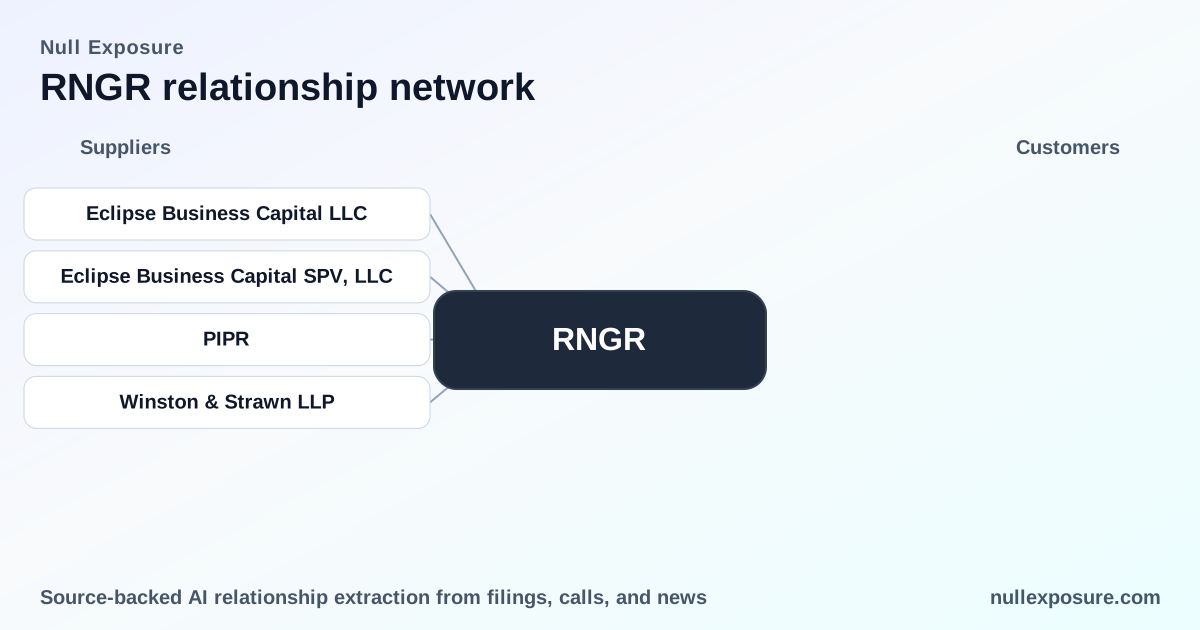
Ranger Energy Services (RNGR): Supplier relationships and the financing architecture behind a strategic acquisition
Ranger Energy Services operates high‑spec onshore well service platforms, cable termination and ancillary field services, and monetizes through day‑rate and project‑based service contracts, equipment sales and targeted asset acquisitions that expand its service footprint. Recent disclosure shows Ranger financing a bolt‑on acquisition and securing both debt commitments and advisory services to execute the deal, reinforcing the company’s capital‑intensive growth model and dependence on external lenders and advisors. For a deeper view of counterparty exposures and contractual posture, visit https://nullexposure.com/.
What investors should take away at a glance
Ranger is a mid‑cap oilfield services firm with material reliance on third‑party financing and professional services to execute strategic transactions. Market metrics (roughly $397m market cap, trailing revenue of $547m and positive EBITDA) confirm scale but also underline that acquisitions and equipment commitments materially shift leverage and operating risk. Company filings and press coverage indicate a contracting posture that favors long‑term supplier relationships for critical hardware and services, and a financing posture that uses asset‑level debt and private placements to fund expansion.
- Contracting posture: Ranger emphasizes long‑term supplier arrangements for materials and equipment, which supports operational continuity but creates purchase commitments.
- Financing and critical counterparties: External lenders and placement agents are central to closing acquisitions and new asset integration.
- Maturity and governance signals: Disclosures show both mature supplier relationships and at least one terminated warrant arrangement, creating governance and obligation history investors must parse.
For an interactive supplier map and relationship analytics, see https://nullexposure.com/.
The disclosed counterparties and what they did for Ranger
The following relationships were disclosed in the company’s recent announcement regarding its acquisition of Basic Energy Services assets. Each description below is drawn from contemporaneous coverage and company statements.
Eclipse Business Capital LLC
Ranger’s controlled subsidiary, RNGR Energy Services, LLC, received a debt commitment letter from Eclipse Business Capital LLC as part of a combined $77.5 million financing package that includes a $50 million revolving credit facility and term loans to support the Basic asset acquisition. According to a CityBiz news report dated March 10, 2026, Eclipse was named as a lender providing the committed financing for the transaction.
Eclipse Business Capital SPV, LLC
Eclipse Business Capital SPV, LLC is listed alongside Eclipse Business Capital LLC in the same debt commitment; the SPV functions as a financing vehicle that participates in the structured credit package backing the acquisition and equipment term loans, per the March 10, 2026 CityBiz article.
Piper Sandler (PIPR)
Piper Sandler is serving as exclusive financial advisor and sole placement agent to Ranger for the Basic asset acquisition and the related debt financing and private placement of preferred stock, according to the March 10, 2026 CityBiz coverage. This assigns Piper Sandler a central role in pricing and distributing the equity and debt necessary to close the deal.
Winston & Strawn LLP
Winston & Strawn LLP is acting as legal counsel to Ranger for the transaction, providing transactional and restructuring legal work tied to the asset purchase from a Chapter 11 proceeding, as reported by CityBiz on March 10, 2026.
Company‑level constraints and what they imply about operations
The disclosure set and related filings reveal several company‑level signals that shape the supplier and financing landscape.
- Long‑term supplier posture: Ranger states it has built long‑term relationships with industry leading suppliers of materials and equipment, indicating a procurement model that prioritizes continuity and scale discounts but also creates long‑dated purchase commitments that affect flexibility.
- Buyer and manufacturer roles in the supply chain: Ranger serves as a buyer of manufactured components and is connected to hardware manufacturers; governance language references minimum purchase obligations tied to manufactured products, which elevates supplier criticality.
- Hardware concentration: The company explicitly references hardware suppliers (for example, perforating gun systems), marking hardware as a material segment of supplier exposure — this increases the operational impact of component supply constraints.
- Mature and terminated contractual history: Filings show both mature supplier relationships and at least one terminated warrant (cancelled effective November 28, 2024), signaling active contract management and prior covenant enforcement that investors should track.
These are company‑level signals drawn from Ranger’s disclosures and transaction materials; they inform contracting posture (long commitments), concentration (critical hardware suppliers), and maturity (longstanding supplier arrangements with some terminated legacy instruments).
What the financing and advisory mix means for risk and execution
The combined funding package — a revolving credit line, equipment term loans, and a placement of preferred equity arranged by Piper Sandler — shifts both leverage and covenant exposure to external parties. Lenders structured as an SPV increase the legal and bankruptcy‑remote complexity, and reliance on a sole placement agent concentrates execution risk in one advisory counterparty. Legal counsel retained from a large firm strengthens documentation and closing capability, which is critical when acquiring assets from Chapter 11.
Key risk drivers for investors:
- Covenant and purchase obligations tied to long‑term supplier contracts can restrict operational flexibility.
- Financing concentration with a few lenders and a single placement agent concentrates execution and refinancing risk.
- Hardware supply dependence increases operational sensitivity to manufacturing disruptions or warranty disputes.
Monitor loan covenants, preferred stock placement terms, and supplier purchase commitments in upcoming filings.
For an investor‑grade breakdown of counterparty exposures and structured financing implications, visit https://nullexposure.com/.
Practical monitoring checklist for next quarters
- Read the debt commitment agreements and preferred stock placement prospectus for covenant triggers and amortization schedules.
- Track integration milestones for the Basic assets and the realization of expected synergies.
- Verify supplier purchase minimums and any manufacturer exclusivity clauses that could affect unit economics.
- Watch legal disclosures for material indemnities, litigation risk, or additional terminated contractual instruments.
Bottom line and next steps
Ranger is executing a capital‑intensive acquisition using a mixed financing package and professional advisory services. The company’s operating model depends on long‑term supplier relationships and external capital partners, which accelerates growth but concentrates counterparty risk. Investors should watch covenant terms, supplier purchase obligations, and the integration execution closely.
For ongoing monitoring and an integrated supplier relationship view, go to https://nullexposure.com/.