RenaissanceRe (RNR) supplier relationships: what investors need to know
RenaissanceRe is a Bermuda-headquartered reinsurance operator that monetizes through underwriting profits and investment income while actively buying and selling reinsurance capacity. The firm uses short-term, market-priced reinsurance and retrocession programs to manage capital and catastrophe exposure, and scales results through strategic acquisitions—most recently the integration of Validus-related businesses—which lift premium volume and underwriting leverage. For investors evaluating counterparties and procurement dynamics, the cross-section of counterparties, broker concentration and contract cadence is the primary driver of both upside and operational risk. For a quick look at the platform and comparable coverage, visit https://nullexposure.com/ for structured supplier intelligence.
High-level operating thesis for counterparties and procurement
RenaissanceRe operates a hybrid counterparty posture: it is both a buyer and seller of reinsurance, purchasing ceded protection and retrocession on an annual-renewal basis while marketing its own capacity through a tight network of brokers. This creates three structural characteristics that shape supplier risk:
- Short-term contract rhythm: Retrocessional and ceded arrangements are generally renewed annually, giving RenaissanceRe flexibility to adjust coverage and pricing but also exposing the company to hard-market cycles and renewal risk—documented in the company’s 2025 disclosures describing annual renewals for retrocessional reinsurance.
- Concentration in distribution: The company’s distribution is highly broker-dependent; three brokerage firms accounted for 81.3% of gross premiums written in 2025, signaling high counterparty concentration on the placement side and a material dependency on a small set of intermediaries.
- Counterparty materiality in recoverables: The top three reinsurers represented 12.6%, 10.1% and 7.0%, respectively, of reinsurance recoverables as of December 31, 2025—an outcome that makes credit quality of those counterparties a material credit and liquidity consideration for investors.
These are company-level operating signals drawn from RenaissanceRe’s 2025 disclosures and should shape diligence on counterparties, contractual terms, and stress-testing assumptions.
The relationship roster investors should review
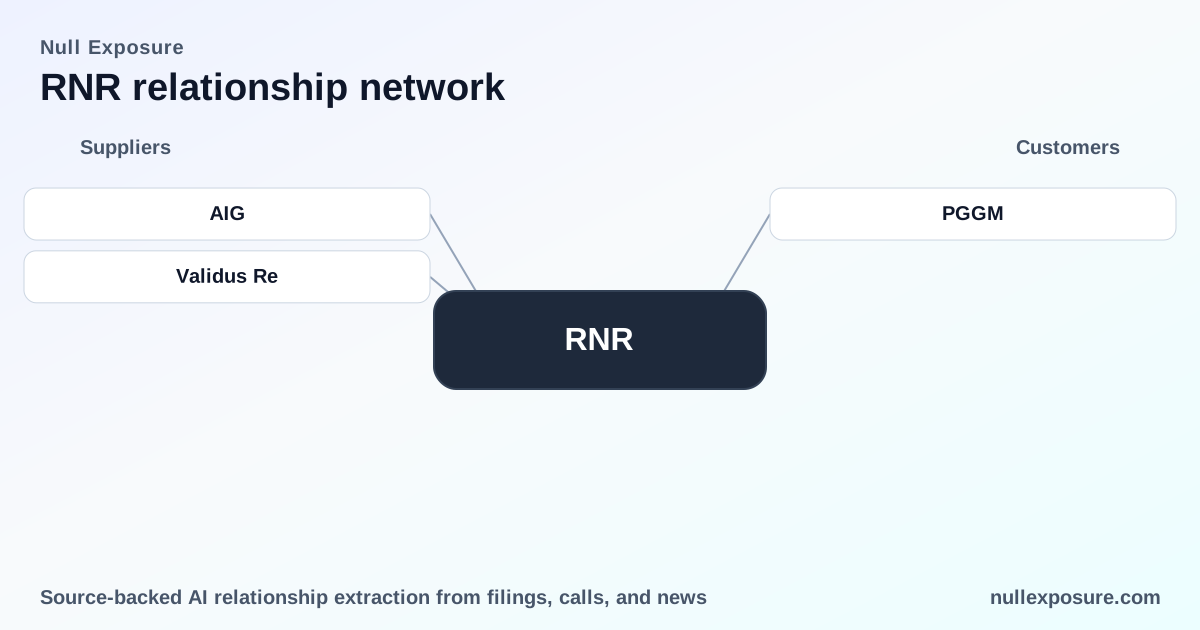
Below are the supplier and counterparty relationships identified in public reportage and how they matter operationally.
AIG — the seller of Validus assets to RenaissanceRe
RenaissanceRe acquired Validus Re and related businesses from AIG, a transaction that expanded its global property & casualty reinsurance scale and contributed to improved profitability. A TradingView article (Zacks) reported this acquisition and its contribution to RenaissanceRe’s enlarged reinsurance footprint in a March 10, 2026 write-up. (Source: TradingView / Zacks, March 10, 2026 — https://www.tradingview.com/news/zacks:eed78ed25094b:0-here-s-why-renaissancere-shares-are-attracting-prudent-investors-now/)
Validus Re — integrated platform driving scale
The Validus Re businesses, acquired from AIG, are now part of RenaissanceRe’s global P&C reinsurance operations and are cited as a key source of incremental premium and underwriting leverage following the deal. The same March 2026 coverage highlights the role of the Validus assets in boosting scale and margins. (Source: TradingView / Zacks, March 10, 2026 — https://www.tradingview.com/news/zacks:eed78ed25094b:0-here-s-why-renaissancere-shares-are-attracting-prudent-investors-now/)
(These two items represent the current public relationship mentions; both are recorded in media coverage tied to the Validus/AIG transaction in early 2026.)
How the relationship mix changes the risk and opportunity profile
The combination of acquisition-driven scale and a broker-heavy distribution network creates a clear set of investment implications:
- Concentration is a critical operational constraint. With three brokers supplying over 80% of GPW, distribution consolidation poses a single-point-of-failure risk for new business flows and pricing negotiation leverage. This is a company-level concentration disclosed in the 2025 filings and must be monitored after any further broker consolidation.
- Short-term contracting enables tactical advantage but increases cyclical exposure. RenaissanceRe’s reliance on annually renewed retrocession and opportunistic buying in the Property segment lets the company dynamically respond to market pricing, but it also means underwriting economics can swing rapidly between years as capacity and price shift.
- Recoverables concentration is material to balance sheet resilience. The top-three reinsurers’ share of reinsurance recoverables (12.6%, 10.1%, 7.0% at year-end 2025) imposes a need for ongoing credit surveillance and collateral terms in retrocession arrangements.
- Dual role complexity increases counterparty monitoring needs. Acting as both buyer and seller of protection means RenaissanceRe faces correlated exposure: counterparties that underwrite capacity for RNR can also be counterparties for recoverables and retrocession, so counterparty stress can propagate through both premium flow and asset-side recoverables.
For operators and procurement teams, the practical takeaways are to secure favorable renewal terms, prioritize counterparty collateral and ratings, and diversify broker channels where possible. For investors, stress testing the P&L under both hard- and soft-market renewal scenarios will surface valuation sensitivity given the firm’s leverage to annual market cycles.
Explore a structured view of these supplier dynamics on https://nullexposure.com/ if you want a consolidated supplier map and historical concentration tracking.
Valuation context and what to watch next
RenaissanceRe’s public financial metrics support a thesis of underwriting-driven earnings with low market beta (beta ~0.23) and a compelling trailing P/E (~5.24) as of the latest published figures, reflecting sizable underwriting profitability and substantial investment returns embedded in the balance sheet. The acquisition of Validus-related businesses materially increases scale, which improves operating leverage but also raises integration and counterparty monitoring obligations.
Key monitoring items for the next 12–18 months:
- Renewal outcomes for major retrocession programs at annual renewal dates.
- Broker relationships and any shifts following consolidation or contractual renegotiations.
- Credit metrics and collateral arrangements for the top reinsurers that account for the largest recoverables balances.
- Integration progress and realized cost/synergy capture from the Validus acquisition.
For deeper supplier-level intelligence and ongoing monitoring of counterparties, visit https://nullexposure.com/ to see how concentrated distribution and counterparty exposures evolve over time.
Final take — what investors should act on now
RenaissanceRe is a capital-efficient, underwriting-centric franchise whose supplier footprint is defined by short-term, annual contracting and high distribution concentration. The acquisition of Validus assets is a clear scale enhancer, but investors must price in the operational reality that a small number of brokers and a handful of large reinsurance counterparties materially influence both top-line access and balance-sheet risk. Monitor renewals, collateral protections, and broker-dependency metrics closely as these are the levers that will drive upside capture or downside vulnerability next cycle.
For a curated supplier report and ongoing alerts on these exact dynamics, go to https://nullexposure.com/ and subscribe for continued coverage and counterparty mapping.