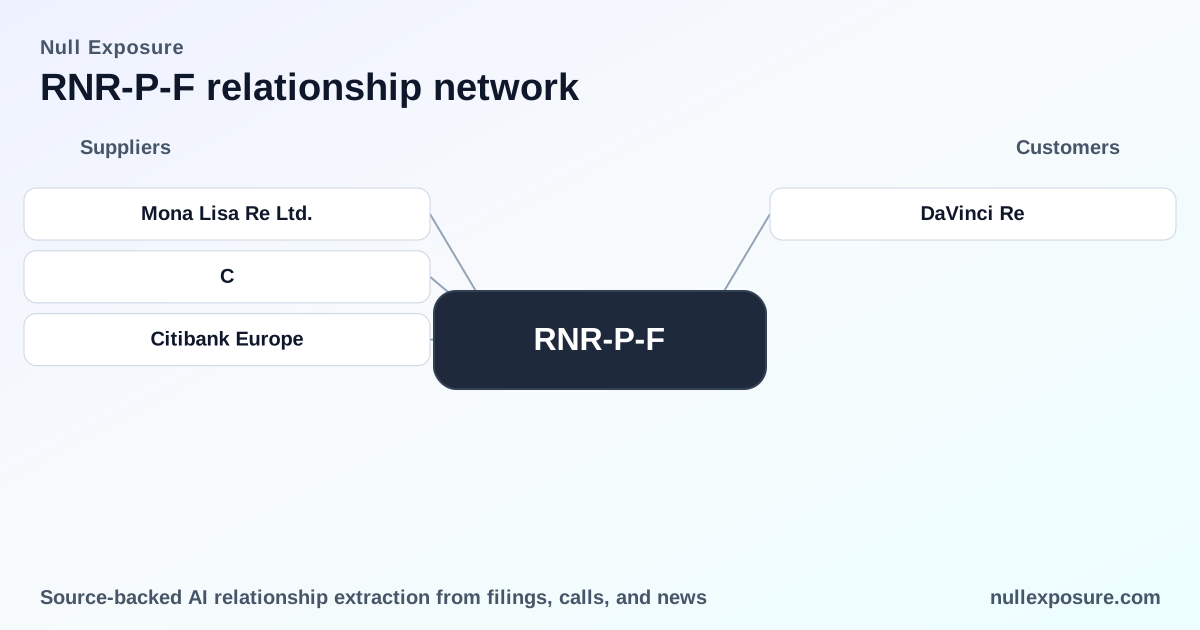
RenaissanceRe (RNR-P-F): Supplier Relationship Brief for Investors
RenaissanceRe monetizes underwriting expertise and balance-sheet capacity by writing property and casualty reinsurance, then managing the float through investment operations; the Depositary Shares Series F is a preferred equity instrument that gives investors exposure to that underwriting franchise without common equity upside. Operationally, RenaissanceRe leverages capital markets and bank counterparty facilities to transfer peak catastrophe risk and to smooth collateral requirements, preserving underwriting capacity while managing liquidity.
Explore supplier coverage on NullExposure
Why these supplier links matter to capital allocators
RenaissanceRe’s recent supplier signals reinforce a two-pronged working model: (1) active use of insurance-linked securities and retrocession to offload catastrophe exposure, and (2) reliance on secured bank facilities to support letters of credit and collateral obligations. That combination keeps underwriting capacity active while shifting tail risk off the balance sheet and preserving liquidity for renewals.
Key business-model characteristics this pattern implies:
- Contracting posture: RenaissanceRe executes short- to medium-term financial contracts (cat bonds, LOC amendments) that are renewable and tied to market conditions.
- Concentration: Counterparty concentration is manageable but strategically important — a handful of capital-market vehicles and bank partners deliver outsized operational leverage.
- Criticality: These supplier relationships are functionally critical; they directly affect the company’s ability to meet collateral and reinsurance obligations during stress.
- Maturity: The relationships shown are transactional and tenor-limited, indicating active capital management rather than long-term, fixed-service outsourcing.
Supplier relationships: the facts you need to track
Mona Lisa Re Ltd. — cat bond protection for 2026 programs
RenaissanceRe secured the top-end target of protection for $400 million through the Mona Lisa Re 2026-1 retro catastrophe bond, providing loss-bearing capacity shared with DaVinci Re on the same placement. According to Artemis (March 10, 2026), the deal was upsized to $400 million of protection allocated to RenRe and DaVinci Re under the structure.
Citibank Europe — secured letter of credit facility amendment (press release)
RenaissanceRe and Citibank Europe executed an amendment on December 22, 2025 that extended the secured letter of credit facility’s availability end date to December 31, 2026 and its expiry to December 31, 2027 while leaving other terms unchanged, ensuring continuity of collateral support for an additional year. This update was disclosed in a RenaissanceRe press release reported by The Globe and Mail (Dec. 22, 2025).
Citibank Europe — deed of amendment (market wire)
A trading update echoed the same December 22, 2025 deed of amendment to the secured LOC facility with Citibank Europe, confirming the effective date and the operational continuity of the facility for the company’s collateral needs. TradingView published the notice summarizing the amendment’s effective date and scope (reported Dec. 22, 2025).
What investors should take from these specific links
Together, the cat bond execution and the bank facility amendment show a disciplined funding approach that blends capital markets risk transfer with traditional bank liquidity lines. The $400 million retro cat bond demonstrates active use of capital markets for peak-loss protection, offloading volatility and protecting capital ratios during adverse events. The Citibank Europe amendment signals continuity in collateral logistics, which is essential for reinsurance players that post LOCs to counterparties and clients.
Operational implications and risk profile:
- Counterparty and market access risk: Reliance on a few major banks and structured vehicles concentrates operational dependency; loss of access would materially raise short-term funding costs.
- Liquidity and collateral management: Extensions of secured facilities reduce immediate rollover risk, preserving working capital for underwriting and investment deployment.
- Capital efficiency vs. cost: Cat bonds transfer volatility off the balance sheet but at explicit pricing; the trade-off between volatility reduction and ongoing financing costs is central to net returns.
- Reputational and execution risk: Execution of cat bonds and amendments requires market credibility; successful placements and renewals reinforce pricing power.
Key implications for investors:
- Preferred shareholders benefit from the firm maintaining capital buffers and reduced earnings volatility, but returns depend on the company sustaining access to these financing channels.
- Monitor renewal timelines and counterparty concentration (e.g., major banks and repeat capital-market arrangers) given the material operational dependency they represent.
- Watch pricing trends in the ILS market and bank funding spreads to understand how hedging costs could evolve vs. historical norms.
Dig deeper into supplier risk and counterparty exposures
Bottom line: what to watch next
RenaissanceRe is executing a clear capital-management playbook: use capital markets (cat bonds) to move downside volatility off the balance sheet, and keep bank facilities current to manage collateral needs and liquidity windows. For investors in RNR-P-F, the immediate takeaway is structural: the preferred series sits on a balance sheet that actively manages catastrophe risk through external protections and short-dated bank facilities—an approach that supports stability in stressed scenarios but depends materially on uninterrupted market and bank access.
Review the timelines on the Citibank facility and the placement calendar for future cat bond issuances as leading indicators of operational continuity and cost of risk transfer. If those channels remain open and competitively priced, the company’s capital position and preferred-holder security profile strengthen; if access tightens, funding costs and collateral strain will be the first-order impacts.
For ongoing tracking and supplier analytics, visit NullExposure for curated updates and supplier-risk intelligence: https://nullexposure.com/