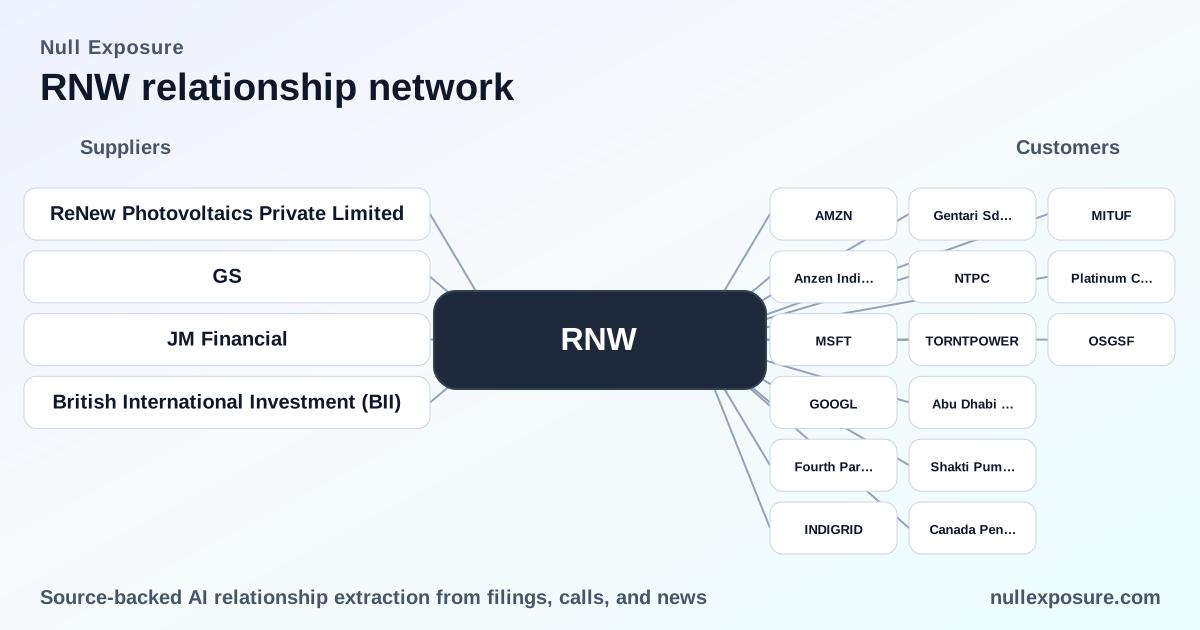
RNW Supplier Network: What Investors Should Know About ReNew's Strategic Alliances
Renew Energy Global PLC (RNW) builds, owns and operates renewable-generation assets and monetizes through project development, long-term power sales and asset-level financing; the company captures margin by controlling project origination, construction and operations while selectively monetizing assets into the capital markets. Recent supplier and advisor disclosures show RNW is pushing vertical integration in solar cell supply while lining up capital markets advisers and development finance to underwrite growth — a configuration that lowers operating cost exposure on modules while concentrating execution risk into a few strategic partners. For more supplier intelligence and relationship tracking, visit https://nullexposure.com/.
Four relationships that matter right now — concise view
RNW’s public mentions in news coverage identify four partners with distinct operational and financial roles: an internal cell manufacturing arm, two investment banks retained for a capital markets transaction, and a development-finance investor that provided project expansion capital. Below are plain-English takeaways for each.
ReNew Photovoltaics Private Limited
ReNew Photovoltaics is RNW’s in‑house solar cell unit that will primarily serve the company’s own project pipeline while selling excess capacity to third parties, effectively creating an internal supply channel that lowers module procurement exposure. This arrangement was reported in SolarQuarter in May 2025 and described as serving internal project needs with surplus capacity available to external buyers (SolarQuarter, May 2025).
Goldman Sachs
Goldman Sachs was named among the investment bankers RNW selected to manage a proposed U.S. listing and other capital markets work, indicating RNW is outsourcing major transactional execution to global banks. VCCircle reported that RNW picked Goldman Sachs as part of the advisor group for the contemplated IPO process (VCCircle, March 2026).
JM Financial
JM Financial sits alongside Goldman Sachs on the advisor roster RNW assembled for its proposed U.S. delisting/IPO activity, representing regional capital markets capability to complement global lead managers. VCCircle’s coverage of the transaction listed JM Financial as one of the selected bankers (VCCircle, March 2026).
British International Investment (BII)
British International Investment provided a $100 million financing tranche to support a 4 GW cell-facility expansion at the Dholera site, supplying project-level capital to accelerate RNW’s vertical integration into cell manufacturing. VCCircle reported the $100 million BII investment tied to the new 4 GW cell facility (VCCircle, March 2026).
How these relationships change the operating model — what investors should extract
The combination of an internal cell plant plus targeted external financing and capital markets advisers reveals a deliberate move toward vertical integration paired with active capital-market dependence.
- Contracting posture: RNW is shifting from a pure-offtaker/operator posture to a hybrid owner-manufacturer model. The ReNew Photovoltaics facility signals a move to insource an essential upstream input — solar cells — which reduces supplier price exposure but increases RNW’s capex and operational responsibilities.
- Concentration of execution: Selecting two lead advisers for a high-profile transaction concentrates transactional capability into a small group of banks, which accelerates execution but raises single-point dependency on those advisers for pricing and distribution outcomes.
- Criticality: Internal cell manufacturing is operationally critical to project gross margins; development finance from BII is financially critical to fund capacity expansion. Both categories matter for on-time project delivery and long-term margin expansion.
- Maturity and risk profile: The Dholera cell plant and related funding indicate RNW is in a growth-and-capex phase where near-term cash needs and execution risk are elevated relative to steady-state asset management.
Note: there are no supplier-specific constraint documents disclosed in the available coverage; as a company-level signal, this suggests RNW’s supplier base did not present formal legal or regulatory constraints in the reviewed sources.
For clients evaluating supplier risk or partnership exposures, our platform tracks these dynamics and how they affect credit, procurement and strategic flexibility — learn more at https://nullexposure.com/.
Practical implications for portfolio and operations teams
The four relationships create distinct lines of opportunity and risk:
- Margin upside via vertical integration: Internalizing cell production reduces cost of goods sold for new solar builds and supports tighter gross-margin control once the plant hits steady-state output.
- Execution risk and capex burden: Building and operating manufacturing capacity introduces plant-level operational risk and increases RNW’s short-term capital intensity; delays or underutilization would compress returns.
- Market access and timing: Retaining Goldman Sachs and JM Financial signals RNW intends to use capital markets to either recycle capital or scale faster; the success of those efforts depends on market conditions and distribution execution.
- Strategic financing precedent: BII’s $100 million injection is a signal of institutional development capital appetite, which lowers funding friction for the Dholera expansion and can attract follow-on development financiers.
Risk and opportunity checklist for investors
- Operational leverage: Internal cell production increases operating leverage; model sensitivity to plant utilization is a priority.
- Funding runway: Monitor project-level financing and RNW’s capital markets timetable tied to adviser activity.
- Counterparty concentration: A small group of strategic partners (banks, BII, internal manufacturing) concentrates both bargaining power and failure modes.
- Regulatory and market exposure: Manufacturing in Dholera creates country- and site-specific delivery risk that affects asset-level returns.
- Commercial optionality: Excess cell capacity sold to third parties creates a revenue stream and reduces market skew on module pricing.
Bottom line and recommended next steps
RNW’s current supplier and adviser set shows a clear strategic pivot: vertical integration to secure input cost and targeted external capital to finance growth. Investors should treat the ReNew Photovoltaics rollout as the most material supplier change (impacting margins and capex), and the Goldman Sachs/JM Financial pairing as the primary mechanism for liquidity events or capital recycling. BII’s financing reduces near-term funding risk for the Dholera expansion but does not eliminate operational execution risk.
For a deeper supplier-risk profile, counterparty concentration metrics and ongoing alerts on changes to these relationships, visit our portal at https://nullexposure.com/ — we maintain continuous monitoring and contextual analysis tailored to investor diligence. For a bespoke supplier-risk briefing on RNW, contact our team through https://nullexposure.com/.
Sources referenced: SolarQuarter report on ReNew Photovoltaics (May 2025) and VCCircle coverage of RNW’s advisor selection and BII financing (March 2026).