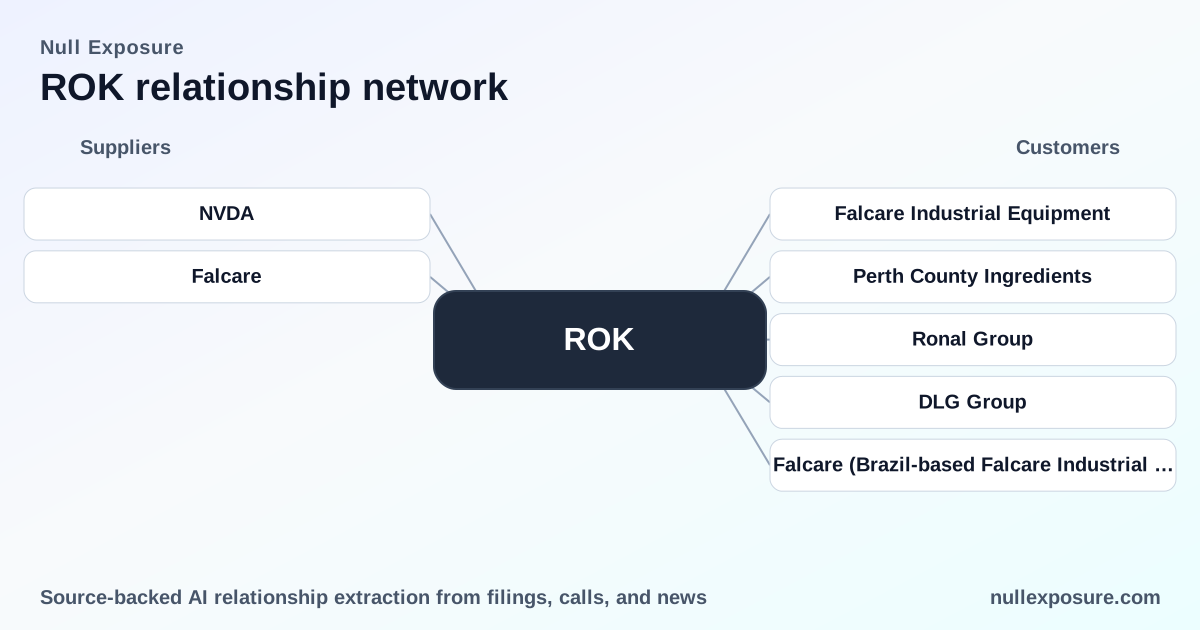
Rockwell Automation (ROK): Supplier Relationships and Strategic Constraints Investors Should Price In
Rockwell Automation operates as a global supplier of industrial automation hardware, software and services—commercializing through branded products (Allen‑Bradley), a software stack (FactoryTalk), recurring software and services contracts, and engineered solutions for large manufacturers. Revenue comes from product sales, subscription and software licenses, and high‑margin services and integration projects, supported by a capital structure that mixes long‑term notes with near‑term credit facilities. For analysts and procurement managers, supplier partner activity is a leading indicator of where Rockwell is positioning its platform play in automation and logistics. Learn more at NullExposure.
Quick financial snapshot for context
Rockwell is a mature industrial leader with a market capitalization of ~$40.9B and trailing twelve‑month revenue of $8.57B (latest quarter 2025-12-31). Profitability is healthy: operating margin ~17.5% and net profit margin ~11.6%, while returns on equity are strong (~23.7%). Valuation is premium — trailing P/E ~41.7 and forward P/E ~30.1 — which prices in continued software and services growth and margin resilience. Institutional ownership is high (~88%), indicating concentrated professional investor interest and scrutiny on strategic partnerships.
Supplier relationships that are currently material
Below I cover every supplier relationship surfaced in recent coverage and explain practical investor implications.
NVIDIA — embedding AI and robotics into logistics
Rockwell announced a collaboration to advance intelligent automation and mobile robotics, integrating NVIDIA technologies with OTTO Motors by Rockwell Automation to produce next‑generation autonomous mobile robots. This partnership accelerates Rockwell’s roadmap for edge compute and AI‑enabled logistics solutions and ramps up potential software and solutions revenue streams as customers adopt autonomous material‑handling. According to an InvestingNews piece dated March 10, 2026, the initiative targets manufacturing logistics and intelligent automation at scale (InvestingNews, FY2026).
Why this matters: NVIDIA’s compute stack increases Rockwell’s addressable software opportunity and strengthens the FactoryTalk/robotics value proposition.
Falcare — project delivery and cost reduction for an end‑user
A press release covered by The Globe and Mail in March 2026 describes Rockwell’s role accelerating project delivery and reducing costs for Falcare, highlighting the company’s execution capabilities on customer projects and systems integration. This is a classic services‑led engagement that converts product relationships into recurring service and maintenance revenue (The Globe and Mail, FY2026).
Why this matters: Execution wins like Falcare convert installed base into annuity‑style revenue and validate Rockwell’s ability to capture system integration margins.
Operating constraints and what they reveal about the business model
Company‑level filings and credit documents show Rockwell runs a mixed contracting posture that balances long‑term capital commitments with short‑term liquidity instruments:
- Rockwell maintains long‑dated debt instruments and multi‑year credit facilities — examples include notes due in 2031 and 2061 and a $1.5B five‑year credit agreement (dated June 29, 2022) referenced in SEC filings — signaling a willingness to lock in long‑term capital to fund strategic initiatives and M&A (Form 8‑K filings and exhibits, 2021–2022).
- Rockwell also uses short‑term instruments: SEC exhibits reference short‑dated notes and a $500M 364‑day term loan documented in a May 19, 2025 filing, indicating active working capital and liquidity management.
These constraint signals imply several business model characteristics:
- Maturity management: The combination of long‑term notes and short‑term credit shows Rockwell manages a laddered debt profile rather than concentrating maturities in a single window, reducing refinancing risk while preserving flexibility for strategic investments.
- Contracting posture: The firm pairs long‑term strategic commitments (product roadmaps, platform partnerships) with near‑term financing to fund working capital and project delivery cycles; this supports both recurring services revenue and capital expenditure on robotics/AI initiatives.
- Concentration and criticality: High institutional ownership and Rockwell’s centrality in automation ecosystems make it a critical supplier for industrial customers; strategic partnerships with technology providers like NVIDIA increase its system stickiness and competitive differentiation.
(Sources: Rockwell SEC exhibits and current reports referencing notes and credit agreements, 2021–2025.)
What these supplier ties mean for investors and operators
Rockwell’s supplier relationships and contracting profile create a set of predictable investment implications:
- Growth lever: software + robotics integration. The NVIDIA collaboration is a direct acceleration of Rockwell’s higher‑margin software and solutions strategy; investors should expect modular revenue upside as robotics and AI are bundled into subscription and services offerings.
- Execution risk is measurable but contained. Project wins like Falcare validate implementation capability and are important to convert product sales into recurring revenue; successful rollouts lower churn and increase lifetime value.
- Capital structure supports scale but demands discipline. Long‑term notes and a $1.5B facility provide firepower for product development and strategic M&A, while short‑term facilities indicate ongoing reliance on commercial liquidity for project cycles.
If you want a concise vendor risk or opportunity brief tied to these relationships, visit NullExposure for structured supplier intelligence.
Practical checklist for investors and procurement teams
- Track adoption metrics for robotics‑enabled solutions and FactoryTalk integrations as the leading indicator of recurring software revenue.
- Monitor rolling liquidity indicators and maturity schedule given the mix of long‑dated notes and 364‑day credit facilities.
- Watch customer case studies (like Falcare) for proof of decreased deployment time and improved TCO — those translate directly into commercial and renewal momentum.
These points summarize how supplier relationships translate into measurable P&L drivers.
Bottom line: position for platform expansion, not just hardware
Rockwell is executing a platform transition: hardware sales continue to provide a durable revenue base, but the strategic partnerships and a deliberate financing mix enable a push into software, AI, and robotics that expand margin opportunity and customer lock‑in. For investors, the key variables are the speed of software monetization, proof points from early robotics deployments, and the company’s ability to manage a mixed maturity debt profile without eroding margin for growth. For operators and procurement, Rockwell’s ecosystem partnerships reduce integration friction and create a clearer path to automation ROI.
For a deeper supplier risk or strategic partner brief, see NullExposure.