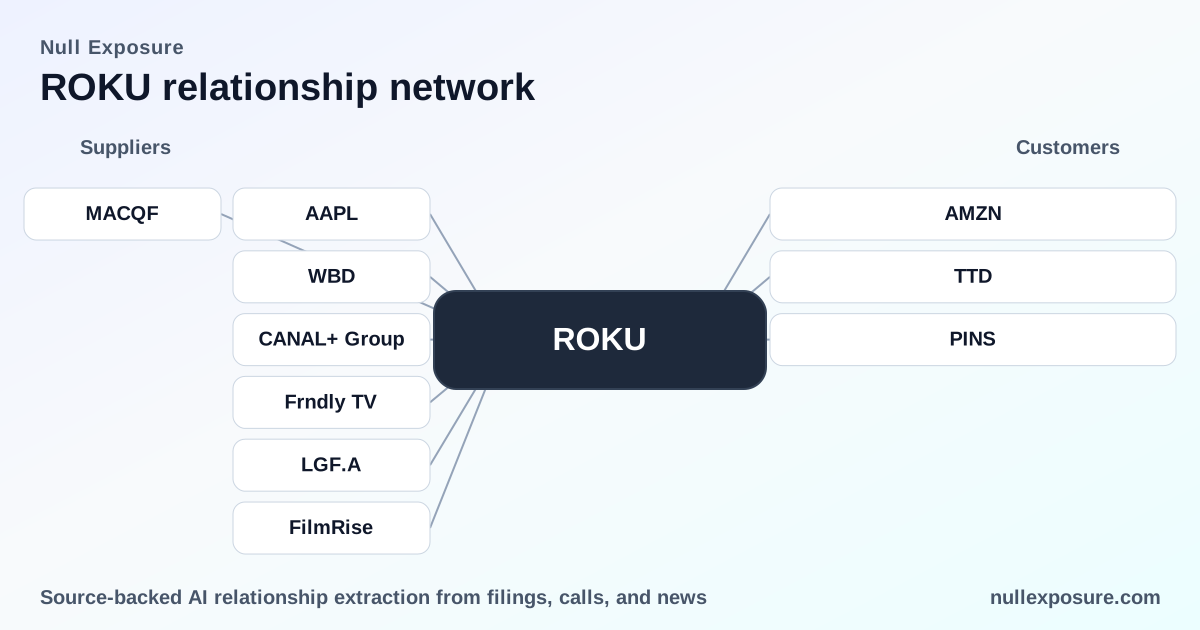
Roku’s supplier map: content partners, manufacturers and what they mean for investors
Roku operates a TV-streaming platform that monetizes across three vectors: advertising on its platform, subscription revenue from The Roku Channel and device sales/licensing to hardware partners. The company grows by expanding content supply and premium subscriptions while controlling costs through outsourced manufacturing and multi-year purchase commitments. For investors, supplier relationships are a direct lever on content depth, platform engagement, and device availability — all of which translate into ad load, subscription ARPU and unit economics. Learn more about supplier signals and how they move Roku’s P&L at https://nullexposure.com/.
How Roku’s supplier posture shapes cashflow and risk
Roku blends media partnerships with hardware outsourcing. Content partners drive engagement and subscription revenue, while contract manufacturers and long-term purchase commitments underpin device supply and gross margin stability. Company disclosures show non-cancelable purchase commitments and outsourced manufacturing, indicating a contracting posture that is tilted to long-term relationships and concentrated manufacturing geographies.
- Contracting posture: Roku holds non-cancelable purchase commitments for licensed content, manufacturing agreements and data center capacity, which creates predictable outflows and price exposure over time.
- Manufacturing concentration: All Roku products are manufactured in China, Southeast Asia, Brazil and Mexico, a geography mix that reduces single-country concentration but leaves the company exposed to regional disruptions.
- Spend scale and maturity: Commitments reported aggregate into the hundreds of millions, signifying mature, high-dollar supplier relationships rather than nascent ad-hoc deals.
- Operational criticality: Suppliers function as either content suppliers (critical to growth and ARPU) or manufacturers (critical to unit supply and margin). Both are strategically important to Roku’s operating model.
These company-level constraints signal both stability (long-term contracts) and supply-chain risk (geographic concentration and large committed spend). If you want supplier-level intelligence feeds and a distilled impact model for portfolio due diligence, visit https://nullexposure.com/ for structured supplier risk analysis.
Supplier relationships that matter — itemized coverage from recent reporting
Apple (AAPL) — premium subscription distribution
Roku added Apple TV as a Premium Subscription offering inside The Roku Channel in the U.S., positioning Apple’s premium catalogue as a revenue-sharing subscription for Roku and a stickier content bundle for users. This was reported by SahmCapital in March 2026 and reinforced by market notices in early 2025.
Warner Bros. Discovery (WBD) — content supplier for low-cost service
USA Today highlighted Warner Bros. Discovery as a content partner for Roku’s new low-cost, ad-light service, indicating Roku aggregates major studio library rights to populate free and subscription tiers and drive user acquisition (USA Today, Aug 5, 2025).
CANAL+ Group — international distribution partnership
WorldScreen reported a distribution deal with the CANAL+ Group that expands access to international series on The Roku Channel across the U.S., U.K., Mexico and Canada, strengthening Roku’s international content slate and multicultural reach (WorldScreen, FY2025).
Frndly TV — acquisition agreement to add live and DVR capabilities
According to AdGully, Roku entered an agreement to acquire Frndly TV, a low-cost subscription service offering live TV, on-demand and cloud DVR, which signals Roku’s push to own more subscription product capability and live-TV distribution mechanics (AdGully, FY2025).
Lionsgate (LGF.A) — licensed movie and TV content
USA Today lists Lionsgate among the studio partners supplying movies and TV shows to Roku’s service, reinforcing Roku’s reliance on established studio libraries to build programming depth (USA Today, Aug 5, 2025).
Apple Inc. (AAPL) — confirmation of channel launch activity
MarketScreener noted Roku’s March launch activity adding Apple TV to The Roku Channel in the U.S., a Near-term distribution milestone that supports incremental subscription monetization and cross-platform user retention (MarketScreener, Mar 2025).
FilmRise — supplementary content partner
FilmRise is identified by USA Today as a content supplier that Roku aggregates for its streaming tiers, providing additional catalog titles that improve free-tier engagement and long-tail viewing options (USA Today, Aug 5, 2025).
Apple TV — product-level listing and premium placement
A Marketscreener release repeated the operational detail that Apple TV is added to Roku’s premium subscription lineup, underscoring the tactical execution of placing premium bundles within The Roku Channel to capture subscription revenue (MarketScreener, Mar 2025).
THEMA (CANAL+ subsidiary) — curated international series and distribution
WorldScreen covered a deal with THEMA, a CANAL+ company, to add multiple international series to The Roku Channel in several markets; THEMA’s CEO highlighted multicultural storytelling as a distribution priority for Roku’s platform (WorldScreen, FY2025).
What investors should take away — risk, upside and monitoring priorities
- Content partnerships are revenue multipliers. Large studio deals and premium channel add-ons (Apple TV, Lionsgate, WBD) directly increase subscription and ad inventory value, improving monetization per active account.
- Manufacturing commitments are a balance of control and concentration. Long-term purchase commitments and outsourced manufacturing yield predictable supply but create exposure to regional manufacturing disruptions in China, Southeast Asia, Brazil and Mexico.
- M&A and product consolidation accelerate capability ownership. The agreement to acquire Frndly TV shifts Roku from aggregator to operator in the live-TV/subscription domain, increasing control over product economics.
- Spend intensity signals strategic dependence. Reported multi-hundred-million commitments imply that supplier disruptions or price changes could have meaningful margin impact.
Key monitoring items for investors: studio licensing renewals and economics, progress integrating Frndly TV, device shipment cadence versus committed volumes, and any interruption tied to the identified manufacturing geographies. For ongoing supplier scoring and to integrate these signals into investment models, see the curated vendor risk reviews at https://nullexposure.com/.
Final verdict for investors
Roku’s supplier footprint combines high-value content deals and high-dollar manufacturing commitments, creating a hybrid risk-return profile that supports aggressive subscriber monetization while leaving the company exposed to supply-chain and licensing concentration risks. Investors should treat Roku’s supplier relationships as first-order drivers of revenue growth and margin variability; watch premium channel distribution, studio renewals, and manufacturing cadence for the quickest read on future revenue and margin trajectory.
For granular supplier intelligence and timely updates to inform portfolio decisions, explore supplier analytics and research tools at https://nullexposure.com/.