Rollins Inc. (ROL): Supplier relationships and commercial signals investors need to price
Rollins is a North American consumer and commercial pest-control services company that monetizes through recurring service contracts, technician labor and the sale and distribution of pest-treatment products. Its economics combine subscription-like revenue from repeat service visits with ancillary product sales and localized pricing power, and the company supplements growth with national marketing campaigns (notably on major social platforms) to drive lead flow and retention. For a concise vendor and supplier risk picture that matters to underwriters and operators, review Rollins’ supplier posture and disclosed vendor relationships at https://nullexposure.com/.
Financial backdrop investors should keep top of mind
Rollins generates $3.76 billion in trailing revenue with an operating margin of ~17.6% and ROE near 39%, supporting a market capitalization around $26.5 billion and a premium valuation (trailing P/E ~50x). These metrics reflect a service business with strong unit economics and steady cash flow, but also a valuation that prices in continued organic growth and efficient service delivery. High operating leverage and recurring contracts make supplier continuity — from chemical manufacturers to payment processors — economically critical to preserving margins.
What the media relationships signal about demand generation
Rollins’ marketing has accelerated on digital platforms, which investors should read as a deliberate shift in customer acquisition strategy toward scalable, performance-based channels. According to a TradingView recap of a Zacks preview dated March 10, 2026, Rollins increased media engagements on social platforms like Facebook and TikTok to broaden mass popularity and lead generation. This digital advertising push supports recurring revenue growth and helps amortize fixed field costs across more accounts.
Explore supplier intelligence and disclosure analytics for Rollins at https://nullexposure.com/.
Supplier relationships identified in recent coverage
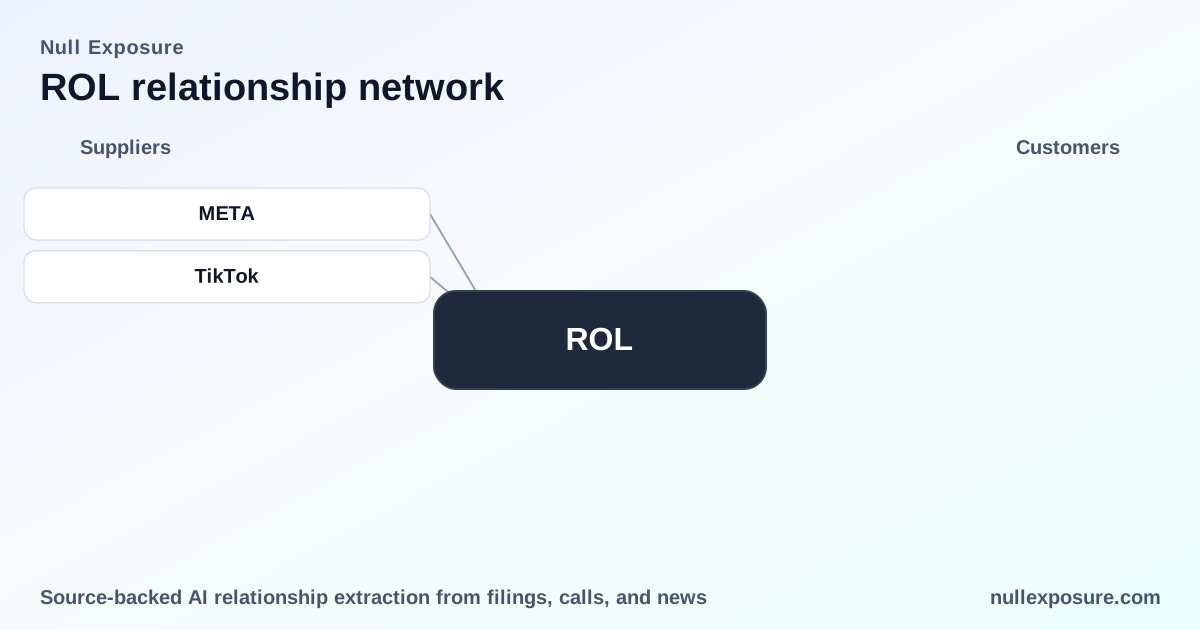
Rollins shows up alongside large social platforms in media coverage, reflecting the company’s advertising strategy rather than a procurement relationship in the classic supply chain sense. The coverage identifies two platform exposures:
Facebook (Meta Platforms, Inc.)
Rollins is increasing advertising presence on Facebook to drive brand awareness and service demand; TradingView’s summary of Zacks’ Q4 reporting notes the company’s accelerated media engagements through Facebook as a factor in its mass-market reach (TradingView / Zacks, March 10, 2026). https://www.tradingview.com/news/zacks:a61b57315094b:0-rollins-gears-up-to-report-q4-earnings-what-s-in-the-offing/
TikTok
The company also leverages TikTok for advertising in the same campaign set, with coverage pointing to expanded video and social advertising on TikTok as complementary to Facebook activity in driving customer acquisition (TradingView / Zacks, March 10, 2026). https://www.tradingview.com/news/zacks:a61b57315094b:0-rollins-gears-up-to-report-q4-earnings-what-s-in-the-offing/
Both citations reflect the same March 2026 market commentary and should be interpreted as evidence of a marketing channel shift rather than a supplier dependency in the manufacturing chain.
What Rollins’ disclosed supplier constraints reveal about operational risk
Rollins’ public disclosures and vendor excerpts highlight three company-level supplier roles: distributors, manufacturers, and service providers. These are material operating signals for investors and procurement teams.
- Rollins states it maintains relationships with a vast network of national pest-control product distributors and manufacturers, indicating a wide procurement base for treatment chemicals and equipment. This diversity reduces single-vendor concentration risk but creates emphasis on logistics and inventory continuity during supply shocks.
- The company acknowledges reliance on third-party payment processors, cloud service providers and telecommunications carriers, which makes digital transaction infrastructure and data services operationally critical to revenue capture and customer management.
- The mixture of distributor and manufacturer relationships points to a hybrid procurement posture: Rollins buys finished products through distributors while also engaging manufacturers — a structure that preserves bargaining flexibility but requires active vendor management to control input costs.
Key constraint takeaways: broad supplier coverage lowers concentrated supplier risk, while dependency on payment and cloud service providers raises the operational criticality of those partners. These are company-level signals derived from Rollins’ disclosures and should be factored into counterparty and continuity planning.
Operational implications for investors and operators
Rollins’ supplier and marketing footprint creates a set of practical consequences for investors and on-the-ground operators:
- Marketing-driven growth supports scale: The move into Facebook and TikTok advertising is a capital-light way to expand the addressable customer base and should improve utilization of the existing technician network.
- Input cost management remains pivotal: Even with a broad distributor/manufacturer network, chemical and equipment pricing volatility can compress margins quickly because field labor is relatively fixed in the near term.
- Third-party service risk is concentrated and critical: Payment processors and cloud vendors are single points of failure for transaction flow and customer experience, so operational resilience in those relationships is essential.
For procurement professionals and risk teams, prioritize continuity contracts with chemical suppliers and redundant arrangements for payments and hosting services. Learn more about supplier impact analysis and disclosure signals at https://nullexposure.com/.
Investment conclusion and action points
Rollins is a high-quality service franchise with repeatable revenue, attractive margins and strong return metrics, but investors must underwrite vendor continuity and digital-ad efficiency to justify the valuation multiple. The company’s explicit use of Facebook and TikTok advertising signals a scalable demand engine; its disclosed reliance on national distributors, manufacturers and service providers frames where operational risk lives.
- For investors: monitor advertising ROAS and procurement cost trends as leading indicators of margin sustainability.
- For operators and suppliers: focus on contract continuity with chemical distributors and establish redundancy for payment and cloud services.
For deeper supplier analytics and ongoing tracking of Rollins’ vendor and media exposures, visit https://nullexposure.com/.