RONB (Baron First Principles ETF) — supplier profile and implications for counterparties
Thesis: RONB is an exchange-traded fund issued by Baron Capital under the Baron First Principles ETF brand; it monetizes through traditional ETF economics—management and operating fees charged to assets under management—while relying on a small set of critical service providers (sponsor, custodian, transfer agent, market makers and distribution partners) to deliver trading liquidity and NAV integrity. Investors evaluating supplier relationships for RONB should prioritize sponsor capabilities, launch maturity and counterparty concentration because these factors drive revenue durability and operational risk.
For a quick look at how we map supplier exposures for funds like this, visit https://nullexposure.com/.
Why supplier relationships matter for a newly launched ETF
An ETF’s commercial success is intrinsically tied to its suppliers. The sponsor defines investment strategy and fee economics, while custody, transfer agency and market-making partners determine whether the fund can attract assets and maintain tight spreads. For a fund launched recently, supplier concentration and the maturity of commercial relationships are the primary operational risks: newly signed contracts and limited distribution history create execution exposure early in the lifecycle, and sponsors shoulder the behavioral risk of initial seed capital and marketing.
A notable signal for RONB: there are no explicit supplier constraints recorded in the relationship data, which is itself meaningful—the public record we have does not disclose contracted limitations or named third-party constraints, so diligence must extend to primary documents and counterparty confirmations rather than relying on summary disclosures.
What the public record shows about RONB’s supplier relationships
Concrete relationship coverage (complete):
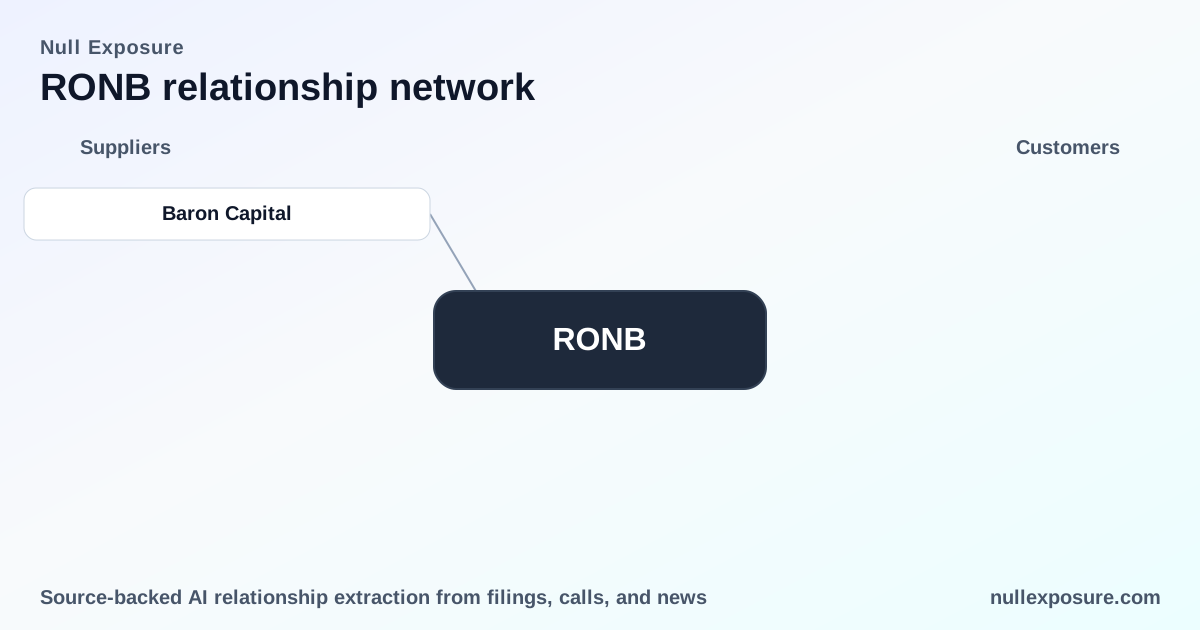
- Baron Capital — In mid-December Baron Capital launched the Baron First Principles ETF (ticker RONB) as part of a five-fund rollout. This establishes Baron Capital as the sponsor and primary commercial counterparty for RONB, responsible for portfolio construction, go-to-market strategy and fee setting. Source: ETF Trends, market insights article (published March 10, 2026) reporting on the mid-December launch.
That is the only relationship recorded in the supplied results. The dataset identifies Baron Capital as the sponsor for RONB and timestamps the public mention to March 10, 2026, referencing a mid-December launch window.
How to interpret that relationship for commercial and operational risk
-
Sponsor centrality — With Baron Capital identified as the sponsor, counterparty risk is concentrated: the sponsor’s distribution muscle, track record and balance sheet capacity determine the fund’s go-to-market success and the likelihood it absorbs early losses or supports seed liquidity.
-
Launch maturity — The fund was launched in mid-December (noted in the March 2026 report), so RONB is early in its commercial lifecycle. Early-stage funds face elevated liquidity and asset-accumulation risk, and supplier commitments (marketing budgets, authorized participant relationships) will determine whether the ETF reaches a self-sustaining scale.
-
Public disclosure gap — The absence of recorded supplier constraints and the single relationship in the available results is a company-level signal: there is limited public reporting of vendor contracts or operational commitments for RONB, so investors and counterparties should treat public filings as incomplete and prioritize primary diligence.
Diligence priorities for investors and operators
Operational and contractual diligence should focus on items that translate directly into trading and NAV stability:
-
Confirm authorized participant and market-maker agreements and whether any market makers have formal quoting obligations. These govern spread and liquidity on the exchange.
-
Validate custody and transfer-agent arrangements, including disaster recovery and settlement chains. Custody concentration elevates settlement risk.
-
Review seed capital commitments and distribution agreements; early asset flows are frequently driven by distribution partners and wholesaling contracts.
-
Confirm fee structure and expense allocation, including any sponsor support for initial expenses, to assess break-even AUM thresholds.
-
Assess sponsor financial strength and track record for similar ETF launches; a sponsor capable of deploying balance-sheet resources reduces the probability of wind-down.
-
Check for regulatory or operational constraints disclosed in filings; the absence of constraints in public search results is not evidence of absence in primary contracts.
Quick risk checklist (operator lens)
- Sponsor concentration: high — sponsor is the single named relationship in public results.
- Maturity: early-stage — mid-December launch with public mention in March 2026.
- Commercial criticality: high — sponsor and distribution partners drive assets under management and fee revenue.
- Public disclosure: limited — no supplier constraints recorded in the dataset; further primary diligence required.
If you want a structured supplier exposure brief for RONB, see how we present supplier-level risk at https://nullexposure.com/.
Market and investor implications
For investors allocating to or trading RONB, the key takeaways are straightforward: expect a period of outsized volatility in spreads and flows until authorized participant and market-maker arrangements are proven, and treat sponsor commitments as the primary counterparty backstop. For operators engaging as potential vendors (custody, transfer agent, market makers), negotiate clarity on quoting obligations, fee arrangements and termination protections—those contractual terms determine whether the relationship is transactional or strategically supportive.
Final recommendations
- Demand primary documentation: sponsor agreement, AP contracts, custody agreement and any marketing/distribution commitments. Public mentions alone are insufficient for operational risk assessment.
- Prioritize counterparties that can commit capital and quoting capacity through an initial growth phase. Sponsor strength and committed market-making are the determinative factors for early-stage ETF survivability.
- Maintain continuous monitoring of announcement cadence and asset flows over the first 6–12 months; the speed of adoption is the clearest predictor of long-term viability.
For a full supplier-exposure analysis and tailored diligence checklist for RONB or similar fund launches, visit https://nullexposure.com/ and request a briefing.