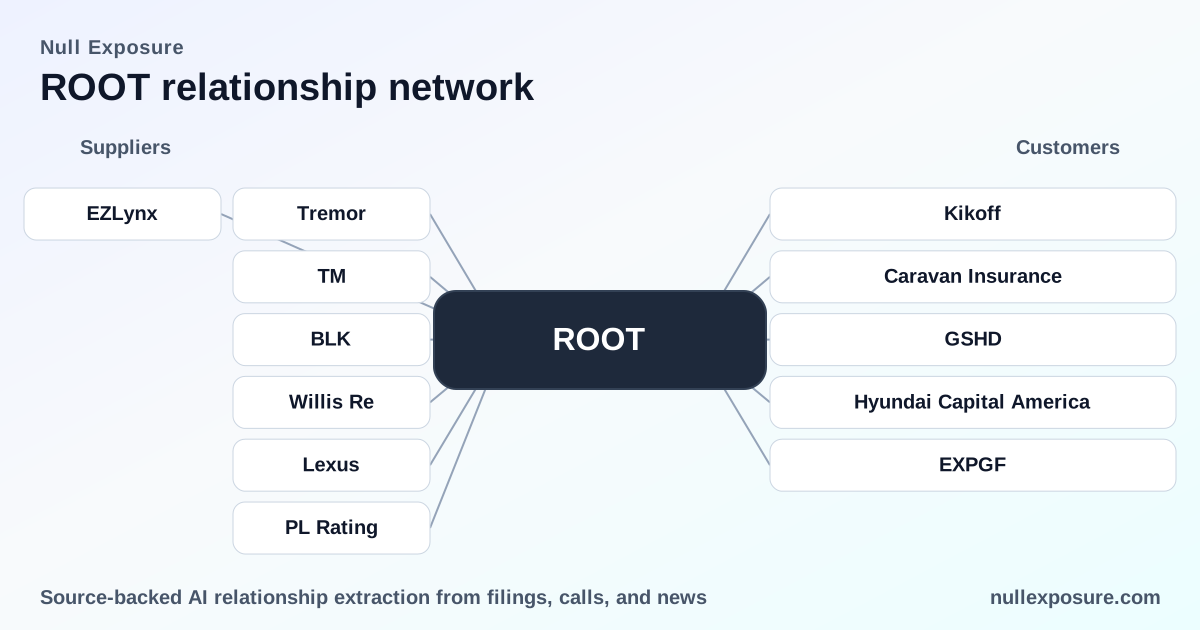
Root Inc (ROOT): supplier map and what it means for investors
Root sells auto insurance by combining telematics, digital distribution, and reinsurance; it monetizes through underwriting margin, platform-led distribution (direct app and increasingly through agency channels), and capital-efficient use of reinsurance and financing to smooth volatility. Root’s economics depend as much on its data-driven pricing and channel expansion as on its counterparty ecosystem — reinsurers, vehicle partners, distribution partners, and critical service vendors. For investors evaluating supplier risk and strategic optionality, the counterparty roster and company-level constraints tell the clearest story about scalability and concentration risk. Visit full coverage for more supplier intelligence: https://nullexposure.com/
How Root partners drive the product in plain English
Root’s product is priced and distributed using telematics and connected-vehicle integrations, then transferred and moderated via traditional insurance plumbing (fronting carriers and reinsurance). That hybrid model leverages modern distribution and legacy risk-transfer partners simultaneously, which reduces capital tied to underwriting but increases dependency on a small set of critical third parties and large reinsurers.
If you want to dig deeper into supplier exposures, start here: https://nullexposure.com/
Active supplier relationships you should know
Tremor Panorama — catastrophe placement partner
Root placed its June property catastrophe program with Tremor Panorama, demonstrating the company’s use of third-party catastrophe placement specialists to manage peak event exposure. According to a GlobeNewswire press release (June 2021), Tremor helped Root execute that cat program quickly (https://www.globenewswire.com/news-release/2021/06/15/2247371/0/en/Root-Inc-and-Tremor-Partner-to-Place-Property-Catastrophe-Program.html).
Willis Re — brokerage support for reinsurance execution
Root worked closely with Willis Re as its broker to coordinate reinsurance placements tied to the same 2021 catastrophe program, highlighting reliance on established reinsurance brokerage expertise to access global capacity. GlobeNewswire reported Root acknowledging Willis Re’s role in executing the program (June 2021) (https://www.globenewswire.com/news-release/2021/06/15/2247371/0/en/Root-Inc-and-Tremor-Partner-to-Place-Property-Catastrophe-Program.html).
Toyota — connected-vehicle telematics collaboration
Root has an ongoing collaboration with Toyota that enables access to real-time telematics from connected vehicles, which Root uses to price and offer insurance instantly at point-of-experience. That alliance was described in a market summary of Root’s 2025/2026 performance (ad-hoc-news, FY2026) (https://www.ad-hoc-news.de/boerse/ueberblick/root-inc-navigates-profitable-growth-amid-costly-expansion-push/68625826).
Lexus — OEM channel extension through the Toyota family
Root’s relationship with Lexus functions alongside the Toyota integration, giving Root a premium OEM channel to price and issue policies based on vehicle telematics and connectivity. The same FY2026 coverage highlighted the Toyota/Lexus collaboration as a material distribution and data channel (ad-hoc-news, FY2026) (https://www.ad-hoc-news.de/boerse/ueberblick/root-inc-navigates-profitable-growth-amid-costly-expansion-push/68625826).
BlackRock — term loan refinancer and financing partner
Root refinanced its term loan with BlackRock in late 2024, exchanging debt economics and maturity profile with an institutional creditor that provides balance-sheet flexibility. Commentary on Root’s refinancing referenced BlackRock’s role in stabilizing Root’s capital structure (Sahm Capital, FY2026) (https://www.sahmcapital.com/news/content/does-roots-root-strong-2025-results-but-softer-q4-profit-reframe-its-profitability-story-2026-03-05).
PL Rating — comparative rater distribution channel
Root launched its product on PL Rating, a comparative rater used by about half of independent agents, expanding its presence into independent agency workflows and accelerating agent appointments. Insurance Journal reported Root’s launch on PL Rating and noted Root is appointed with roughly 4% of independent agents (Insurance Journal, FY2025) (https://www.insurancejournal.com/news/national/2025/08/07/834923.htm).
EZLynx — agent rater integration for wholesaling distribution
Root also rolled out on EZLynx, another widely used comparative rater, which complements PL Rating and broadens the company’s reach into the independent agent ecosystem. Insurance Journal’s FY2025 coverage recorded Root’s launch on EZLynx alongside PL Rating (https://www.insurancejournal.com/news/national/2025/08/07/834923.htm).
Constraints and what they signal about operational posture
Root’s supplier relationships sit inside several company-level constraints that shape contracting, concentration, and criticality.
- Counterparty profile — large reinsurers participate in external reinsurance programs. This signals that Root relies on institutional reinsurance capacity to scale written risk and cap catastrophe exposure; access to that global capacity is a strategic enabler rather than a marginal input.
- Licensing posture — Root uses third‑party technology and IP. The company licenses external technology in certain products, indicating that some capabilities are not wholly proprietary and are subject to third‑party licensing terms and renewal cycles.
- Service concentration — dependence on a single vendor for payment processing and a fronting arrangement in Texas. Root discloses exclusive reliance on one third-party payment processor and routes Texas business through an unaffiliated county mutual fronting carrier; both are single points of operational or regulatory failure that elevate vendor-management risk.
- Active reinsurance posture — ongoing ceding and retrocession. Root actively cedes portions of business to reinsurers, an operational practice that reduces balance-sheet volatility but raises counterparty credit and structural dependency considerations.
- Infrastructure dependence — third-party data centers and a leading cloud provider. Core delivery runs on external cloud and data-center infrastructure, making platform availability and vendor SLAs a material operational factor.
These constraints collectively create a working model that is capital-efficient but vendor-concentrated: Root leverages third parties to scale distribution and risk transfer while retaining underwriting economics, which accelerates growth but increases supplier leverage and critical-path dependencies.
Investment implications — what this supplier map tells you
- Upside vector: OEM integrations with Toyota/Lexus are strategic growth levers because they provide real-time pricing signal and a captive, high-quality customer funnel. If these channels scale, Root’s loss selection and distribution economics improve materially.
- Risk vector: Payment processing concentration and the Texas fronting arrangement are binary operational risks. A vendor failure or a regulatory change around fronting would cause immediate distribution friction and potential capital strain.
- Balance-sheet dynamic: Reinsurance and institutional financing (e.g., BlackRock term loan) are central to Root’s capital strategy; maintaining access to global reinsurance and institutional lenders is critical for volatility management.
- Distribution diversification: Integration with PL Rating and EZLynx signals an intentional pivot into agent channels, which lowers single-channel concentration but requires sustained agent adoption to matter at scale.
Key items for a diligence checklist:
- Confirm SLAs and redundancy for payment processing and cloud infrastructure.
- Validate contract length and exclusivity terms with Toyota/Lexus.
- Review reinsurance counterparty concentration and collateral provisions.
- Map fronting carrier documentation and regulatory contingencies in Texas.
If you want a supplier-risk scorecard tailored to these relationship vectors, start here: https://nullexposure.com/
Bottom line and next steps
Root’s supplier roster mixes modern OEM telematics partnerships and digital distribution integrations with traditional reinsurance, fronting, and financing relationships. That combination enables rapid underwriting scale while creating concentrated dependencies that are both operationally and financially material. For operators and investors, the critical questions are the stability of payment and cloud vendors, the contractual depth of OEM partnerships, and the diversity and strength of reinsurance counterparties.
For actionable supplier intelligence and comparative risk scores for Root and its peers, visit https://nullexposure.com/ — the fastest way to translate supplier relationships into investment signals.