Roper Technologies (ROP): supplier exposures that matter for investors
Roper Technologies is a diversified industrial owner-operator that monetizes through recurring, high-margin software and engineered-product franchises serving niche end markets. The company acquires and operates mission-critical software and instrumentation businesses, collects subscription and service-run revenue, and leverages centralized back-office functions to drive margin expansion across a portfolio that emphasizes predictability over cyclical capital spending. Supplier relationships for Roper are therefore important where third‑party cloud and AI services underpin product delivery or scalability, because those inputs can influence service availability, cost structure, and operating leverage. Explore supplier profiling and supplier risk mapping at https://nullexposure.com/.
How Roper makes money and why supplier exposures matter
Roper’s core strategy is acquisition-led consolidation of niche software and industrial technology franchises that deliver recurring revenue and strong operating margins. Revenue derives from a mix of software subscriptions, maintenance, and engineered product sales; this creates a business model that is sensitive to software service continuity and the unit economics of cloud and AI infrastructure. Given Roper’s emphasis on margin durability, third‑party supplier costs or service interruptions—particularly in cloud and AI—translate directly to operating risk and potential margin compression.
Key business model drivers:
- Recurring revenue and high operating margins, which amplify the impact of input cost changes.
- Acquisition-led growth, which increases reliance on standardized cloud/AI platforms for rapid integration and scale.
- Decentralized portfolio management, which increases the number of product lines exposed to common suppliers.
Supplier relationships disclosed in public materials
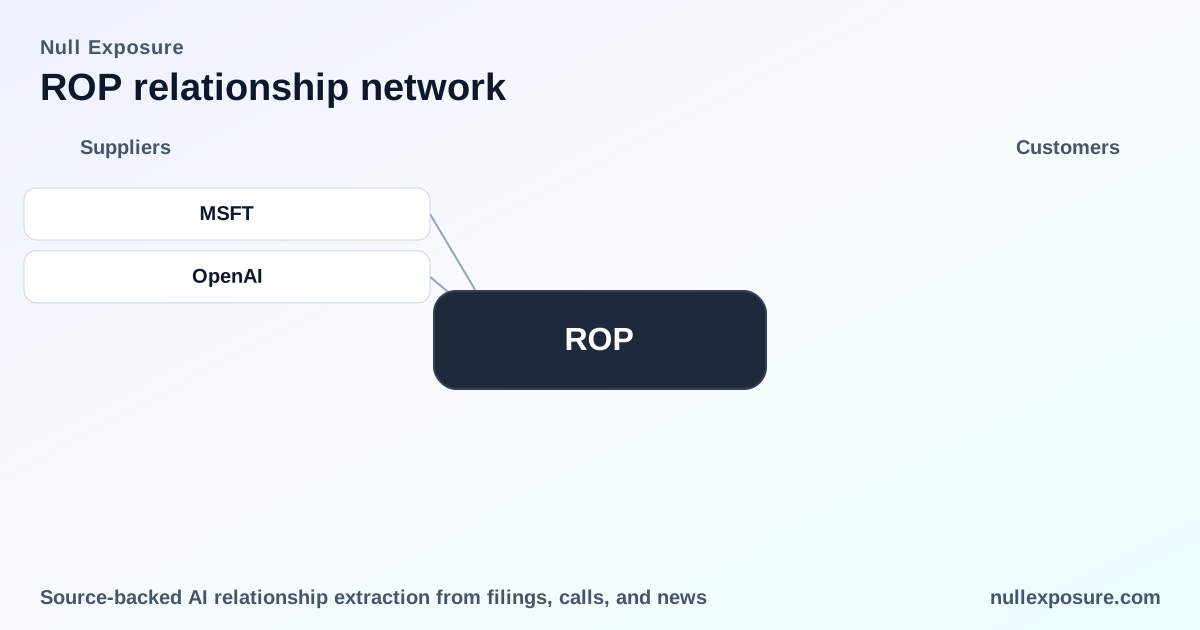
Roper’s public filings and related commentary identify two external technology providers whose services support Roper’s software and AI capabilities. Each relationship has straightforward operational implications for investors.
Microsoft — cloud and AI infrastructure provider
Roper discloses reliance on third‑party cloud computing platforms and associated AI services from major providers such as Microsoft, which creates exposure to service availability and pricing changes that could affect both product uptime and cost of goods sold. According to TradingView’s coverage of Roper’s FY2026 10‑K (published March 10, 2026), the company flags Microsoft among the third‑party cloud and AI providers it uses. (TradingView, March 10, 2026: coverage of Roper FY2026 10‑K)
OpenAI — AI technology supplier used across product lines
Roper also names OpenAI as an external AI technology provider whose tools are integrated into product functionality, and it warns that such reliance introduces risks tied to availability, licensing, and pricing dynamics. The same TradingView summary of the FY2026 10‑K highlights OpenAI alongside other cloud/AI vendors as a source of operational risk related to service continuity and pricing. (TradingView, March 10, 2026: coverage of Roper FY2026 10‑K)
Operational constraints and what they reveal about Roper’s contracting posture
Company-level disclosures provide two clear signals about how Roper approaches suppliers and procurement:
-
Global sourcing and low supplier concentration for materials and supplies. Roper states that most materials and supplies are “readily available from numerous sources and suppliers throughout the world.” This is a company-level signal that baseline hardware and component supply risk is low, which supports the resilience of its engineered-product operations across geographies.
-
Buyer posture in supplier relationships. The firm characterizes itself as a buyer of materials and services, which implies a contracting posture that favors negotiation leverage and multi‑sourcing rather than single‑source dependency for commodities and common inputs.
Taken together, these constraints indicate a mature vendor management stance for physical supplies but a more concentrated dependency for high-value cloud and AI services, where the vendor set is narrow and switching costs are higher.
What this means for investors: concentration, criticality, and contractual risk
-
Concentration risk is asymmetric. Physical materials are broadly sourced globally, reducing single‑source risk for hardware inputs. In contrast, cloud and AI supplier choice is concentrated among a handful of providers (for example Microsoft and OpenAI as disclosed), creating a higher-impact single‑vendor risk for Roper’s software franchises.
-
Criticality is high for cloud/AI services. For software-centric revenue streams, uptime and latency affect churn, renewal rates, and customer satisfaction. A cloud outage or sudden pricing shift would compress margins and could disrupt recurring revenue recognition, making these supplier relationships strategically important.
-
Contract maturity and negotiating leverage vary. Roper’s buyer posture increases its leverage for commoditized inputs, but for specialized cloud/AI platforms, contractual differentiation and provider lock-in limit immediate negotiating power, especially for AI capabilities that accelerate product differentiation.
Mid‑article action item
For a deeper view of Roper’s supplier map and how these exposures affect portfolio businesses, review the supplier intelligence available at https://nullexposure.com/.
Portfolio implications and risk checklist for operators and allocators
Investors and operators should prioritize three practical checks when assessing Roper exposure:
- Vendor concentration monitoring: Track the share of cloud/AI spend across Microsoft, OpenAI, and other providers and monitor contract expiration windows for potential price resets.
- Operational resiliency testing: Require evidence of multi‑region deployment, SLAs, and contingency plans for critical software platforms to evaluate uptime risk and customer impact.
- Unit economics sensitivity analysis: Stress test EBITDA margins against plausible cloud/AI price increases and outages to quantify downside on recurring revenue models.
Each of these checkpoints directly links supplier behavior to Roper’s margin durability and cash generation profile.
Final thoughts and next steps
Roper’s disclosures frame a clear and practical supplier risk profile: broad geographic sourcing reduces commodity supply risk, while concentrated reliance on a small set of cloud/AI providers introduces operational and pricing exposure for high‑margin software franchises. Investors should view these relationships as strategic levers—manageable through active vendor risk management but nontrivial given the centrality of cloud and AI to Roper’s revenue economics.
To examine supplier exposures across other portfolio companies or to subscribe to continuous supplier monitoring, visit https://nullexposure.com/. For tailored supplier risk assessments that integrate contractual timing and spend exposure, start your review at https://nullexposure.com/.