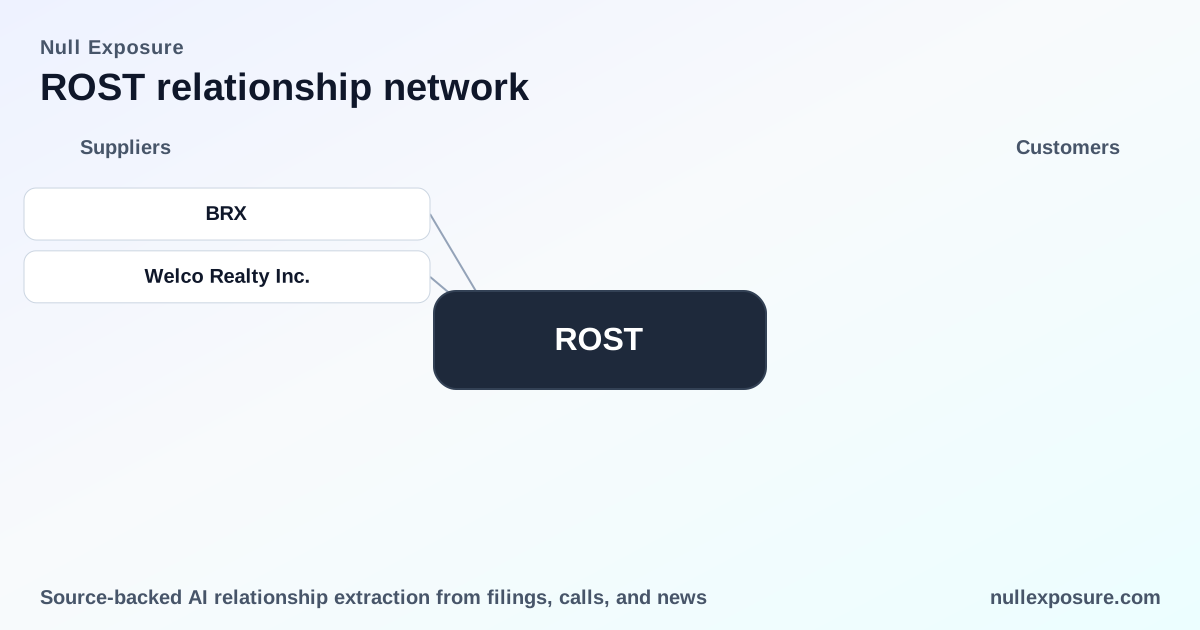
Ross Stores (ROST) — supplier and landlord relationships that matter for investors
Ross Stores monetizes by operating a national off-price apparel chain (Ross Dress for Less and dd’s DISCOUNTS), buying inventory primarily from manufacturers and foreign vendors, distributing it through a regional logistics network, and leasing retail space under long-term store leases. The business converts inventory turn and wide merchandise sources into predictable store-level margins and cash flow; suppliers and landlords are therefore critical operational nodes that underpin store occupancy economics and inventory availability. For a clear view into those nodes, review the relationships below and the company-level constraints that shape Ross’s contracting posture and operational risk.
Want the full supplier map and monitoring tools? Visit https://nullexposure.com/ for ongoing coverage and alerts.
What the on-the-ground relationships tell investors
Ross’s supplier profile is not just about garments — it is also about real estate partners who enable location strategy and third-party logistics that move goods. Two recent public reports highlight active landlord relationships in Long Island, New York, which are representative of Ross’s practice of occupying converted big-box or grocery footprints to accelerate market penetration.
Ross and Brixmor Property Group — half of a former TJ Maxx
Ross occupies a 22,221 square-foot footprint in the Riverhead shopping center at 1080 Old Country Rd., taking roughly half of a former TJ Maxx space, according to Brixmor Property Group’s spokeswoman. This tenancy illustrates Ross’s preference for adaptive reuse of discount retail space to control capex and speed openings. (Newsday, March 10, 2026 — https://www.newsday.com/business/ross-stores-inc-off-price-store-lake-grove-riverhead-hyt899wt)
Ross and Welco Realty Inc. — converting a former grocery store
Ross’s approximately 26,000-square-foot store at 3210 Middle Country Rd., Lake Grove, occupies a portion of a former Fairway Market grocery site within DSW Plaza, per Welco Realty’s leasing president. This example reinforces Ross’s tactical leasing of grocery-to-apparel conversions for community-level convenience and traffic capture. (Newsday, March 10, 2026 — https://www.newsday.com/business/ross-stores-inc-off-price-store-lake-grove-riverhead-hyt899wt)
How these relationships fit Ross’s operating model
Ross’s landlord relationships are an operational extension of its real-estate-light inventory model. Several company-level constraints explain the firm’s posture toward suppliers and landlords:
-
Contracting posture — long-term leases dominate. According to Ross’s filings (FY2026), “Nearly all of our stores are leased. The majority of our new stores have unexpired original lease terms ranging from three years to ten years, with three to four renewal options of five years each.” That structure provides stability of occupancy and predictability for store-level cash flows, while embedding renewal optionality that management can exercise based on performance.
-
Sourcing geography — concentrated in Asia. Ross discloses that it “directly source[s] a portion of the products sold in our stores from foreign vendors, predominantly in Asia (including China),” which signals supply-chain exposure to Asia and the trade, currency, and logistics dynamics that accompany it.
-
Vendor role — direct purchases from manufacturers. The company reports purchasing “the majority of our merchandise directly from manufacturers,” indicating a manufacturing-supplier relationship (not purely intermediary buying) that favors price control but raises concentration risk around key vendors.
-
Distribution model — regional cross-dock and third-party logistics. Ross uses “a combination of owned, leased, and third-party cross-dock facilities” and moves product to stores via contract carriers multiple times per week. This creates a hybrid logistics network where third-party distribution and transport providers are operationally critical.
-
Service provider reliance — frequent contract-carrier shipments. Shipments to stores occur “three to six times per week depending on location,” making the carrier network an ongoing operational dependency.
Collectively, these constraints show a mature retail model that balances long-term real estate commitments with global sourcing and outsourced distribution, producing steady revenues (Revenue TTM: $22.75B) and healthy margins (Operating Margin TTM: 12.3%).
Implications for investors and operators
-
Occupancy stability is a strength. Long lease terms with renewal options lower near-term vacancy risk and smooth rent exposure across the store base. That structure supports predictable store economics even when individual locations require refresh or merchandise shifts.
-
Supply-chain concentration is a risk vector. Direct sourcing from Asia and reliance on manufacturers concentrates supplier risk geographically and operationally. Investors must watch vendor diversification and shipping patterns as indicators of resilience.
-
Real estate partners matter for growth and capital efficiency. The Brixmor and Welco examples show Ross’s strategy of converting large-format spaces; landlords that can deliver suitable footprints quickly accelerate Ross’s market expansion without heavy capex.
-
Logistics partners are critical to execution. Frequent store replenishment and a mixed distribution network make third-party carriers and cross-dock providers single points of operational failure if not properly diversified.
If you want a deeper look into how these relationships affect covenant exposure or tenant credit in retail portfolios, check monitoring tools at https://nullexposure.com/.
Practical due diligence actions
- Request lease schedules and standard lease term summaries (renewal options, breakpoint clauses, tenant improvement obligations) to model store-level cash flow sensitivity.
- Map primary manufacturing suppliers by region and test alternative sourcing scenarios for Asian supply disruptions.
- Validate third-party carrier concentration and contingency plans for cross-dock hubs that serve critical regions.
Final read: what investors should take away
Ross’s commercial footprint is built on long-term leases, direct manufacturer sourcing, and a hybrid distribution network — a combination that drives stable margins but concentrates exposure in Asian sourcing and logistics partners. The two recent landlord relationships in Long Island are operationally consistent with Ross’s strategy of converting big-box and grocery sites to off-price apparel space, which supports rapid openings and favorable occupancy economics. For investors evaluating supplier and landlord counterparty risk, prioritize lease-term detail, vendor geographic diversity, and third-party logistics concentration.
For continuous supplier intelligence and landlord monitoring tailored to retail portfolios, visit https://nullexposure.com/ and sign up for alerts that track these exact relationships and constraints.