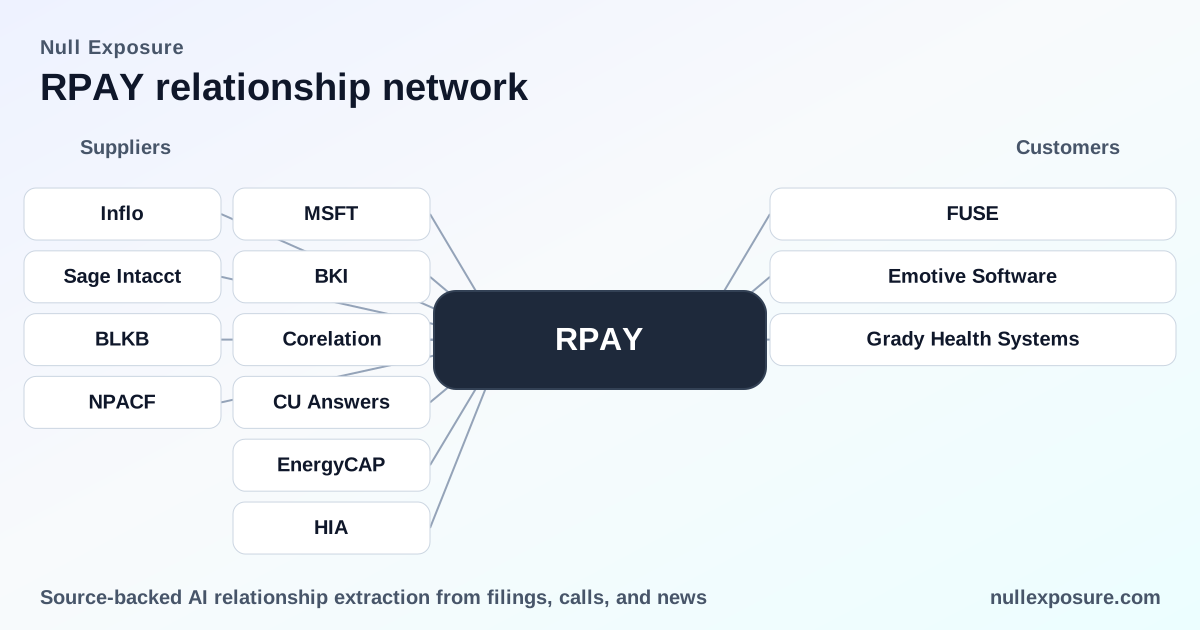
RPAY supplier map: which integrations power Repay's payments franchise
Repay Holdings builds and monetizes an integrated payments platform by embedding payments into vertical software and service providers and charging transaction-based fees and platform services. The company sells deeply into industry-oriented verticals—mortgage, credit unions, property management and others—by delivering certified integrations and white‑label processing; revenue comes from payment volume, processing fees and value-added platform services, supported by a $309.3M trailing twelve‑month revenue run rate and an EBITDA contribution of $67.4M (company data). For investors and operators, the relevant question is simple: which supplier and software relationships are mission‑critical to Repay’s growth and what operational concentration or vendor risk do they imply? Learn more at https://nullexposure.com/.
Why these supplier relationships matter for valuation and execution Repay’s go‑to‑market is integration‑driven: the company wins distribution by being the embedded payments engine inside existing software stacks and service organizations. That operating posture drives three structural consequences:
- Contracting posture: Repay acts as a service provider to platform partners and typically operates under integration or certification agreements rather than direct consumer channels.
- Concentration and criticality: A diversified roster of platform integrations reduces single‑counterparty concentration, but a handful of enterprise relationships can still be revenue‑critical if they unlock multi‑year payment volumes.
- Maturity and scalability: Certification and “enhanced integrations” signal scalable, repeatable implementations that convert into long sales pipelines and ongoing merchant volumes.
Repay itself flags dependency on outside service and technology providers as a material operational risk: “We rely on other service and technology providers. If such providers fail in or discontinue providing their services or technology to us, our ability to provide services to clients may be interrupted.” That statement functions as a company‑level warning about vendor dependence and integration risk.
Partners and integrations driving growth Below are the supplier relationships identified in public remarks from Repay’s Q2 FY2024 earnings call transcript, with a short plain‑English takeaway for each.
Microsoft Dynamics — Repay is building pipeline from a Microsoft Dynamics integration that helps place payment acceptance inside Dynamics customers, expanding enterprise distribution channels (InsiderMonkey Q2 FY2024 earnings call transcript, published March 10, 2026: https://www.insidermonkey.com/blog/repay-holdings-corporation-nasdaqrpay-q2-2024-earnings-call-transcript-1333774/).
Black Knight — Repay is executing a mortgage debit acceptance initiative with Black Knight that is expected to generate multi‑year contribution to volumes and revenues beyond the current year, positioning Black Knight as a strategically important mortgage channel (InsiderMonkey Q2 FY2024 earnings call transcript, March 10, 2026).
Corelation — Repay achieved certified integrating‑partner status with Corelation’s KeyStone core platform, which grants it direct access to credit union clients using that core and supports repeatable deployments (InsiderMonkey Q2 FY2024 earnings call transcript, March 10, 2026).
CU Answers — Repay announced an enhanced integration with CU Answers, the credit union‑owned service organization, which opens payment processing to hundreds of credit unions and accelerates scale within that vertical (InsiderMonkey Q2 FY2024 earnings call transcript, March 10, 2026).
EnergyCAP — Repay cited EnergyCAP among recent software integrations that are building a healthy sales pipeline, indicating wins in the utilities/energy software channel (InsiderMonkey Q2 FY2024 earnings call transcript, March 10, 2026).
HIA — After completing a payment integration with HIA, Repay went live with its first HIA client in early 2023 and is now rolling out accounts payable solutions across hundreds of properties, demonstrating a hospitality/property management use case with installed momentum (InsiderMonkey Q2 FY2024 earnings call transcript, March 10, 2026).
Inflo — Inflo is listed among recent software integrations contributing to Repay’s sales pipeline, adding to the company’s broad set of vertical integrations (InsiderMonkey Q2 FY2024 earnings call transcript, March 10, 2026).
Sage Intacct — Sage Intacct is another recent integration that enhances Repay’s access to accounting and finance applications, enabling embedded payments within back‑office workflows (InsiderMonkey Q2 FY2024 earnings call transcript, March 10, 2026).
Blackbaud — Repay highlights Blackbaud as a multi‑year growth relationship where the company helps Blackbaud monetize payments and improve payables and commerce flows, marking Blackbaud as a strategic software partner for nonprofit and education markets (InsiderMonkey Q2 FY2024 earnings call transcript, March 10, 2026).
Quadient — Quadient is named alongside other integrations as part of the growing sales pipeline, indicating exposure to document and customer communications software channels (InsiderMonkey Q2 FY2024 earnings call transcript, March 10, 2026).
How these relationships shape Repay’s operating profile Collectively, these integrations create a diversified distribution strategy: core processors and credit‑union service organizations (Corelation, CU Answers), enterprise software (Microsoft Dynamics, Sage Intacct), vertical specialists (Black Knight, Blackbaud, HIA, EnergyCAP, Quadient) and analytics/finance tools (Inflo). That spread reduces single‑partner concentration while enabling multiple verticals to feed payment volume into one platform.
- Contracting posture: Repay positions itself as the embedded payments service provider that signs certification and integration agreements with platform vendors. Certification statements (for Corelation and CU Answers) indicate formalized integration contracts that support long‑lived, scalable deployments.
- Concentration: The company’s remarks single out Black Knight and Blackbaud as partners with multi‑year contribution profiles; these relationships are commercially significant and therefore operationally important for forecasting volume growth.
- Criticality and maturity: Completed integrations (HIA live client rollout; Corelation certification; CU Answers enhanced integration) represent higher maturity, where implementation risk is lower and revenue realization is nearer term.
Risk considerations investors should weight
- Vendor dependency: Repay’s own risk disclosure names reliance on service and technology providers as a firm‑level constraint; investors should treat integration partners as potential points of failure for client onboarding or service continuity.
- Execution concentration: Multi‑year initiatives with large platforms (Black Knight, Blackbaud) create upside if they scale as discussed, but also create single‑partner execution risk if adoption lags.
- Commercial conversion: A healthy sales pipeline from integrations (Microsoft Dynamics, Sage Intacct, Quadient, Inflo, EnergyCAP) is a positive leading indicator, but conversion timing drives near‑term revenue recognition and cash flow.
Actionable investor steps
- Track deployment milestones for certified integrations (Corelation, CU Answers) and multi‑year initiatives (Black Knight, Blackbaud) as key inflection points for volume growth.
- Monitor Repay’s public commentary on pipeline conversion and client counts in these channels; these are practical leading indicators for the top line.
- For deeper supplier‑level diligence, review integration announcements and platform partner roadmaps to confirm the extent of technical embed and go‑to‑market alignment.
If you want ongoing supplier‑level tracking and supplier risk scoring for Repay and its partners, visit https://nullexposure.com/ for tailored research and monitoring. For institutional access to supplier relationship intelligence and to map counterparty concentration across portfolios, go to https://nullexposure.com/ and request a briefing.
Bottom line: Repay’s commercial strategy is integration‑first and the company has assembled a broad set of platform partners that both lower concentration and create a few high‑impact dependencies. Execution against Black Knight and Blackbaud and successful conversion of the Microsoft Dynamics/Sage Intacct pipeline will materially influence Repay’s revenue trajectory, while the firm’s disclosed reliance on service and technology providers frames vendor resilience as an essential investment due diligence item. Learn more at https://nullexposure.com/.