Republic Power Group (RPGL): Supplier relationships, capital actions, and operational signals investors should track
Republic Power Group Limited builds and sells enterprise resource planning (ERP) software, consulting and technical support services, and peripheral hardware to corporate and government customers in Singapore and Malaysia, monetizing through software licensing, implementation services, recurring support contracts, and hardware sales. The company’s public profile is small-cap and concentrated — recent capital-market activity (an IPO and a reverse share split) and a high insider ownership stake make supplier and market-service relationships material to liquidity, governance, and execution risk. For a concise pack of supplier-intelligence and market signals on RPGL, visit https://nullexposure.com/.
How RPGL operates and where the cash comes from
Republic Power Group sells integrated ERP solutions through direct engagements and service contracts. Revenue flows from three durable sources: license and software sales, implementation/consulting fees, and ongoing maintenance/support, with peripheral hardware sales as an incremental line. The company reports strong gross margins and fast reported revenue growth in recent periods, consistent with a services-heavy ERP provider that captures high-margin recurring revenues once clients are onboarded.
Key headline metrics that frame supplier and counterparty risk:
- Revenue TTM: 3,010,800 (reported) — demonstrating scale in a regional ERP niche.
- Gross profit TTM: 2,384,100 and Operating margin TTM: 63.2% — indicating a high-margin service mix.
- Market capitalization: 2,547,400 — small-cap status with correspondingly thin market liquidity.
- Percent insiders: 40.86% and Percent institutions: 0.143% — governance and liquidity characteristics that influence how supplier contracts and capital services are negotiated.
These financials imply a contracting posture oriented toward concentrated, enterprise-level deals where client retention and service SLAs are critical; supplier relationships that touch billing, escrow, exchange services, or capital markets will therefore be high-impact for investors assessing operational continuity.
Capital-market and service-provider relationships that matter
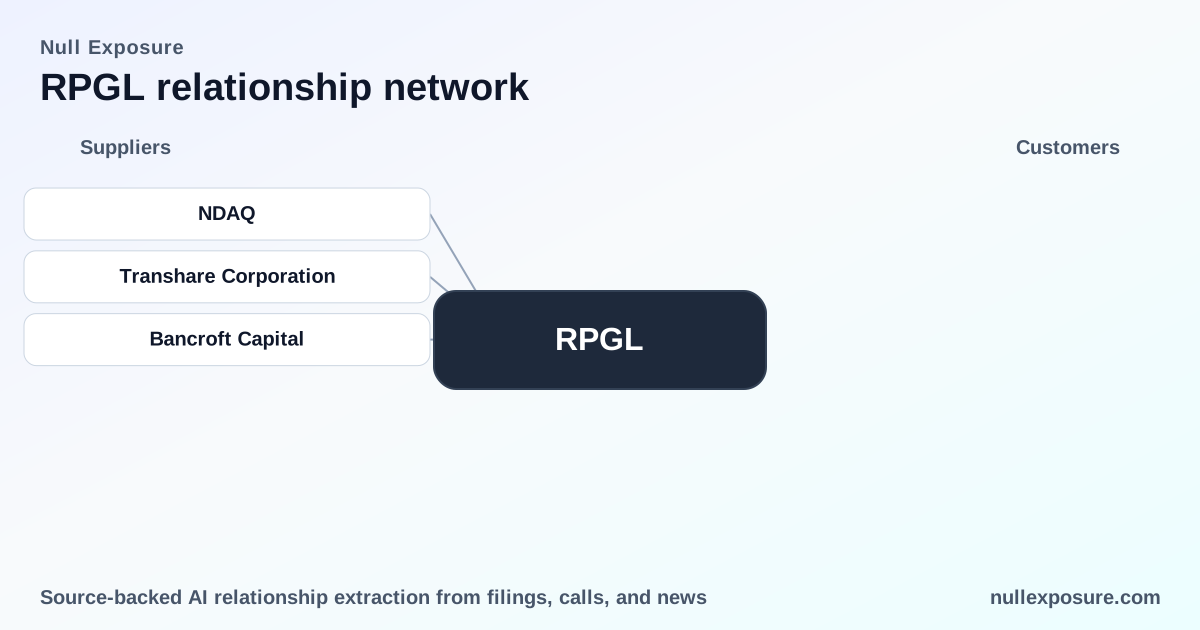
Nasdaq — exchange venue for the company’s listed Class A shares
Republic Power Group announced that its Class A Ordinary Shares will trade on The Nasdaq Capital Market on a reverse-split adjusted basis effective February 23, 2026; this places Nasdaq as the primary listing venue for public trading and for compliance/regulatory interactions. (Source: Futunn news post, March 2026 — https://news.futunn.com/en/post/69040840/republic-power-group-limited-announces-1-for-20-reverse-share)
Transhare Corporation — exchange agent and paying agent on corporate action
Transhare Corporation has been engaged as the exchange agent and paying agent to execute the company’s 1-for-20 reverse share split, a function that centralizes share conversion, payment handling and shareholder communications for the action. The use of a named exchange agent concentrates operational criticality in a single third-party for the split process. (Source: Futunn news post, March 2026 — https://news.futunn.com/en/post/69040840/republic-power-group-limited-announces-1-for-20-reverse-share)
Bancroft Capital — underwriter on the IPO
Republic Power Group’s initial public offering was underwritten on a firm-commitment basis by Bancroft Capital, indicating Bancroft’s role as the primary capital markets intermediary for the company’s listing. That underwriting relationship is a historical capital-market tie that affects market placement and investor constituency from the IPO. (Source: ValueTheMarkets coverage of the IPO, 2025/2026 — https://www.valuethemarkets.com/news/republic-power-group-ipo-nasdaq-2025)
What the lack of explicit constraints tells us (company-level signals)
The sourced relationship data includes no explicit contractual constraints or limitations disclosed in the scraped relationships. That empty constraints set itself is a signal: no public supplier-side covenants or named limitations were detected in the relationship feed, so analysts must rely on company-level operational indicators to assess supplier risk.
From the company profile and financials, investors should treat these structural characteristics as the operating constraints and posture:
- Concentration: Geographic focus on Singapore and Malaysia and a small institutional investor base imply customer and market concentration, increasing the impact of any single large client loss.
- Contracting posture: The product mix (ERP + services + hardware) indicates long implementation cycles and recurring revenue, which favors stable supplier relationships but also makes the company dependent on professional services vendors and systems integrators.
- Criticality: ERP systems are mission critical for customers; any supplier outage, payment disruption, or third-party failure (for example, an exchange agent or cloud provider) can have outsized commercial and reputational effects.
- Maturity: Small market capitalization, high insider ownership, and the use of a reverse split suggest early-stage public company dynamics with potential liquidity constraints and governance centralization.
These are company-level constraints derived from the public profile; none of the three identified relationships include explicit contractual limits in the available feed.
Visit https://nullexposure.com/ for deeper intelligence packages and relationship dashboards tailored for supplier risk assessments.
How investors and operators should act on these signals
- Monitor filings and communications around the reverse share split execution and Transhare’s processing timelines; errors or delays in conversion can impair trading liquidity and investor confidence.
- Track trading liquidity post-listing on Nasdaq — thin float and high insider ownership raise volatility and price discovery issues that affect capital-raising options.
- For operators managing vendor and client relationships, prioritize service-level guarantees and redundancy in implementation partners because ERP delivery is critical to customer churn and revenue recognition.
- Reassess counterparty concentration in capital markets and banking relationships; with Bancroft Capital historically underwriter, confirm whether aftermarket support or market-making was arranged to stabilize liquidity.
Key takeaway: Republic Power Group’s supplier relationships are compact but consequential — capital-market intermediaries (Nasdaq, Bancroft) and a named exchange agent (Transhare) play outsized roles for liquidity and corporate action execution; operational supplier risk centers on implementation and support vendors given the ERP business model.
Final notes and next steps
For analysts building a risk-adjusted view of RPGL, prioritize: (1) governance and insider sell-side activity, (2) customer renewal and concentration disclosures, and (3) execution quality on capital-market actions such as the reverse split. To pursue a tailored supplier-risk or relationship-monitoring package, start with a focused intelligence pull at https://nullexposure.com/ — and if you want ongoing alerts on RPGL counterparties and capital-market moves, sign up at https://nullexposure.com/ for continual coverage.
Sources cited in the relationship summaries include the Futunn news post announcing the reverse split and the ValueTheMarkets article documenting the IPO underwriting.