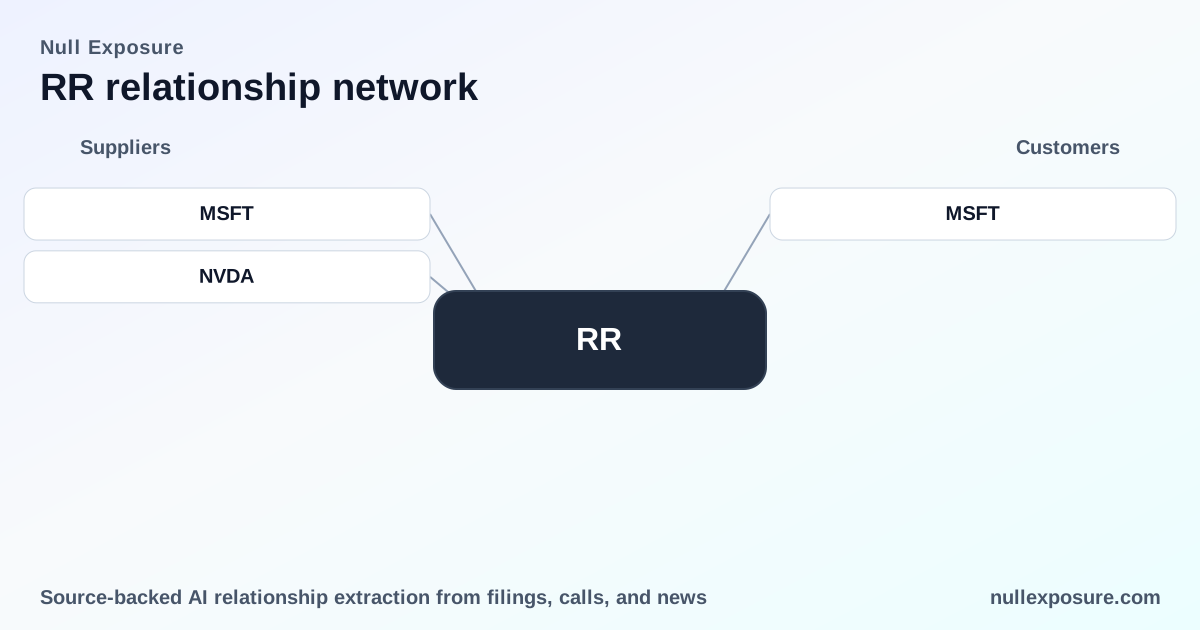
Richtech Robotics (RR) — Supplier relationships and what investors need to know
Thesis: Richtech Robotics develops and sells robotic automation systems for the service industry and monetizes through hardware sales, software-enabled deployments, and related services; its supplier posture is a mix of short-term component purchasing and longer-term leased facilities, creating concentration and manufacturing risk that directly affect revenue delivery and gross margins. For investors evaluating RR supplier risk, the critical questions are whether claimed technology partnerships translate into commercial channels, how concentrated component sourcing is, and how supplier geography exposes the company to logistical disruption. Read more or contact NullExposure for deeper vendor mapping at https://nullexposure.com/.
How Richtech operates and where supplier risk shows up
Richtech’s revenue base is small relative to market capitalization — Revenue TTM $4.93M vs. Market Cap $516.5M — which amplifies supplier and partner signals. The company sources components largely on a purchase-order basis while also maintaining noncancelable operating leases for offices and retail locations. Filings show the top five suppliers accounted for roughly 65% of procurement in FY2025, indicating significant supplier concentration that creates single-point failure risk for production schedules and cost structure.
- Contracting posture: a hybrid model — short-term component buys for flexibility, paired with long-term lease commitments for fixed retail/operational footprint.
- Geographic exposure: manufacturing and subassembly activity is concentrated in APAC (primarily China) with active effort to increase U.S. final-assembly capacity.
- Relationship roles: suppliers act as manufacturers (OEM/ODM) and service providers (technology consultants, lease partners, assembly); the company has compensated consultants with equity, indicating strategic outsourcing of development services.
These are company-level signals drawn from public filings; they shape concentration, criticality, and maturity of RR’s supply chain and should guide diligence. If you want a supplier deep-dive, start here: https://nullexposure.com/.
Market commentary on partner claims and reputational risk
In early 2026, multiple legal notices and news releases linked RR’s public statements about collaborations—especially with large technology vendors—to a wave of investor litigation and negative press. The controversy centers on whether announced “collaborations” equate to commercial partnerships that generate revenue and channel access. This is a reputational and material disclosure risk given RR’s small revenue base and reliance on third-party technology components.
Raw relationship results — each entry explained
Below I list every relationship instance surfaced in the collected results, with a plain-English summary and the cited source.
-
Microsoft — GlobeNewswire press (Feb 3, 2026): Richtech faces a class-action complaint alleging the company represented a collaborative and commercial relationship with Microsoft that Microsoft denies, asserting the engagement was a non-commercial AI Co‑Innovation Lab participation. Source: GlobeNewswire investor alert (Feb 3, 2026).
-
Microsoft — Sahm Capital notice (Feb 6, 2026): A legal notice reiterates Microsoft’s characterization of the engagement as a standard lab program for prototyping, not a commercial partnership, which underpins investor claims. Source: Sahm Capital investor notice (Feb 6, 2026).
-
Microsoft — Intellectia.ai report (Mar 2026): Coverage notes that Microsoft clarified the arrangement was a customer program without commercial elements, and that clarification led to investor disappointment and litigation. Source: Intellectia.ai class-action coverage (Mar 2026).
-
Microsoft — Sahm Capital deadline notice (Feb 12, 2026): The notice repeats the class-action allegation that Richtech misrepresented a collaborative/commercial relationship with Microsoft. Source: Sahm Capital investor deadline (Feb 12, 2026).
-
Microsoft — Intellectia.ai securities notice (Mar 2026): Intellectia again reports Microsoft’s clarification that the engagement lacked commercial elements and the resultant investor concern. Source: Intellectia.ai securities notice (Mar 2026).
-
Microsoft — GlobeNewswire (Feb 12, 2026): Portnoy Law Firm press release announcing a class action repeats the allegation that Richtech overstated a commercial relationship with Microsoft and cites Microsoft’s clarification of a lab engagement. Source: GlobeNewswire Portnoy Law Firm release (Feb 12, 2026).
-
Microsoft — GlobeNewswire reminder (Feb 14, 2026): A subsequent GlobeNewswire reminder reiterates Microsoft’s statement characterizing the engagement as a standard customer program with no commercial element, contrasting with Richtech’s public statements. Source: GlobeNewswire reminder (Feb 14, 2026).
-
Microsoft — PR Newswire (Feb 2026): A PR Newswire notice states that the class-action complaint alleges Richtech claimed a collaborative/commercial relationship with Microsoft when none existed. Source: PR Newswire investor alert (Feb 2026).
-
Microsoft — PR Newswire (similar alert, Feb 2026): Parallel PR Newswire distribution echoes the same class-action allegations and cites a Hunterbrook Media article dated Jan 29, 2026, about Microsoft’s denial. Source: PR Newswire investor alert (Feb 2026).
-
Microsoft — Sahm Capital pump-and-dump alert (Feb 20, 2026): Sahm Capital raises questions about possible market manipulation tied to overstated collaboration claims, again noting the Microsoft engagement was likely a free prototyping program. Source: Sahm Capital analysis (Feb 20, 2026).
-
Microsoft — GlobeNewswire (Feb 22, 2026): GlobeNewswire reports on the class-action filing and the lead-plaintiff deadline, repeating the claim that defendants misled investors about a Microsoft relationship. Source: GlobeNewswire class-action notice (Feb 22, 2026).
-
Microsoft — GlobeNewswire (Feb 19, 2026): Additional GlobeNewswire Portnoy Law Firm press release repeats allegations that Richtech misrepresented a commercial relationship with Microsoft. Source: GlobeNewswire (Feb 19, 2026).
-
Microsoft — AI Journ investor reminder (late Feb 2026): AI Journ republishes the investor reminder that Richtech announced a “hands-on collaboration” through Microsoft’s AI Co‑Innovation Labs to jointly develop agentic AI in robots; Microsoft later clarified program context. Source: AI Journ investor reminder (Jan/Feb 2026).
-
Microsoft — GlobeNewswire French/DE releases (Feb 6–12, 2026): International GlobeNewswire distributions reiterate the class-action allegations and Microsoft’s clarification, showing global propagation of the investor notices. Source: GlobeNewswire international releases (Feb 6–12, 2026).
-
NVIDIA — Intellectia.ai (Mar 2026): Coverage identifies that Richtech’s ADAM robot is built on the NVIDIA Jetson Orin platform, indicating a technology dependency on NVIDIA’s edge AI compute. Source: Intellectia.ai class-action coverage (Mar 2026).
-
NVIDIA — Intellectia.ai securities notice (Mar 2026): A companion notice references ADAM’s development on NVIDIA Jetson Orin, reinforcing that NVIDIA hardware is a component platform for Richtech’s products. Source: Intellectia.ai securities notice (Mar 2026).
All of the Microsoft entries converge on the same substantive point: public statements about a Microsoft collaboration were characterized by Microsoft as a standard, non‑commercial engagement, and that characterization is central to multiple class-action notices and investor alerts. The NVIDIA entries identify the Jetson Orin platform as the compute architecture for Richtech’s ADAM robot.
What constraints and filings tell investors about operational risk
Company disclosures give direct signals about supplier dynamics:
- Contracting mix: The company uses both short-term purchase orders for components and noncancelable operating leases for facilities; procurement practices favor flexibility but create vulnerability to component lead times. (Company filings, FY2025.)
- Geography and capacity: Components and subassemblies are primarily manufactured in China, while management is increasing U.S. final assembly to better serve North American customers — a cross-border production model that raises logistical and geopolitical risk. (Company filings, FY2025.)
- Concentration: Top five suppliers accounted for ~65% of procurement in FY2025, a material concentration that makes supplier disruption a critical business risk rather than a minorOperational hazard. (Company filings, FY2025.)
- Supplier roles: Suppliers act as manufacturers (OEM/ODM) and service providers; Richtech has issued equity to consultants for technology development services, indicating reliance on external technical partners for product R&D. (Company filings, FY2024–FY2025.)
These constraints describe contract posture (mixed short- and long-term), concentration (high), criticality (high for core components and compute platforms), and maturity (outsourced manufacturing and consulting relationships rather than fully in‑house capability).
Investors’ practical takeaways and actions
- Disclosure and reputational risk are immediate. The Microsoft controversy is already driving litigation and press; for a small revenue base, these reputation events affect customer adoption and fundraising.
- Manufacturing concentration is a core operational risk. With 65% procurement tied to top suppliers and significant APAC assembly, ramp durability depends on supply-chain stability.
- Technology partnerships are product-critical. NVIDIA’s Jetson Orin is a foundational component for ADAM; compute availability and licensing should be monitored.
If you want a tailored supplier-risk report or to map dependency concentration across specific vendors, start here: https://nullexposure.com/. For ongoing monitoring and legal‑risk tracking tied to supplier claims, NullExposure provides targeted alerts and analyst briefs — contact us via https://nullexposure.com/ to commission a vendor-risk memo.