Red River Bancshares (RRBI): Supplier footprint and what it means for investors
Red River Bancshares operates as the holding company for Red River Bank, a regional Louisiana commercial and retail bank that monetizes through net interest margin, fee income from deposit and lending services, and modest shareholder distributions. The company’s franchise is capital-light on a per-branch basis, leans on long-term real estate commitments for its physical network, and outsources specialized technical security services while keeping core banking operations in-house. Investors should evaluate property strategy, third-party cybersecurity dependence, and small but tangible supplier commitments when sizing operational risk and cost flexibility. For a quick supplier-focused view and further supplier relationship intelligence, visit https://nullexposure.com/.
One concrete counterparty transaction investors should know about
The Advocate reported that Red River Bank acquired a former Chase Bank branch at 1911 W. Pinhook Road, an asset purchase that converts a national-bank footprint into a local retail/commercial touchpoint for Red River (reported FY2020). This transaction reflects Red River’s approach to selectively growing physical presence through acquisitions of existing branch locations rather than greenfield builds (The Advocate, FY2020: https://www.theadvocate.com/acadiana/news/business/red-river-bank-buys-branch-office-on-pinhook-road/article_4eac0f20-1dc6-11eb-aada-53c335116b51.html). Acquiring existing branch real estate accelerates deposit and customer acquisition while leveraging known traffic patterns.
How filings define Red River’s supplier posture today
Company disclosures as of December 31, 2024, reveal a consistent contracting posture and supplier mix:
- Long-term real estate commitments: The company maintains six operating leases on land and buildings for banking centers under long-term leases. This signals a deliberate, sticky branch network with fixed occupancy cost structure and limited near-term flexibility on physical footprint (company filing, Dec 31, 2024).
- Third-party service providers for technical and security functions: Red River operates internal networks but relies on external firms for network design, architecture and cybersecurity — including a third-party managed detection and response (MDR) service that actively monitors systems around the clock. These are active, mission-critical vendor relationships that support regulatory and operational resilience (company filing, Dec 31, 2024).
- Low committed near-term supplier spend on construction: The bank disclosed one committed construction agreement to renovate a banking center with approximately $12,000 remaining as of year end, placing committed supplier cash outflows for that project well under $100k (company filing, Dec 31, 2024).
Taken together, these disclosures show a mature, conservative operating model: fixed-cost exposure through long-term leases, targeted and low-dollar capital commitments, and reliance on specialized service providers for cybersecurity rather than in-house full capability build-out.
Every named counterparty in Red River’s supplier view
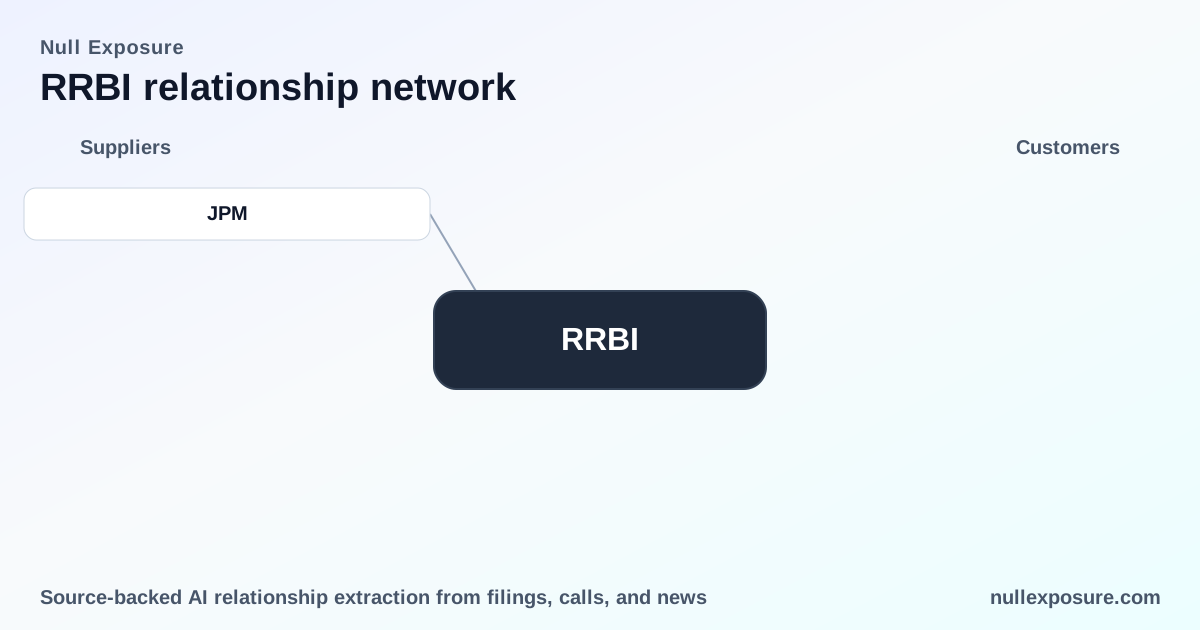
- Chase Bank (JPM): Red River purchased a former Chase branch office at 1911 W. Pinhook Road, converting legacy national-bank real estate into a Red River location to expand its retail and commercial footprint. (The Advocate, FY2020: https://www.theadvocate.com/acadiana/news/business/red-river-bank-buys-branch-office-on-pinhook-road/article_4eac0f20-1dc6-11eb-aada-53c335116b51.html)
Why these supplier signals matter to investors
Real estate and cybersecurity suppliers drive different risk profiles for a regional bank:
- Branch lease commitments are strategic and sticky. Long-term leases for six locations create predictable occupancy costs that support branch-level economics, but reduce agility to rapidly downsize physical footprint if market conditions deteriorate.
- Cybersecurity vendors are operationally critical. Outsourcing MDR and network design concentrates operational resilience in a small set of specialist suppliers; any lapse or transition friction is an immediate business continuity and regulatory risk.
- Capex flexibility is intact. The sub-$100k committed construction balance suggests limited near-term capital commitments tied to supplier invoices, preserving liquidity for lending and balance-sheet management.
From a financial lens, Red River’s public metrics underline a stable regional banking profile: market capitalization roughly $582.6M, trailing P/E 13.9, return on equity ~12.5%, and a conservative dividend yield — positioning the company as a profitable regional franchise with moderate shareholder returns and a focus on core banking economics (company financials, latest quarter 2025-12-31).
Practical implications for supplier risk management and investor monitoring
Investors and operators should track a few actionable items:
- Monitor branch transaction activity. Continued purchases of former national-bank branches indicate growth-by-acquisition of retail footprint; track purchase cadence and any acceleration in lease liabilities.
- Assess cyber third-party concentration. Given the active MDR engagement, review third-party vendor continuity plans, SLAs, and change-of-provider triggers in filings or disclosures.
- Watch committed construction and capital spend. Even small committed amounts can signal renovation cycles; ongoing low commitments support liquidity for core lending operations.
For an investor-ready supplier map and deeper counterparty intelligence, explore our platform at https://nullexposure.com/. This view helps quantify supplier criticality and contracting posture relative to peer banks.
Actionable takeaways for investors evaluating RRBI supplier relationships
- Branch acquisitions are a deliberate growth lever. Expect continued opportunistic purchases of existing branches rather than aggressive new builds.
- Third-party cybersecurity is a single point of operational criticality. Confirm vendor resilience and contractual protections when evaluating operational risk exposure.
- Lease structure reduces short-term flexibility but supports stable branch economics. Long-term leases anchor fixed costs and customer access.
- Near-term supplier spend risk is low. Current committed construction obligations are negligible, preserving balance sheet optionality.
For investors focused on supplier-related operational risk, Red River’s profile is straightforward: a regional bank with fixed real estate commitments and outsourced high-skill security functions, minimal near-term contractor spend, and measured growth via branch acquisitions. To translate these signals into a comparative supplier risk score or to build a counterparty watchlist, visit https://nullexposure.com/ for detailed supplier intelligence and ongoing monitoring.