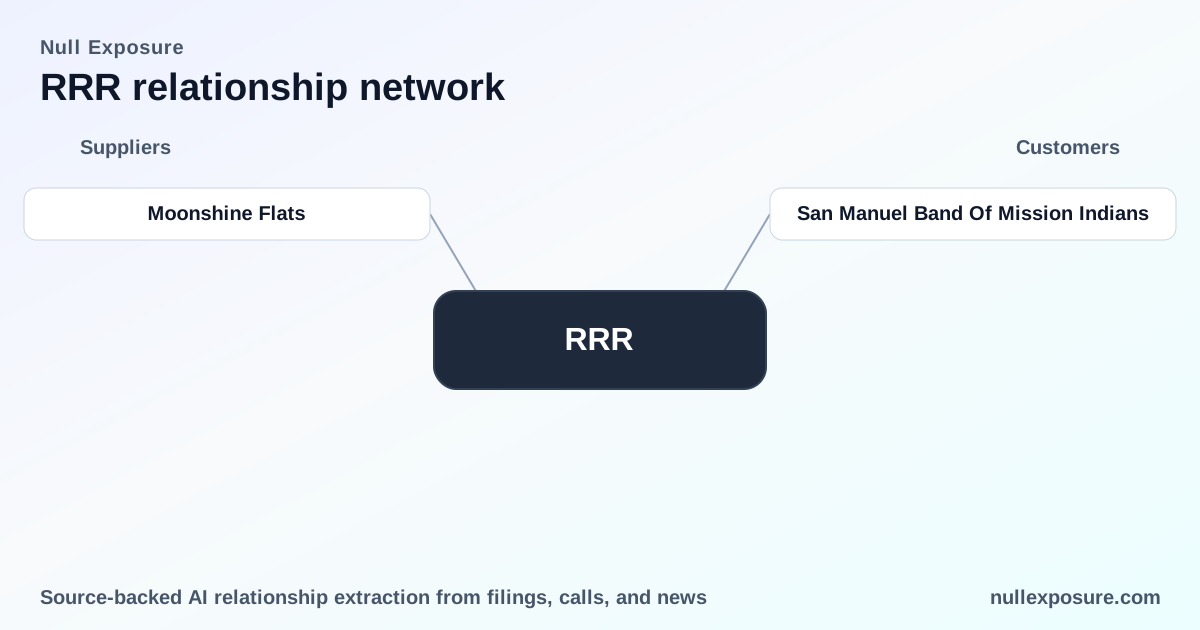
Red Rock Resorts (RRR): A supplier-focused read on the Moonshine Flats tie-up and vendor posture
Red Rock Resorts operates and monetizes a vertically integrated casino-resort business through interests in Station Holdco and Station LLC: gaming revenue at table and slot floors, hospitality and room revenue, food & beverage and entertainment partnerships, and ancillary real estate and promotional economics. With trailing revenue around $2.01 billion and EBITDA near $814 million, Red Rock’s operating model depends on non-gaming brand extensions and third-party concepts to drive foot traffic and increase per-guest spend in its Las Vegas properties. For investors and operators, supplier and brand partnerships are not mere line-item contracts — they are demand drivers that shift guest mix, cost structure, and operational complexity.
Explore supplier mapping and relationship intelligence at https://nullexposure.com/ for a concise view of these dynamics.
The Moonshine Flats partnership — what it is and what it does
Red Rock announced a partnership to bring Moonshine Flats’ country-western bar and live-music concept to Las Vegas for the first time. According to an earnings call transcript reported by InsiderMonkey in March 2026, this move introduces a branded F&B and entertainment format into Red Rock’s property roster and positions the company to capture country-music–oriented foot traffic in a major leisure market. (Source: InsiderMonkey interview/transcript, Q4 2025 / March 2026 — https://www.insidermonkey.com/blog/red-rock-resorts-inc-nasdaqrrr-q4-2025-earnings-call-transcript-1693351/)
Bringing an established regional concept into Las Vegas is a classic non-gaming monetization lever: it converts a hospitality operator’s available square footage into diversified revenue, increases dwell time, and creates cross-sell opportunities for rooms and gaming. For investors, the key questions are execution risk, contract economics (royalty vs. lease vs. revenue share), and incremental margin profile; for operators, it’s site fit, staffing, and promotional integration.
Complete supplier relationship list disclosed in the results
- Moonshine Flats — Red Rock is partnering to introduce the Moonshine Flats country-western bar and live-music concept to Las Vegas, deploying the brand as a food & beverage and entertainment anchor to draw guests. Reported during Red Rock’s FY2026 communications and reflected in a Q4 2025 earnings-call transcript summarized by InsiderMonkey. (InsiderMonkey, Q4 2025 transcript / March 2026 — https://www.insidermonkey.com/blog/red-rock-resorts-inc-nasdaqrrr-q4-2025-earnings-call-transcript-1693351/)
This list reflects all supplier or supplier-like relationships surfaced in the current results set.
What the Moonshine Flats tie-up implies for Red Rock’s operating and contracting posture
- Contracting posture — commercial partnership / brand license: This is a brand-driven relationship rather than a core systems vendor deal; expect a licensing or revenue-share structure with marketing support and operational performance covenants. That posture favors variable-cost exposure (percentage of sales) over fixed rent, preserving balance sheet flexibility.
- Concentration — low single-relationship concentration: The current relationship set shows Moonshine Flats as a single branded supplier, implying low supplier concentration risk from this tie-up but also limited diversification benefit until more such brand deals scale.
- Criticality — moderate for non-gaming revenue: The concept is material to F&B/entertainment revenue strategy but not critical to core gaming operations; it improves guest experience and non-gaming margins, so operational success affects ancillary revenue and marketing ROI rather than casino profitability directly.
- Maturity — early-stage deployment: This is a new-market launch (Moonshine Flats’ first entry into Vegas) and therefore an early-phase relationship, with opening execution, guest acceptance, and unit-level profitability to validate assumptions.
If you track supplier-driven revenue diversification as a valuation lever, this is a high-conviction operational bet on non-gaming uplift that is low-cost to trial but high on execution risk until unit economics are reported.
Company-level vendor controls and what they tell investors
Red Rock’s public disclosures state: “We engage subject matter experts such as consultants and auditors to assist us in establishing processes to assess, identify and manage potential and actual cybersecurity threats, to actively monitor our systems internally using widely accepted digital applications, processes, and controls, and to provide forensic assistance to facilitate system recovery in the case of an incident.” This language signals two firm-level points:
- Service-provider reliance is explicit and active. The company treats third-party consultants and auditors as operating partners for cybersecurity and resilience, indicating an established outsourcing posture for specialized risk functions.
- Vendor maturity and governance are present. Active monitoring, forensic readiness, and use of external subject-matter experts suggest an institutional vendor-management process rather than ad hoc supplier engagements.
Those disclosures are a positive governance signal for investors: when a gaming operator externalizes cybersecurity and resilience functions to vetted service providers, operational continuity risk — which is critical to gaming continuity and financial performance — is managed proactively. That said, outsourcing increases third-party concentration risk if a small set of providers carry key operational functions — something procurement and security teams should monitor.
Explore deeper supplier-risk analytics and vendor governance profiles at https://nullexposure.com/ to contextualize these controls against your portfolio’s operational risk appetite.
How operators and procurement teams should act now
- For operators: test unit economics before scaling — pilot Moonshine Flats in a single property and instrument marketing, spend-per-guest, and room-booking lift. Ensure labor and scheduling models are integrated into property operations to avoid margin erosion.
- For procurement and risk teams: validate cybersecurity and forensic arrangements with third-party auditors and consultants; require SLAs, incident response playbooks, and subcontractor vetting to reduce concentration risk.
- For investors: monitor disclosure cadence around revenue share, royalty rates, and unit-level profitability for branded F&B concepts; incremental non-gaming margin expansion is measurable and will move consensus estimates.
Bottom line and tactical takeaway
Red Rock’s Moonshine Flats partnership is a targeted, low-concentration brand play aimed at growing non-gaming revenue and guest appeal in Las Vegas. Company disclosures on active engagement with cybersecurity consultants and auditors indicate mature vendor governance for critical operational risks, which supports resilience as Red Rock experiments with new supplier-driven concepts. For investors, the combination is a clear signal: management is pursuing margin-accretive non-gaming growth while maintaining externalized controls on operational risk.
For a focused supplier intelligence view and to map how these and other partner relationships affect valuation and operational risk, visit https://nullexposure.com/. For portfolio teams building diligence checklists and vendor-risk heatmaps tied to hospitality operators, NullExposure’s supplier profiles accelerate decision-making — start here: https://nullexposure.com/.
Key takeaway: Moonshine Flats is a strategic entertainment/F&B partner that increases non-gaming optionality; Red Rock’s active use of service providers for security and monitoring suggests disciplined governance as it expands third-party relationships.