Regal Beloit (RRX): supplier relationships and operational constraints that matter to investors
Regal Beloit Corporation designs, manufactures and sells electric motors, motion controls and power transmission equipment and monetizes through product sales and aftermarket support to industrial customers worldwide. Revenue is driven by engineered hardware and replacement cycles, with margin upside from higher-value motion controls and aftermarket services. For investors evaluating supplier exposure and partner dependency, the company's disclosed hedging posture and a small set of strategic partnerships should be read as deliberate defenses against commodity and interest-rate volatility. Learn more about supplier profiles at NullExposure.
Why supplier and counterparty maps change the investment case
Regal Beloit is a capital-intensive industrial OEM with roughly $12.5 billion market capitalization and trailing revenue near $5.93 billion. The business monetizes primarily through sale of physical products, which creates three structural supply-side characteristics:
- Commodity sensitivity: material inputs and components influence margins; the company uses short-dated commodity forward contracts to stabilize input costs through the next 12–24 months.
- Financial hedging and contract maturity: the company has longer-dated interest-rate hedges that smooth financing cost volatility through March 2027, reflecting a willingness to accept multi-year financial commitments.
- Counterparty concentration and credit posture: credit exposure is managed against major international banks, indicating large-enterprise counterparties for financial contracts rather than a decentralized roster of small suppliers.
Those are not abstract notes on a balance sheet — they shape contracting posture, supply-chain concentration, and the maturity profile of counterparty risk. Regal Beloit hedges short-term commodity exposure while locking in longer-term interest-rate protection, a combination that reduces earnings volatility but allocates operational risk around raw-material availability and aftermarket demand rather than financing shocks alone. For an interactive view of relationships and supplier risk, visit NullExposure.
What the disclosed constraints tell you about how RRX runs its business
Company disclosures reveal three clear operational constraints that inform contract structures and supplier sensitivity:
- Long-term interest-rate swaps: the company entered into receive-variable/pay-fixed forward starting non-amortizing swaps with a combined notional of $250 million to hedge the Term Facility; these swaps expire in March 2027, signaling a multi-year financial hedge that reduces near-term rate exposure but concentrates swap maturity in 2027 (company disclosures).
- Short-term commodity forwards: Regal uses commodity forward contracts that mature through December 2025 to hedge forecasted purchases, which indicates the firm hedges input cost risk on a rolling short-term basis and retains exposure beyond the next 12–24 months unless renewed (company disclosures).
- Counterparty credit policy: exposure is limited to major international banks and financial institutions meeting established credit guidelines, indicating the company places counterparty exposure with large enterprises rather than smaller regional banks or suppliers (company disclosures).
Taken together, these signals show a conservative counterparty stance and a mixed maturity profile — long-dated financial protection versus short-dated commodity hedges — which is material for operators and investors sizing refinancing, margin, and working-capital risk.
Supplier and partner relationships that appear in the public record
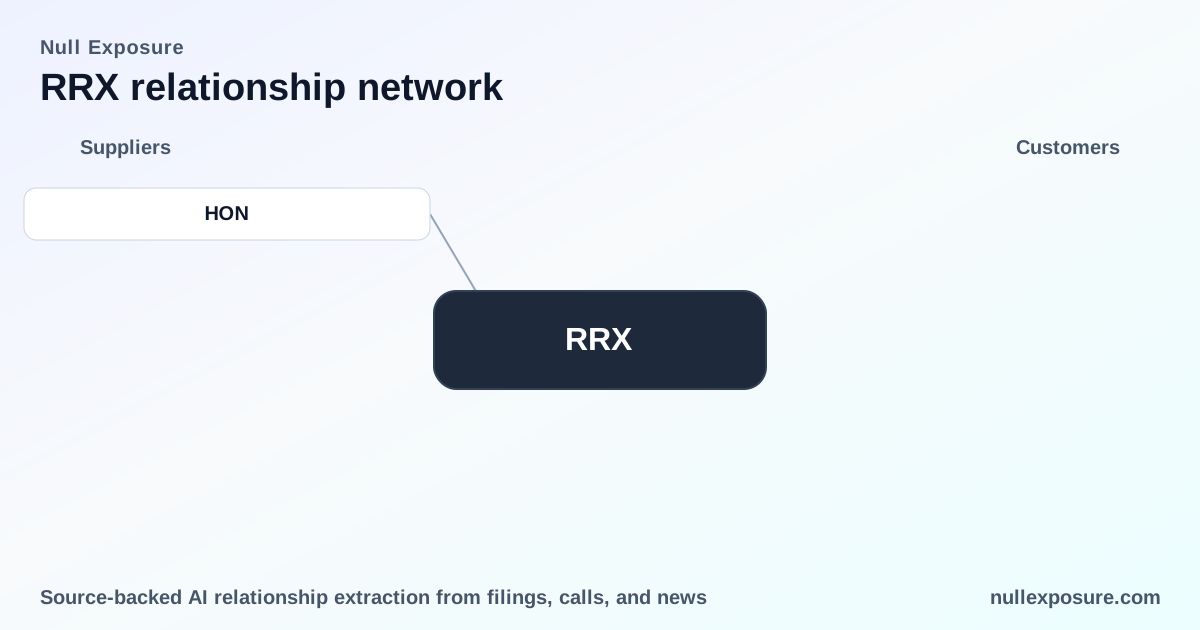
Honeywell — strategic development for eVTOL actuators
Regal has developed electromechanical actuators for the emerging eVTOL market through a partnership with Honeywell, highlighting a product-development collaboration that targets aerospace electrification and high-growth adjacencies. According to an earnings call transcript published by InsiderMonkey on March 10, 2026, Regal highlighted those actuators as an example of a partnership developed with Honeywell in FY2026 (InsiderMonkey, Q4 FY2025 earnings call transcript, March 2026).
This relationship is a product-development partnership rather than a simple supplier-customer purchase arrangement; it positions Regal to sell higher-margin, specialty components into aerospace platforms. The collaboration with Honeywell introduces strategic upside into new markets while slightly increasing execution complexity given aerospace qualification cycles and certification requirements.
How these relationships and constraints change the risk/reward profile
Operationally, the Honeywell collaboration signals a deliberate move into electrified aerospace components — a higher-margin, higher-technical-barrier segment that increases upside if regulatory and certification timelines stay on track. For investors, this can re-rate parts of the business toward growth multiple expansion if commercialization scales.
On the risk side:
- Commodity exposure remains near-term because hedges run through December 2025; procurement teams must manage roll risk and potential pass-through pricing in FY2026–FY2027.
- Financing-rate risk is concentrated in 2027 because interest-rate swaps expire in March 2027; refinancing or hedge renewals around that date will be material to cost of capital assumptions.
- Counterparty credit risk is concentrated in major global banks, reducing counterparty default risk but increasing dependency on syndicated market access for large financial contracts.
These factors, combined with a forward P/E (~17.8) materially below the trailing P/E (~44.9), suggest the market is pricing near-term earnings improvement and successful execution on higher-margin products as necessary to justify the current valuation.
Practical takeaways for investors and operators
- Investors should watch two near-term timelines: commodity forward maturity (through Dec 2025) and interest-swap maturity (March 2027). Both are leverage points that will shape margin and financing cost trajectories for the next 12–24 months.
- Operators and supply-chain managers should prioritize continuity plans for raw-material inputs beyond 2025 and ensure capacity to meet aerospace qualification demands if the Honeywell partnership progresses to volume.
- Strategic buyers or partners evaluating Regal for M&A or supplier relationships should value the company’s conservative counterparty posture and the upside from specialty electromechanical products.
For a consolidated review of Regal’s supplier network and relationship-level signals, consult the full profile at NullExposure.
Closing recommendation
Regal Beloit is a mid-cap industrial OEM with a mix of defensive hedging and selective strategic partnerships. The Honeywell collaboration is a clear growth vector into electrified aerospace, while short-dated commodity hedges and a lumped swap maturity in 2027 create identifiable timing risks that investors should monitor closely. For deeper supplier analytics and a searchable map of RRX relationships, see NullExposure.