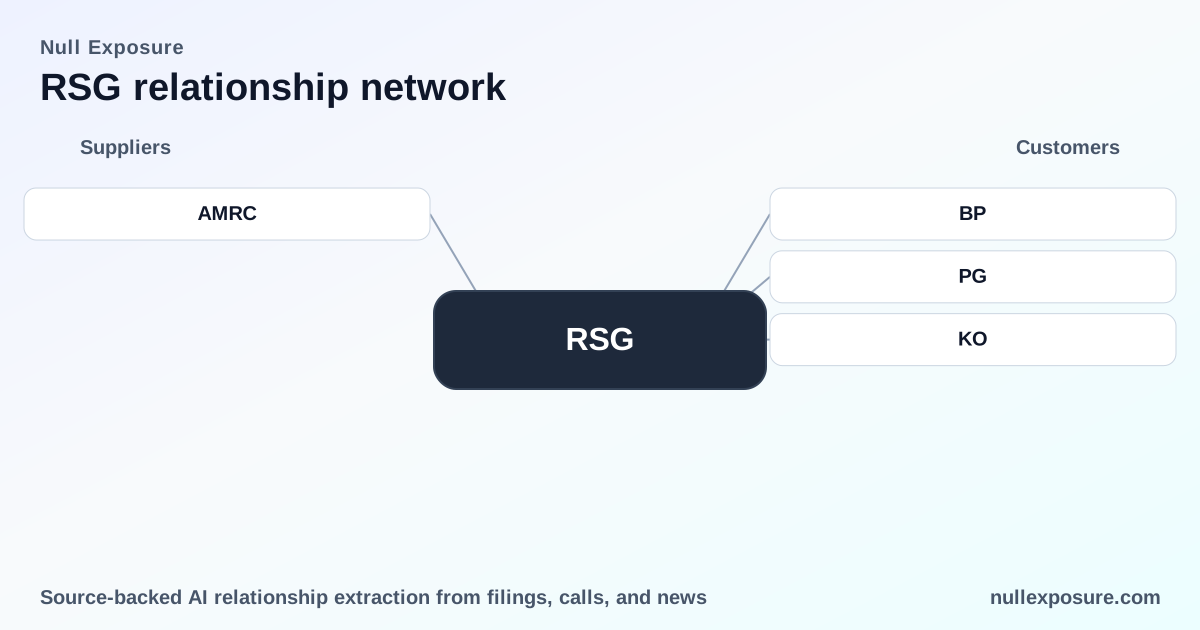
Republic Services (RSG): supplier relationships, constraints, and what they mean for investors
Republic Services operates and monetizes as the second-largest U.S. non-hazardous waste services company, collecting fees from residential, commercial and municipal customers while capturing additional margin through landfill disposal, recycling operations and energy-from-waste projects. Revenue streams split between recurring collection contracts, fee-based landfill and transfer operations, and growing landfill gas-to-energy initiatives, positioning Republic to convert scale into stable cash flow and predictable backend pricing power. For direct access to the full supplier intelligence that underpins this analysis, visit https://nullexposure.com/.
How Republic’s supplier posture shapes the business
Republic’s operating model is capital-intensive and infrastructure-driven. The company leases and owns specialized real property—landfills, transfer stations and heavy equipment—that are specific to the waste industry, which creates long-lived vendor commitments and high switching costs for both Republic and its suppliers. According to Republic’s filings (latest quarter 2025-12-31), the most significant lease obligations are for real property and equipment specific to our industry, underscoring the asset-heavy nature of the business and the resulting supplier dependence on specialized construction, equipment and energy developers.
Three company-level constraints emerge as investment-relevant signals:
- Republic functions as a material buyer of leased property and equipment, which drives long-term capital commitments and makes vendor selection and negotiating leverage central to margins.
- The company maintains formal procedures to select and monitor third‑party service providers, indicating governance around supplier performance and regulatory compliance.
- The asset base sits squarely in the infrastructure segment, meaning supplier relationships are critical, long-tenured, and operationally mission‑critical rather than interchangeable.
These characteristics produce a supplier profile where counterparty quality, execution capability and regulatory reliability are value drivers—and where contract structure and lease terms materially influence capital allocation and free cash flow.
Why a few strategic suppliers matter for growth
Republic’s financial profile—$16.59B trailing revenue, $5.14B EBITDA and a market capitalization near $69.4B—supports sizeable project pipelines, especially in renewables and landfill gas-to-energy. Management has signaled that municipal contract renewals and energy projects are core to 2026 guidance, allocating vendor spend accordingly. Supplier partnerships that deliver turnkey energy projects or specialized landfill services therefore become revenue multipliers rather than simple cost inputs.
For investor due diligence, focus on:
- Contract length and termination provisions with major suppliers.
- Vendor track record on project delivery and environmental compliance.
- The degree to which suppliers enable monetization of landfill gas and renewable energy upside.
If you want to track supplier commitments and project pipelines cited in filings and news coverage, start at https://nullexposure.com/.
The supplier relationships: who is on Republic’s vendor list
Ameresco — preferred developer for landfill gas-to-energy projects
Ameresco is Republic’s preferred developer for complex landfill gas‑to‑energy projects, providing a steady pipeline of work as Republic scales its renewables initiatives. A Markets/FinancialContent report dated February 23, 2026 noted that Ameresco continues to see a steady pipeline of work as Republic’s preferred developer for complex landfill gas‑to‑energy projects, directly tying the vendor to Republic’s FY2026 renewables push. (Markets/FinancialContent, Feb 23, 2026)
This relationship is operationally significant because landfill gas projects convert an environmental compliance obligation into a cash-generating energy asset; a reliable developer partner like Ameresco is therefore strategic to Republic’s higher‑margin growth initiatives.
Operational risks and concentration to watch
Republic’s supplier stance creates concentrated operational risks that investors must price into valuation and scenario analysis:
- Asset specificity: Leases for landfills and equipment are highly specific, increasing replacement cost and raising the stakes of supplier failure or construction delays.
- Counterparty execution risk: For energy projects, developer performance directly impacts revenue timing and cash flow conversion. The Ameresco tie demonstrates Republic’s preference for established developers, but execution delays would have outsized P&L effects.
- Governance and regulatory exposure: Republic’s formal provider-selection procedures reduce but do not eliminate regulatory and environmental risk; oversight failures or vendor noncompliance would be both operational and reputational.
These are not abstract concerns—Republic’s filings explicitly document its lease obligations and supplier oversight processes, which investors should reconcile with project-level disclosures when modeling future EBITDA and free cash flow.
Investment implications and what to monitor next
For investors and operators evaluating Republic’s supplier relationships, the actionable checklist is straightforward:
- Monitor quarterly guidance and management commentary for project pipelines tied to preferred developers (Ameresco is a clear example cited in 2026 coverage).
- Track capital deployment to landfill gas projects versus traditional capital expenditures; capital allocated to energy projects has higher margin potential and longer-term cash conversion implications.
- Watch municipal contract renewals and the structure of vendor agreements—renewal risk amplifies supplier concentration because municipal contracts underpin large portions of collection revenue.
Republic’s capital structure and valuation (forward P/E ~30.9, EV/EBITDA ~16.3) embed long-term growth expectations; supplier performance on energy projects will be a tangible mechanism to realize that premium. For a deeper read on supplier exposures and project-level relationships, visit https://nullexposure.com/.
Bottom line: supplier relationships are strategic levers for RSG’s cash-flow trajectory
Republic Services runs an infrastructure-intensive model where supplier selection and long-term vendor contracts are central to unlocking renewable and municipal growth. Ameresco’s role as a preferred landfill gas-to-energy developer is a clear example of how supplier partnerships convert compliance and waste assets into higher-margin energy revenue. Investors should treat supplier execution and lease commitments as first‑order inputs to any valuation or operational due diligence.
If you want continuous, supplier-focused intelligence and relationship tracking for Republic and its peers, start here: https://nullexposure.com/.