Rush Street Interactive (RSI): Supplier Relationships That Drive Market Access and Operational Risk
Rush Street Interactive operates online casino and sports-betting platforms across the United States and Latin America and monetizes primarily through net gaming revenue, content licensing and revenue-share arrangements with third-party game suppliers, market-access fees and branded marketing partnerships. For investors, the supplier profile is a direct lever on growth and margin volatility: long-term licensing and marketing commitments secure market access but create fixed-cost exposure tied to platform availability and regulatory geographies. Explore supplier-level signals and relationship examples that illuminate where RSI’s operational and financial risk sits. For a practical view of supplier analytics and exposure mapping, visit https://nullexposure.com/.
How RSI’s supplier posture shows up in its contracts and spend
RSI’s supplier relationships are contractual, concentrated and operationally critical. Company disclosures and related excerpts indicate a mix of licensing, service and marketing agreements that are typically non‑cancelable, long‑term and material in dollar terms. These characteristics together shape both upside (predictable content and access) and downside (fixed obligations and outage sensitivity).
- Licensing first: third‑party gaming content is offered under revenue‑share licensing arrangements where suppliers take a percentage of net gaming revenue while RSI receives a limited license to distribute games within permitted jurisdictions. This is an income‑generating and cost‑sharing model that aligns incentives with suppliers. According to company disclosures, these arrangements are standard for content suppliers (company filings, FY2026).
- Long‑term, non‑cancelable commitments: RSI reports non‑cancelable contracts with marketing vendors and licensors that create future minimum payments, including marketing obligations (reported at $10.8 million) and license/market access commitments ($34.7 million) as line items in minimum payment schedules (company filings).
- Service provider and hosting role: RSI hosts its platform using a combination of third‑party public and private cloud infrastructure and on‑premise server rooms hosted by land‑based casino partners, positioning those suppliers as service providers whose uptime is critical to revenue (company filings).
- Geographic concentration and regulatory exposure: operational disruptions have been recorded in several U.S. states where RSI operates (New Jersey, West Virginia, Maryland, Louisiana and Ohio), underscoring jurisdictional service risk that maps directly to revenue and licensing compliance (company filings).
- Spend scale: supplier commitments surface in the $10m–$100m band overall, which is large enough to be material but not so large as to indicate a single supplier dominates the balance sheet (company filings).
These points summarize company-level signals drawn from RSI disclosures rather than individual vendor-specific excerpts.
What that means for investors
The operating model combines recurring revenue exposure with fixed supplier obligations. Long-term marketing and licensing contracts protect distribution and content over time, supporting revenue visibility, but they also create obligations that accelerate cost recognition if growth slows or regulatory restrictions compress addressable markets. Given that technology and hosting suppliers are central to platform performance, service outages translate into direct revenue loss and reputational erosion — a critical factor when assessing downside risk.
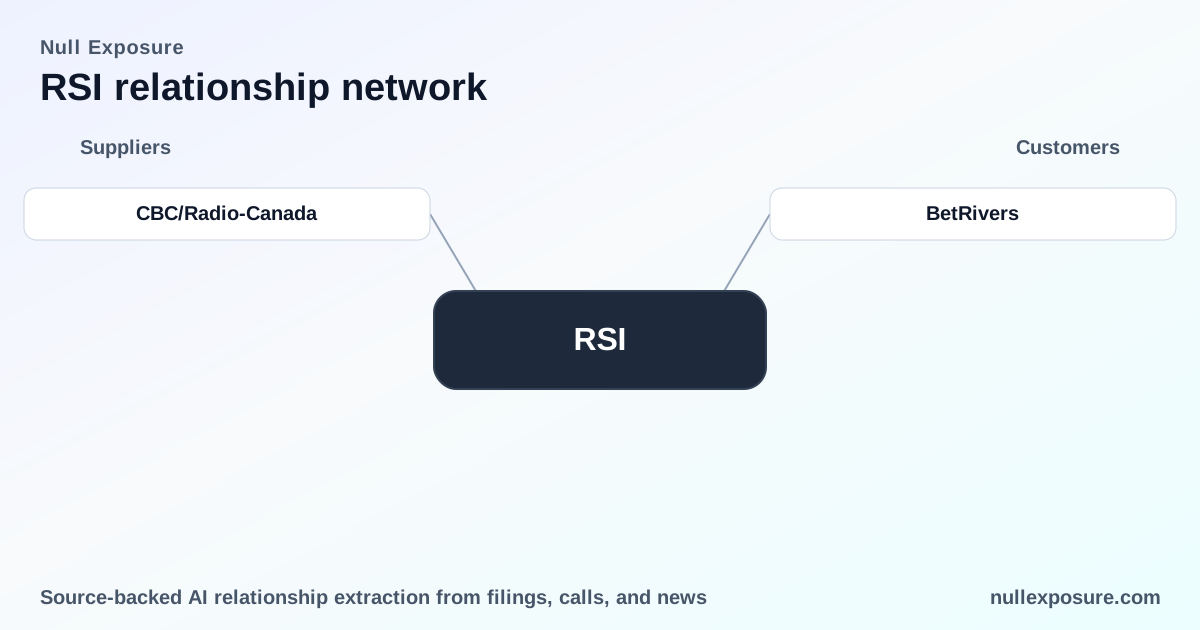
Public-facing relationship: BetRivers and CBC/Radio‑Canada
The available relationship mention in public news coverage connects RSI’s BetRivers brand to a Canadian broadcaster:
- BetRivers launched Alberta pre‑registration in coordination with a sponsorship of CBC/Radio‑Canada’s broadcast of the Olympic Winter Games Milano Cortina 2026, marking a multi‑Olympic collaboration for the brand (news release, Sahm Capital, March 10, 2026). This is a marketing and brand‑building relationship that supports market entry and customer acquisition in Canada under a high‑profile media partnership (Sahm Capital news release, FY2026).
This item is representative of RSI’s strategy to leverage national broadcast sponsorships and marketing partnerships to accelerate regulatory market entries and depositoric acquisition.
Operational constraints you must factor into any supplier assessment
Company disclosures provide specific constraint excerpts that are material to supplier risk assessment at the corporate level:
- Contract type — Licensing & long‑term: RSI relies on licensing deals and non‑cancelable marketing and strategic partnership agreements; these are contractually binding with future minimum payments and align supplier compensation with net gaming revenue (company filings).
- Role — Service provider & active relationships: RSI uses third‑party cloud and hosted infrastructure and counts suppliers as active service providers in the delivery chain; uptime and integration quality are therefore critical (company filings).
- Geography — North America focus: multiple service disruptions were noted across key U.S. states, highlighting jurisdictional concentration risk that links supplier reliability to revenue performance (company filings).
- Materiality — Critical infrastructure: the technology stack and hosting relationships are explicitly described as critical to platform performance and customer satisfaction (company filings).
- Segment — Services: RSI procures sportsbook odds feeds, streaming data, and risk/trading services from external vendors, which are essential inputs to its betting products (company filings).
- Spend band — $10m–$100m: documented commitments and non‑cancelable marketing and license payments place RSI supplier exposure in a material but not single‑supplier‑dominated spend band (company filings).
These constraints are company-level signals that shape how procurement, legal and compliance teams should prioritize vendor due diligence and SLA structures.
Practical implications for operators and portfolio managers
- Contract design matters: Insist on SLAs and outage remedies where hosting and data feeds are concerned; RSI’s disclosures show service providers are central to product delivery and outages have occurred in critical jurisdictions. Operational SLAs directly protect revenue capture.
- Balance long‑term marketing with flexibility: Long‑term, non‑cancelable marketing contracts secure customer acquisition pipelines but reduce nimbleness. For investors, these commitments should be evaluated against customer growth metrics and retention economics.
- Monitor geographic regulatory risk: Given service disruptions in states that represent meaningful revenue pools, operational continuity planning and contingency hosting are valuation drivers.
- Watch cost transparency and revenue share: Licensing and revenue-sharing with game suppliers reduce upfront costs but compress margins when volume grows; modeling should assume ongoing revenue-split impacts.
Mid‑report resource: for a vendor exposure map and supplier‑level risk scoring, see https://nullexposure.com/.
Financial context and closing recommendation
RSI is operating at scale with Revenue (TTM) of $1.134 billion and gross profit of $392.8 million, but the company also shows operating margin pressure and a valuation reflecting growth expectations (PEG and PE metrics). The supplier profile—long‑term licensing, material marketing commitments and critical hosting dependencies—is a structural feature that supports market access while creating downside sensitivity to outages and slowing player acquisition.
- Investors should treat supplier contracts as first‑order risk factors: model non‑cancelable commitments into downside scenarios and stress test platform outage durations in jurisdictional revenue models.
- Operators should prioritize redundancy and contract renegotiation: aim to convert large fixed marketing commitments into performance‑tied or step‑down structures where feasible.
For a deeper vendor breakdown and to benchmark RSI’s supplier exposure against peers, review the portal at https://nullexposure.com/. If you want a tailored report or a supplier remediation plan aligned to RSI’s public disclosures, start here: https://nullexposure.com/.