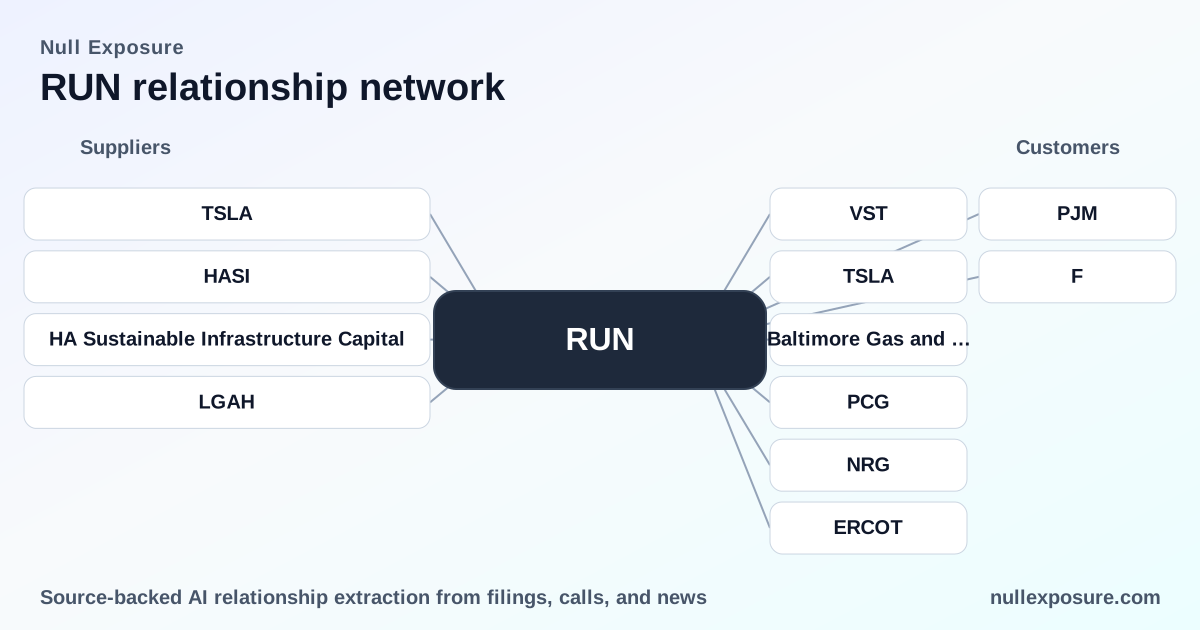
Sunrun (RUN) — supplier relationships that shape the rooftop solar economics
Sunrun designs, installs, finances and operates residential solar-plus-storage systems across the United States and monetizes through a combination of upfront system sales, long-term owned-asset cash flows (leases and power purchase agreements), and financing partnerships that scale virtual power plant (VPP) capacity. The company retains material asset exposure on its balance sheet while using third‑party capital to accelerate deployment and manage working capital, so supplier terms, capital partners and battery suppliers are direct drivers of margins and growth cadence. For a concise view of supplier risk and partner concentration, visit https://nullexposure.com/.
Why supplier relationships matter for investors
Sunrun’s model is not a component-supply business — it is an asset-centric energy platform whose unit economics depend on installed-costs, battery pairing rates, and the availability of financing to fund retained assets. Supplier posture therefore affects near-term margins, capital intensity and the timing of VPP revenue recognition. Key company-level signals drawn from filings and market reporting show a contracting posture geared to short-term payment flexibility, reliance on a limited set of manufacturers, and active supplier financing obligations that feed working capital.
- Short-term contracting with payment extensions is a deliberate cash-management tool: the company has contract language that allows extension of supplier payment terms up to 90 or 120 days, which increases short-term liquidity optionality for deployment cycles.
- Concentration on a limited set of manufacturers raises procurement sensitivity: Sunrun purchases panels, inverters and batteries from a limited set of suppliers, making vendor continuity and pricing crucial to cost per watt.
- Active supplier finance profile: supplier finance obligations outstanding (reported as of December 31, 2024) indicate ongoing third‑party funding and short-term liabilities that support installation cadence.
These operating characteristics are company-level constraints and directly influence how Sunrun negotiates with battery partners, financing sponsors and OEMs. For deeper supplier mapping, see https://nullexposure.com/.
Line-by-line: every supplier relationship pulled from recent reporting
Tesla (TSLA) — battery OEM used in Brightbox pairings
Sunrun pairs rooftop solar with home batteries commonly supplied by Tesla (Powerwall) as one of the preferred brands for its Brightbox home battery offering, particularly where grid reliability or time-of‑use tariffs justify storage. This supplier relationship drives both product bundling and customer economics. Source: ad-hoc-news.de coverage of Sunrun strategy, March 10, 2026 (FY2026).
Hannon Armstrong Sustainable Infrastructure Capital (HASI) — structured capital JV partner
Sunrun closed a new joint venture with Hannon Armstrong, described in Q4 commentary, to bring capital into residential solar and storage builds; the relationship is structured to scale financed VPP capacity alongside Sunrun’s asset ownership. Source: Q4 2025 earnings call coverage on InsiderMonkey, reported March 10, 2026 (FY2026).
HA Sustainable Infrastructure Capital — $500M commitment to VPP growth
Market reporting attributes a financing partnership with HA Sustainable Infrastructure Capital committing up to US$500 million over 18 months to support roughly 300 MW of home-based power plants while Sunrun retains ownership of the underlying assets. That commitment is a near-term funding wedge that materially accelerates VPP expansion without immediate asset sales. Source: SahmCapital analysis, January 28–29, 2026 (FY2026).
HA Sustainable Infrastructure Capital (duplicate entry) — financing emphasis reiterated
A separate SahmCapital piece repeats that HA Sustainable Infrastructure Capital will finance 300 MW of additional residential solar and storage capacity, underscoring the same capital-supply relationship and its relevance to Sunrun’s growth runway. Source: SahmCapital report, January 29, 2026 (FY2026).
Tesla, Inc. — product-level mention reinforcing Powerwall usage
A second news mention references rooftop systems paired with home batteries such as the Tesla Powerwall, reinforcing Tesla’s role as a recurrent battery supplier in Sunrun installs and product bundles. This recurring supplier reference signals both product preference and marketplace availability impact. Source: ad-hoc-news.de market overview, March 10, 2026 (FY2026).
LG (LGAH) — alternative battery OEM
Reporting notes LG as an alternate battery supplier for Brightbox pairings depending on market and timing, indicating Sunrun sources batteries from more than one OEM but remains dependent on a small set of manufacturers for key components. Source: ad-hoc-news.de coverage, March 10, 2026 (FY2026).
What the relationships imply for cash flow and execution
Sunrun’s supplier map shows a balanced mix of strategic OEMs (Tesla, LG) for hardware and capital partners (Hannon Armstrong / HA Sustainable Infrastructure Capital) for funded growth. The combination produces three practical implications for investors:
- Cost and margin sensitivity: reliance on a limited number of battery and panel manufacturers concentrates procurement risk and pricing leverage that flow directly into gross margins.
- Growth funding without asset sales: capital partnerships that commit multi‑hundred‑million dollar tranches to VPP expansion allow Sunrun to scale retained-asset economics while preserving ownership — a structurally higher-margin outcome than sale‑leaseback models.
- Working capital dynamics: contractual ability to extend payment terms to suppliers up to 90–120 days, together with active supplier finance obligations reported at December 31, 2024 ($130,238), indicates deliberate short‑term liquidity management tied to deployment seasonality.
These dynamics create both optionality and exposure: Sunrun can accelerate installs by layering financing partners, but execution slippage or OEM supply constraints would compress returns.
Explore supplier concentration and capital-partner mapping at https://nullexposure.com/ for actionable counterparty intelligence.
Investment takeaways and risks to watch
Sunrun’s supplier relationships are economically critical. Positive thesis drivers include expanding VPP monetization funded by partners like Hannon Armstrong and HA Sustainable Infrastructure Capital and the ability to pair solar with high‑value batteries (Tesla, LG) to increase net present value per install. Primary risks are procurement concentration, potential battery supply disruptions that raise installed costs, and reliance on short-term supplier financing that elevates working-capital sensitivity during deployment surges.
- Monitor announcements from capital partners for changes in tenor or committed capital.
- Track OEM supply cadence and pricing trends for batteries and inverters.
- Watch Sunrun’s supplier payment terms disclosure and supplier finance balances in quarterly filings as a signal of stretched cash conversion.
For a pragmatic supplier risk scorecard and to benchmark counterparty exposure against peers, return to https://nullexposure.com/.
Final thought
Sunrun monetizes both hardware sales and long-lived asset cash flows, so supplier contracts and financing partners are not peripheral — they are core determinants of throughput and margin. Investors should treat OEM relationships and capital commitments as first-order risk factors when modeling unit economics or forecasting VPP revenue. Use the companion analysis at https://nullexposure.com/ to convert these supplier signals into investment scenarios and scenario-weighted outcomes.