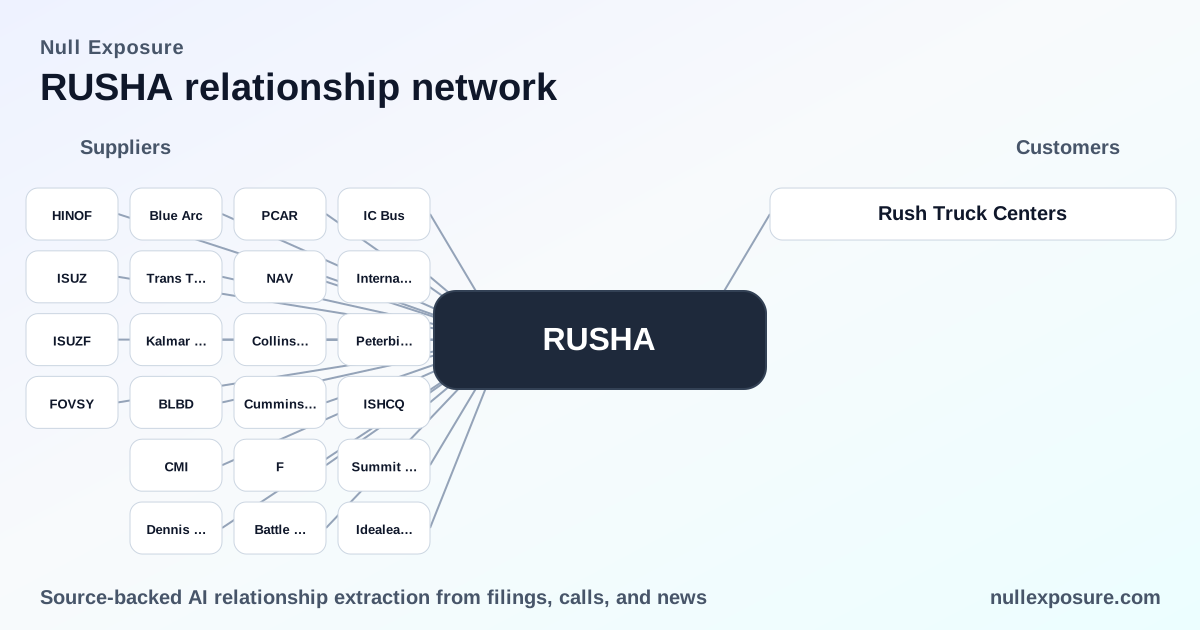
Rush Enterprises (RUSHA) — supplier map and what it means for investors
Rush Enterprises is an integrated commercial-vehicle retailer that monetizes through new and used vehicle sales, parts and service, leasing and rental operations, and vehicle up‑fitting and technology offerings. The company operates nonexclusive dealership networks that stock manufacturer-branded trucks and buses, generate recurring parts and service revenue, and run dedicated leasing fleets — a high-capex, asset-heavy distribution model that converts manufacturer supply into diversified retail and aftermarket cash flow. For investors, the core thesis is simple: Rush leverages scale in physical vehicle centers to capture margin in sales and higher-margin recurring services, while remaining exposed to manufacturer supply dynamics and concentrated purchasing commitments.
Learn more about supplier exposure and supplier sourcing at https://nullexposure.com/.
How Rush sources and the contracting posture that matters to returns
Rush executes dealership agreements with multiple truck and bus manufacturers and buys inventory and proprietary parts directly from manufacturers or favorable wholesale sources, per company disclosures. Those dealership agreements are nonexclusive and allow Rush to use manufacturer marks and sell parts and services in defined territories; they display a mix of contractual maturity — the firm reports agreements that expire between May 2025 and January 2029, indicating a combination of long-term and short-term contractual exposures. According to Rush’s FY2024 10‑K, the company also disclosed that a significant portion of revenue is derived from manufacturer-sourced trucks, buses and parts, making these supplier links commercially critical to operations.
- Contracting posture: Nonexclusive dealership agreements; rights to brand and parts but with defined territory and finite terms.
- Concentration and spend: Rush signals material purchasing scale — it expects to purchase or lease roughly $200–$250 million of commercial vehicles for its leasing business in 2025, a company-level spend band that drives negotiating leverage but also creates execution risk if supply or pricing shifts.
- Criticality and maturity: Manufacturer relationships are operationally critical (inventory and parts flow), and agreement expirations concentrated in the 2025–2029 window create medium-term renewal risk and potential renegotiation dynamics.
Supplier relationships — a granular, source-backed list
Below is a company-by-company review drawn from Rush’s filings and reporting. Each entry is a concise plain-English summary with source context.
IC Bus
Rush reports that bus sales from IC Bus accounted for a material portion of revenue in 2024, underlining the role of school and commercial bus franchises in its mix (Rush FY2024 10‑K).
International Motors
The company states that parts sourced from International Motors contribute meaningfully to parts revenue, reflecting reliance on established manufacturer parts channels (Rush FY2024 10‑K).
Peterbilt
Rush operates under nonexclusive dealership agreements that explicitly authorize Rush to act as a Peterbilt dealer, providing new-vehicle and service capacity (Rush FY2024 10‑K).
International
Rush’s vehicle centers represent International branded trucks across multiple locations; an acquisition wave in 2021 expanded International centers and reinforced that relationship as a core supply line (TruckingInfo, 2021).
Summit Truck Group
Rush acquired 16 dealership locations from Summit Truck Group in 2021, materially expanding Rush’s footprint in International and related franchises (TruckingInfo, 2021).
Idealease
The Summit transaction included Idealease leasing operations at several locations, integrating commercial vehicle leasing into Rush’s offering and expanding fleet services (TruckingInfo, 2021).
Collins Bus
Rush’s Canadian expansion and regional divisions list Collins Bus as part of the product lineup offered through acquired units in FY2025 reporting (Quantisnow insight, 2025).
Cummins Clean Fuel Technologies, Inc.
Rush’s operations provide CNG fuel systems through an investment in Cummins Clean Fuel Technologies, positioning Rush to offer alternative-fuel up‑fits and systems (GlobeNewswire press release, Dec 2025).
Ford
Rush’s vehicle centers represent Ford commercial products alongside heavy-duty manufacturers, indicating diversified OEM sourcing across heavy- and medium-duty channels (GlobeNewswire / company press releases, FY2025–FY2026).
Blue Arc
Recent company presentations list Blue Arc among represented OEMs at Rush vehicle centers, signaling inclusion of new energy and electrified offerings in the product set (Company press release coverage, FY2026).
Battle Motors
Rush’s product catalogs and regional divisions include Battle Motors for electric commercial vehicle offerings, consistent with Rush’s expanded alternative-power inventory (Quantisnow insight, FY2025).
Kalmar Ottawa
Rush lists Kalmar Ottawa among medium-duty brands offered, indicating presence in terminal-tractor and port/industrial vehicle segments (Quantisnow insight, FY2025).
Trans Tech
Leeds Transit and other Canadian acquisitions include Trans Tech franchise support for school-bus service, showing Rush’s multi-brand bus coverage in Ontario and Quebec (Quantisnow insight, FY2025).
International Truck
Affiliate naming in news and corporate descriptions distinguishes International Truck as a specific product set represented across Rush centers, reinforcing Navistar OEM exposure (Quantisnow insight, FY2025).
Isuzu
Isuzu franchises are included at various Rush locations, and Isuzu shows up repeatedly in FY2025–FY2026 reporting as a brand represented at vehicle centers (QuiverQuant / GlobeNewswire, FY2025–FY2026).
Blue Bird
Blue Bird is named among the bus manufacturers represented at Rush vehicle centers in FY2025 and FY2026 press reporting, adding to Rush’s school-bus franchise breadth (Yahoo Finance / QuiverQuant, FY2025–FY2026).
Dennis Eagle
Dennis Eagle appears as a franchise included at certain dealership locations and is listed among brands represented in Rush’s center network (TruckingInfo / company press, FY2021–FY2025).
Navistar
References use both “Navistar” and its product brands (e.g., IC Bus, International), and Rush has historically tied truck sales and engine transitions to Navistar performance (TruckingInfo historical commentary).
Hino
Hino is part of the OEM roster represented at Rush vehicle centers, appearing across FY2025–FY2026 reporting as a manufacturer partner (QuiverQuant / GlobeNewswire, FY2025–FY2026).
Peterbilt Motors Company
Beyond generic Peterbilt references, Rush’s public activities include direct marketing and promotional interactions with the Peterbilt organization, such as dealer events and bidding for special-build slots (Fleet Equipment Mag, FY2024).
Implications for investors: where the leverage and risks live
Rush’s model converts manufacturer supply into diversified retail cash flow and higher-margin service revenue, but the economics depend on large, concentrated purchasing commitments and the stability of dealership agreements. The company-level signals are clear: direct manufacturer sourcing, material fleet purchase/lease spend (>$100M band), and nonexclusive—but time-limited—dealership contracts. That mix gives Rush negotiating flexibility across brands but also exposes Rush to simultaneous renewal windows and OEM product cycles that can affect inventory access and pricing.
For investors evaluating supplier risk, the priorities are:
- Monitor upcoming agreement expirations (2025–2029) as potential inflection points for dealer economics.
- Track manufacturer production and parts availability — these directly affect new-vehicle margins and service throughput.
- Watch Rush’s leasing capex plans and used‑vehicle flows, since the company expects sizable fleet purchases for leasing in 2025.
If you want a supplier-centric view that maps these relationships to contractual timelines and spend bands, visit https://nullexposure.com/ to access structured supplier exposure analysis.
Bottom line and next steps
Rush runs a classic asset-intensive dealership model: scale creates aftermarket and service leverage, but supplier contracts and vehicle purchasing commitments create concentrated execution risk. The supplier roster is broad — from legacy OEMs (Peterbilt, International, Navistar, Isuzu, Ford, Hino, Blue Bird) to newer alternative-power suppliers (Blue Arc, Cummins Clean Fuel Technologies) — which supports product diversification but requires active supplier management around contract renewals and capital allocation.
For a tailored review of Rush’s supplier exposures and to benchmark them against peers, go to https://nullexposure.com/.