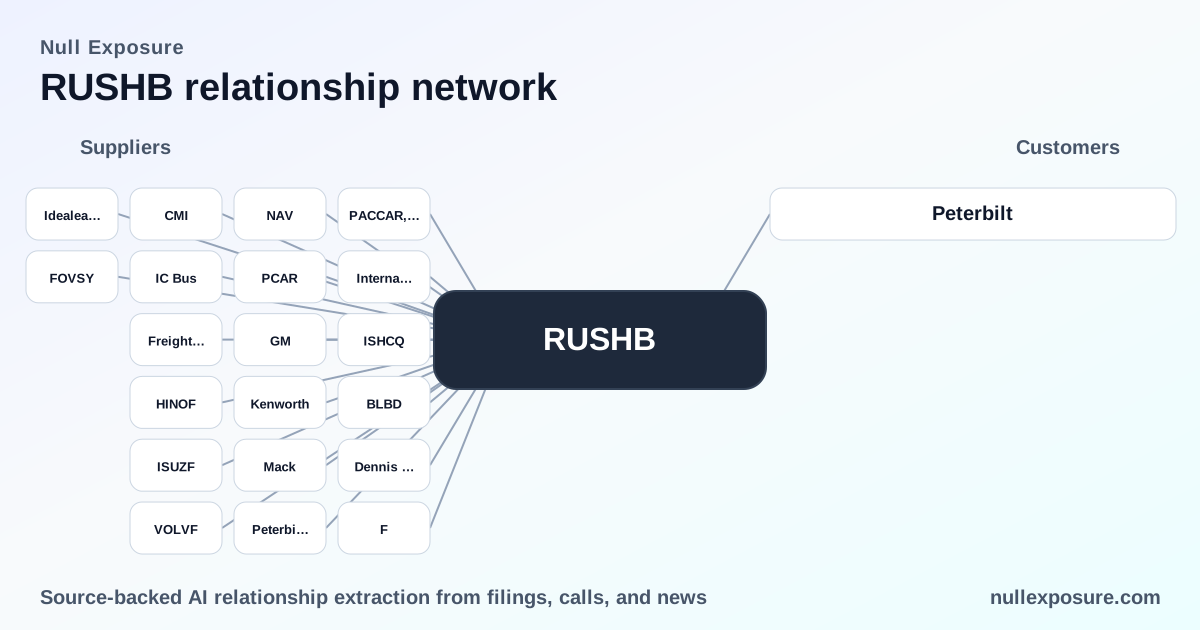
Rush Enterprises (RUSHB): a supplier map investors need to price into the model
Rush Enterprises operates and monetizes as a vertically distributed commercial-vehicle retailer: it purchases new trucks, buses and proprietary parts from vehicle manufacturers, retails new and used vehicles through its Rush Truck Centers network, and generates recurring aftermarket revenue from service, parts and leasing operations. Revenue is driven by new-vehicle allocations, parts margins and higher-margin service/up‑fitting and leasing income across more than 150 locations in North America. For investors evaluating supplier concentration and counterparty risk, supplier relationships determine inventory flow, parts margins and the company’s ability to capture national-account fleet business. Learn more about how provider links affect valuation at https://nullexposure.com/.
Why supplier relationships matter for the RUSHB thesis
Rush is not a commodity reseller — it is a franchised dealer network whose economics are directly tied to manufacturer allocations, proprietary parts access and long-term franchise agreements. Manufacturer partnerships determine vehicle flow, pricing power on parts, and the duration of point-of-sale rights, which collectively shape working capital intensity and gross-profit stability. The company’s reported margins and capital allocation programs (including a recent $150 million repurchase program) are readable only through the lens of these supplier ties.
Read the broader supplier-risk playbook at https://nullexposure.com/ to benchmark Rush against peers.
What the filings and press releases show about contracting and geography
Rush’s public disclosures include explicit language that its Peterbilt and International franchise agreements have defined multi-year expirations, while other manufacturer agreements typically run through 2025–2028 or are indefinite. That establishes a hybrid contracting posture: a foundation of multi-year dealer franchises with a rolling set of shorter or indefinite arrangements across other brands. The company also discloses geographic concentration: all activity is concentrated in the United States and Ontario, Canada, which creates regional demand exposure and operational focus. These are company-level signals drawn from the 2024 Form 10‑K and related investor materials (FY2024–FY2025).
The supplier list — plain-English relationship summaries and sources
Below are each of the supplier relationships identified in Rush’s documents and contemporaneous coverage, with concise takeaways and source citations.
-
PACCAR, Inc. — Rush purchases new Peterbilt vehicles and most Peterbilt parts from PACCAR at the prevailing prices charged to franchised dealers, making PACCAR a primary parts and OEM supplier for Peterbilt inventory. Source: Rush 2024 Form 10‑K (FY2024).
-
PACCAR — PACCAR’s dealer approval language appears in Rush’s franchise documentation and contract excerpts, reflecting standard franchisor controls over who can represent Peterbilt. Source: Rush 2024 Form 10‑K (FY2024).
-
International Motors — Rush reports that a significant portion of revenue comes from trucks purchased from International and related parts, indicating International is a material OEM supplier for Rush’s International-brand dealerships. Source: Rush 2024 Form 10‑K (FY2024).
-
International — Rush’s vehicle centers represent International as one of the core manufacturers supplying Class 8 truck inventory and parts for Rush Truck Centers. Source: company press releases and news coverage around the 2025 repurchase announcement (FY2025).
-
International Truck — Historical reporting groups International Truck with Peterbilt as the supplier of Class 8 trucks that Rush sells through its centers. Source: industry coverage and historical Rush filings (FY2018).
-
Peterbilt — Peterbilt is a foundational OEM partner: Rush holds Peterbilt franchises and purchases vehicles and parts through PACCAR’s Peterbilt channel, with multi‑year franchise terms disclosed in the 10‑K. Peterbilt is a critical, contractually defined supplier. Source: Rush 2024 Form 10‑K and multiple 2025 news items (FY2024–FY2025).
-
Peterbilt Motors Co. — Industry coverage describes Rush’s product mix as including Class 8 trucks from Peterbilt Motors Co., reinforcing the operational role of Peterbilt product lines in Rush showrooms. Source: trucking trade press (FY2018).
-
Ford — Ford is listed among the manufacturers Rush represents at its Rush Truck Centers, supplying medium-duty inventory for select locations. Source: Rush corporate press releases and investor communications (FY2025).
-
GMC — Rush’s origin story includes a GMC franchise at founding, establishing a historical link between the company and GMC product lines in used/new inventory rotation. Source: company history reported in industry obituary/retrospective (FY2018).
-
Kenworth — Kenworth is named in industry summaries as a manufacturer partner as Rush expanded its national footprint, indicating additional OEM relationships beyond the core Peterbilt/International pair. Source: market commentary on Rush’s scale and partnerships (FY2026).
-
Freightliner — Freightliner appears alongside Kenworth and other manufacturers in descriptions of Rush’s manufacturer partnerships, suggesting Rush’s offering spans multiple major truck OEMs. Source: market commentary and filings summarizing partner manufacturers (FY2026).
-
Mack — Mack is referenced in coverage of Rush’s partner roster, indicating presence in Rush’s lineup of heavy-duty OEM relationships. Source: market commentary on Rush’s manufacturer partnerships (FY2026).
-
Volvo — Volvo is listed in external coverage describing the mix of manufacturer relationships Rush maintains across its network. Source: market reporting on Rush’s partner ecosystem (FY2026).
-
Blue Bird — Blue Bird is explicitly named among bus manufacturers that Rush represents at vehicle centers, indicating a role in the company’s bus-market inventory and parts sales. Source: GlobeNewswire press release and investor communications (FY2025).
-
Dennis Eagle — Dennis Eagle is included in the list of manufacturers Rush sells through its centers, contributing to niche municipal/commercial vehicle offerings. Source: analyst and press reports covering Rush’s product mix (FY2025–FY2022).
-
IC Bus — IC Bus is identified as a bus-brand supplier represented at certain Rush locations; Rush also reports bus purchases and related parts as revenue drivers. Source: Rush 2024 Form 10‑K and acquisition press coverage (FY2022, FY2025).
-
Isuzu — Isuzu is listed among medium-duty manufacturers represented in Rush Truck Centers, often at specific franchise locations included in acquisitions. Source: acquisition coverage and investor materials (FY2021–FY2025).
-
Hino — Hino appears in Rush’s manufacturer roster for medium-duty trucks sold at Rush Truck Centers, showing breadth in light- and medium-duty OEM relationships. Source: investor communications and analyst reporting (FY2025–FY2026).
-
Cummins Clean Fuel Technologies, Inc. — Rush identifies CNG fuel systems provided through an investment in Cummins Clean Fuel Technologies as part of its technology and up‑fit offerings, linking Rush to alternative-fuel equipment suppliers. Source: QuiverQuant news item summarizing product and technology offerings (FY2025).
-
Idealease — Rush’s acquisition activity included Idealease leasing operations at several locations, indicating Rush operates commercial vehicle leasing services sourced from or branded under Idealease. Source: acquisition coverage in The Trucker (FY2021).
Operating-model constraints that investors should internalize
-
Contracting posture: Rush discloses multi-year franchise expirations for Peterbilt and International (contracts expiring between 2025 and 2029), and other manufacturer agreements generally run between 2025–2028 or are indefinite; this creates a mixed maturity profile where core OEM relationships are contractually bounded while many others are rolling or indefinite (company disclosure in the 10‑K). Because the Peterbilt and International agreements are explicitly named in the filing, they represent long-term, higher-certainty relationships.
-
Geographic concentration: All business is concentrated in the United States and Ontario, Canada, which focuses demand risk regionally and amplifies local macro cycles (company Form 10‑K disclosure).
-
Manufacturer role and criticality: Rush purchases proprietary vehicles and parts directly from OEMs; manufacturers are both inventory suppliers and gatekeepers of proprietary parts, making OEM relationships strategically critical and operationally essential (company disclosures).
-
Segment exposure and maturity: The business sits at the intersection of vehicle manufacturing and aftermarket services; the manufacturing segment supplies the critical inventory, while aftermarket services provide recurring margins that stabilize free cash flow.
Investment implications and risk checklist
Rush’s earnings power is a function of OEM allocations, parts access and service penetration. Key investor action points:
- Monitor franchise renewals and OEM allocation language for Peterbilt and International given their named long-term status.
- Track geographic demand in North America and parts/service margin trends for early signals of margin compression or lift.
- Review Rush’s M&A and leasing activity (including Idealease integrations) as sources of margin expansion and national-account scale.
If you want a supplier-risk heatmap and peer comparison for material OEMs and contract maturities, start here: https://nullexposure.com/.
Bottom line and next steps
Rush’s supplier architecture is a core value driver: Peterbilt and International anchor the network with contractually defined terms; a broad roster of additional OEMs supplies coverage across vehicle segments; and parts/service channels provide recurring margin stability. For valuation work, model manufacturer allocation risk, parts margin sensitivity, and the timing of franchise expirations into working-capital and free-cash-flow assumptions.
For a structured supplier exposure briefing and comparable dealer roll-up analysis, visit https://nullexposure.com/ and download the supplier-risk memo.