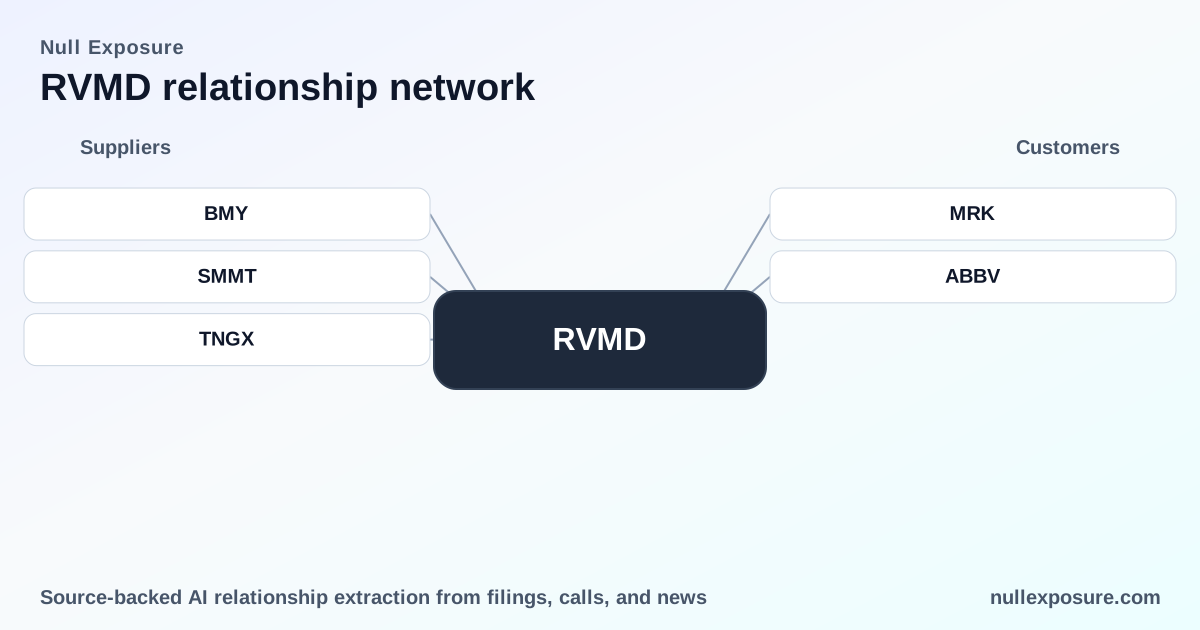
Revolution Medicines (RVMD) — supplier relationships that drive clinical optionality and partner risk
Revolution Medicines is a precision oncology developer that advances RAS(ON) inhibitors through clinical programs and monetizes primarily through collaborations, clinical-stage value creation, and future licensing or product sales upon approval. As a clinical-stage company with minimal product revenue, the firm's economics today depend on partnering deals, outsourced manufacturing and trial services, and the de-risking value that successful combination studies deliver to larger pharma collaborators.
For a concise view of RVMD’s supplier posture and counterparties, visit https://nullexposure.com/ — the summary below is written for investors and operators evaluating contractual exposure and strategic upside.
How Revolution Medicines runs the supplier engine: short contracts, outsourced manufacturing, high external R&D spend
Revolution Medicines runs a highly outsourced operating model. The company relies on contract manufacturing organizations (CMOs) and contract research organizations (CROs) for clinical supply and trial execution, and its public disclosures state these arrangements are generally cancelable on short notice (30–90 days). That contracting posture creates operational flexibility but also increases counterparty dependence and operational concentration on third-party manufacturers.
- Contracting posture: Agreements with CROs/CMOs are described as short-term and cancelable with 30–90 days’ notice, signaling a nimble but fragile supply chain for trial materials and services.
- Role and criticality: Manufacturing and clinical services are core vendor dependencies — manufacturing is outsourced for both drug substance and drug product, and these providers are operationally critical to trial timelines and potential commercialization.
- Maturity and stage: Relationships are active and oriented around clinical supply and trials rather than long-term commercial supply agreements today; that aligns with Revolution’s clinical-stage status.
- Spend profile: Filings show material third-party R&D expense lines; company-level signals classify third-party R&D spend in a high band, consistent with significant outsourced spend to support multiple programs.
These characteristics mean counterparties evaluating RVMD as a supplier or vendor partner should prioritize supply continuity provisions, capacity visibility, and commercial-transition planning.
Partner-by-partner: what every investor should know
Bristol Myers (BMY)
Revolution entered a collaboration to evaluate daraxonrasib in combination with Bristol Myers’ PRMT5 inhibitor, navlimetostat, in certain pancreatic cancer patients. This is a strategically significant combo with a large-cap pharma, offering validation and potential commercial upside if the combination delivers clinical benefit. See the Finviz news report (March 10, 2026): https://finviz.com/news/323597/rvmd-reports-wider-than-expected-q4-loss-issues-2026-expense-view.
Summit Therapeutics (SMMT)
RVMD has established a clinical collaboration with Summit Therapeutics to test combinations of its RAS(ON) inhibitors with Summit’s pipeline drugs, representing mid-market biotech collaboration that expands clinical testing channels and de-risks target biology across partners’ platforms. Source: Finviz news report (March 10, 2026): https://finviz.com/news/323597/rvmd-reports-wider-than-expected-q4-loss-issues-2026-expense-view.
Tango Therapeutics (TNGX)
Revolution also collaborates with Tango Therapeutics to evaluate RAS inhibitor combinations with Tango’s pipeline assets, a relationship that broadens combination strategies and increases the clinical read-through across synthetic-lethality and combination approaches. Source: Finviz news report (March 10, 2026): https://finviz.com/news/323597/rvmd-reports-wider-than-expected-q4-loss-issues-2026-expense-view.
What these relationships imply for counterparty risk and upside
The mix of collaborators — a large global pharmaceutical company plus smaller biotechs — balances scientific validation with breadth of clinical testing. The Bristol Myers collaboration is the most consequential commercially: partnering with a major oncology franchise increases the probability that positive data will lead to sizable downstream deals or co-development arrangements. Collaborations with Summit and Tango function as de-risking plays that broaden mechanistic validation and create multiple potential inflection points.
From an operational risk perspective, the company-level signals are clear: manufacturing and trial execution are outsourced and active, and third-party R&D spend is material. That structure implies:
- Suppliers and vendors are operationally critical to RVMD’s timelines, and short-term cancellation clauses create exposure to sudden shifts in demand or supplier substitution costs.
- For larger partners, the value is primarily clinical validation and optionality rather than immediate revenue; for smaller biotechs, RVMD’s compounds act as combination enablers that can accelerate both parties’ pipelines.
- Contract terms investors should watch: capacity commitments, change-of-control provisions, IP/know-how protections, and transition plans for commercialization if a program advances.
If you want a deeper supplier-profile and counterparty risk assessment, review more structured summaries at https://nullexposure.com/.
Investor action checklist: what to monitor now
- Track clinical milestones from the Bristol Myers combination study — positive efficacy or safety signals materially reprice RVMD’s partnership value.
- Monitor manufacturing disclosures and any supplier concentration amendments; short-notice cancellability is a risk that should be hedged by capacity guarantees or dual sourcing.
- Watch near-term R&D spend and cash runway indicators; sustained high external spend without milestone-driven partner payments increases dilution risk.
- Evaluate each collaboration’s commercial optionality: which deals include milestone payments, co-promotion rights, or upstream licensing triggers.
For institutional workflows and operational diligence templates that map supplier risk to financial exposure, see https://nullexposure.com/.
Final assessment: partner-driven upside with supplier fragility to manage
Revolution Medicines’ business model is partner-centric: the firm's clinical programs and future revenue depend on the successful execution of combination trials with collaborators and dependable third-party manufacturing. The most valuable relationship on paper is with Bristol Myers, given its scale and the potential commercial leverage of a successful combination; Summit and Tango provide important scientific breadth and additional catalytic events.
Investors should value the upside from strategic collaborations against company-level supplier fragility driven by outsourced manufacturing, short-term contracts, and material third-party R&D spend. Protect portfolio exposure by focusing on milestone readouts, supplier continuity language in filings, and cash runway metrics tied to partner funding.
For a focused supplier-risk brief and ongoing monitoring of RVMD’s counterparty network, visit https://nullexposure.com/ — the repository for structured supplier intelligence and relationship tracking.