Revolution Medicines (RVMDW) — supplier relationships that drive operational leverage and funding optionality
Revolution Medicines is a clinical-stage precision oncology company that monetizes through strategic collaborations, asset-centric financing, and milestone-driven partnerships rather than commercial product sales. The firm advances RAS-targeted therapeutics through outsourced development and manufacturing, then captures value by licensing combinations, securing clinical collaborations with larger biopharma players, and tapping structured capital markets solutions such as royalty/advance facilities. Investors evaluating supplier and partner exposure should treat Revolution’s counterparty mix as a hybrid operating model: clinical validation via collaborators plus liquidity via royalty financing.
Explore additional supplier relationship detail and monitoring tools at https://nullexposure.com/.
What management told investors in the 2025 Q4 call — the headline relationships
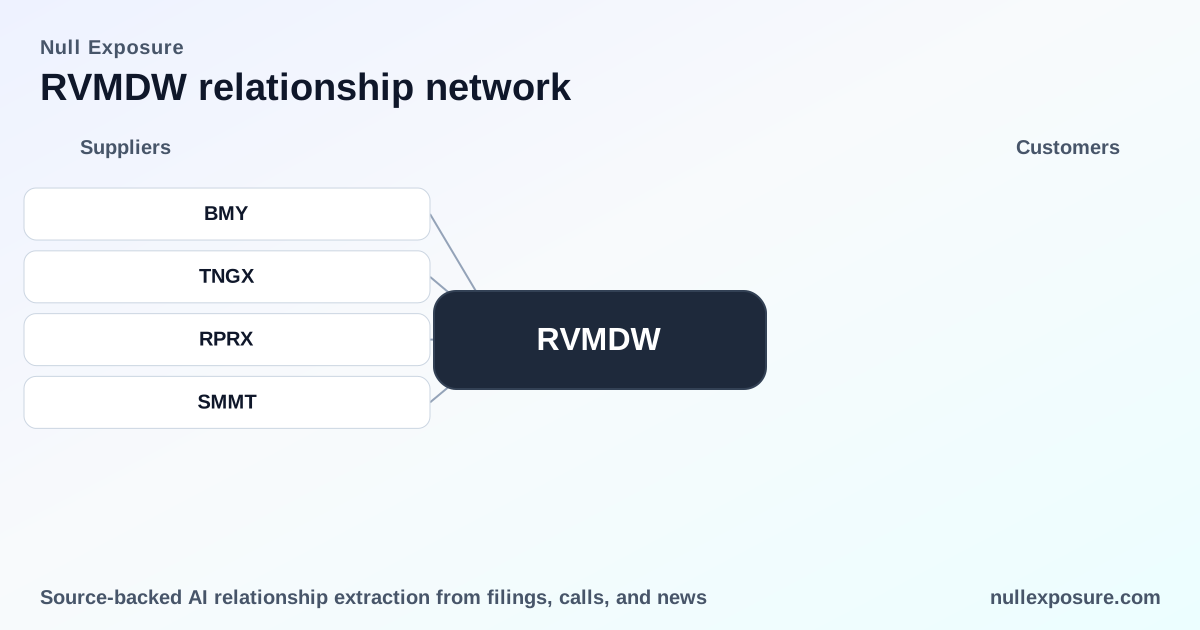
Management used the 2025 Q4 earnings call to signal two types of external relationships that matter for operational execution and capital structure: clinical-development collaborators (Bristol-Myers Squibb, Tango Therapeutics, Summit Therapeutics) that validate combination strategies for RAS-targeted assets, and structured capital partner Royalty Pharma which provides committed funding. These partners affect near-term trial design, capital runway, and the company’s reliance on external manufacturing and trial service providers.
The clinical and financing partners, one by one
Bristol-Myers Squibb
Revolution has a clinical collaboration with Bristol-Myers Squibb to evaluate daraxonrasib combined with Navlimetostat (an MTA cooperative PRMT5 inhibitor) in pancreatic cancer patients whose tumors carry both a RAS mutation and MTAP deletion. This is a strategic combination trial that leverages BMS’s development capabilities to accelerate proof-of-concept. According to the 2025 Q4 earnings call, the collaboration is positioned as a targeted, biomarker-driven clinical evaluation (2025 Q4 earnings call).
Tango Therapeutics
The company is collaborating with Tango Therapeutics to study RAS(ON) inhibitors in combination with Tango’s Vopimetostat (a PRMT5 inhibitor) in patients with tumors harboring RAS mutations and MTAP deletions. This collaboration again focuses on biomarker-defined combination strategies and extends Revolution’s clinical footprint into partnered combination programs. Management disclosed this initiative on the 2025 Q4 earnings call (2025 Q4 earnings call).
Summit Therapeutics
Revolution is evaluating its RAS(ON) inhibitor in combination with Summit Therapeutics’ PD-1/VEGF bispecific antibody, Ivonescimab, across multiple solid tumor settings. The collaboration broadens combination approaches into immuno-oncology and angiogenesis modulation, potentially increasing the number of indications and clinical development pathways. Management referenced this ongoing evaluation during the 2025 Q4 earnings call (2025 Q4 earnings call).
Royalty Pharma
In 2025, Revolution entered a strategic partnership with Royalty Pharma that provides access to up to $2 billion in committed capital under the agreement. This structured financing significantly changes the company’s capital posture, offering runway extension and optionality to fund multiple clinical programs without immediate dilution from equity markets. Management highlighted the deal and its scale on the 2025 Q4 earnings call (2025 Q4 earnings call).
Supplier and operating constraints that shape risk and optionality
The company’s public filings and remarks set clear operating constraints that investors should treat as company-level signals rather than attributes of any single collaborator:
- Contracting posture: short-term, cancelable supplier arrangements. Revolution’s contracts with CROs and CMOs are generally cancelable on 30–90 days’ notice, which creates operational flexibility but also execution risk if a supplier relationship terminates at a critical path moment.
- Criticality: sole-source exposures exist. Management acknowledges that some third-party suppliers are sole sources for key starting and intermediate materials, so a disruption could materially impact development timelines.
- Relationship role: outsourced manufacturing is the baseline. The company outsources all manufacturing (CMOs) and relies on third parties for drug substance and drug product, indicating low vertical integration and heightened supplier dependency.
- Relationship role: reliance on external service providers for trials and approvals. Revolution depends on CROs, clinical investigators, contract labs and consultants for trial conduct and regulatory work; this is a sustained operational model rather than a transitional phase.
These constraints collectively describe a company structured for capital efficiency and scientific focus, but with concentration and operational risk concentrated in third-party suppliers and a small number of strategic collaborators.
Midway action: for a consolidated view of counterparties and supply risk, visit https://nullexposure.com/.
Investment implications — what investors and operators should watch
- De-risking via Royalty Pharma reduces near-term financing risk: access to up to $2 billion provides clear runway and optionality for multiple concurrent trials, lowering the probability of near-term equity raises. However, the facility creates structured repayment and revenue-sharing dynamics that affect long-term cash flows and upside capture.
- Collaborations accelerate validation but do not eliminate development risk: partnerships with BMS, Tango and Summit validate combination strategies and broaden the scientific program, but these are still clinical collaborations where success is binary and timing uncertain.
- Operational execution depends on a small set of external providers: the cancelable nature of CRO/CMO contracts gives management flexibility but also means short notice supplier disruptions can immediately affect trial schedule. Sole-source material suppliers amplify that exposure.
- Capital markets instrument (warrant RVMDW) vs. underlying equity risk: investors in the warrant should treat supplier and collaborator news as binary catalysts that affect the underlying equity’s development outlook and therefore warrant asymmetric payoff profiles.
Practical monitoring checklist for investors and operators
- Track milestone and draw schedules tied to the Royalty Pharma agreement because those will determine cash availability and covenant pressure.
- Monitor trial enrollment and combination study readouts with BMS/Tango/Summit for early efficacy signals that change program prioritization.
- Watch supplier disclosures for any shift from sole-source to multi-sourcing or notice periods longer than 30–90 days; those are operational upgrades.
- Assess whether management moves to internal manufacturing or long-term supply agreements; that would materially reduce concentration risk.
For a deeper, supplier-centric diligence package, see how we map counterparties at https://nullexposure.com/.
Conclusion — the structural verdict
Revolution Medicines operates as a capital-efficient, collaboration-led oncology developer: external clinical collaborators provide validation and multi-pathway development; a large structured financing partner provides runway; and outsourced suppliers enable lean operations at the expense of concentration risk. For investors and operators, the critical evaluation points are the Royalty Pharma draw schedule, the progress of combination trials with BMS/Tango/Summit, and the company’s actions to mitigate sole-source manufacturing risk. Those three vectors determine whether the company converts its scientific platform into lasting shareholder value.